Contact Person: Mr.Li
Mobile: +86-18509252400
Wechat: 18509252400
Email: info@mudsolidscontrol.com
Address: No.2 Huochang Road, Yangling District,Xianyang City, Shaanxi Province, China
A shear pump does not make clay swell. Water does that. What the pump changes is how much of the bag gets to meet the water, and the gap between those two things is where bentonite saving comes from.
Add a shear pump to a rig that builds gel by running sacks through a jet hopper into a pit and letting an agitator handle the rest, and bentonite use commonly drops 20 to 30 percent. A rig that already mixes well sees a smaller change. Hard makeup water or low-yield clay holds the saving down regardless, because those limits sit upstream of the pump.
Those percentages belong to rigs that mix poorly. A loop with good shear already gets most of the yield out of the bag, and there is not much left over for a new pump to recover. The larger your monthly bentonite bill, the more it is worth working out which case you are in.
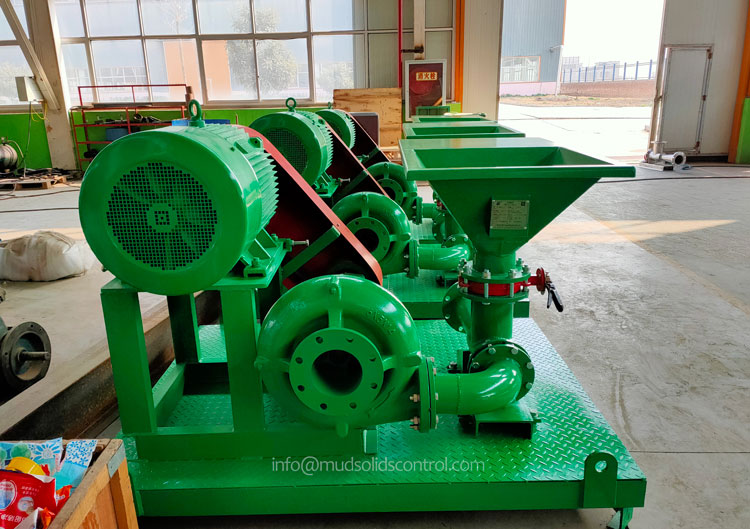
How much you get back depends less on the pump than on the state of your mixing before it arrived. Three setups cover most rigs, and the spread between them is wide. What the same clay delivers under three mixing setups:
| Mixing setup | Bentonite you get back | What you notice first |
| Jet hopper straight into a pit | 20 to 30 percent | Gel reaches the target funnel viscosity sooner |
| Hopper plus pit agitators, no shear | 10 to 20 percent | Fewer sacks per 100 bbl for the same reading |
| Already running a shear pump | Little or nothing | Check the impeller clearance first |
Put your own tonnage against those ranges. A rig buying 30 tonnes of bentonite a month and mixing it in a pit is looking at roughly 6 to 9 tonnes a month that stop going into the hole. At your landed price per tonne, that is the number for the memo.
Sack count is the drilling fluid cost saving that shows up on a purchase order. The rest of it turns up as less waiting on gel and less waste volume to haul off site.
Jobs that build fresh mud often are where the difference shows. Top hole sections, HDD shots starting from a clean tank, water well work, and any site with one mixing compartment all build gel in a hurry, then do it again days later. A rig nursing a mature system buys little fresh clay, so there is little to save.
The percentages come from equipment suppliers quoting rigs that mix through a hopper alone, and that is all they are. Replacing them with your own count takes one afternoon, and the method is further down this page.
The yield figure on a bentonite data sheet is a laboratory number. API 13A grades drilling bentonite with a floor of 91 barrels of usable mud per ton of clay. The test that produces that number stirs a weighed sample hard, lets it rest, then stirs it again before anyone reads a viscosity. Energy and time are both written into the procedure.
A jet hopper and a pit agitator deliver neither. Powder hits the water in lumps, the outside of each lump gels over within seconds, and that gel skin slows the water trying to reach the dry core. The half-wetted lumps that ride over the shaker screen are called fish eyes, and the clay sealed inside them never contributed anything to the mud.
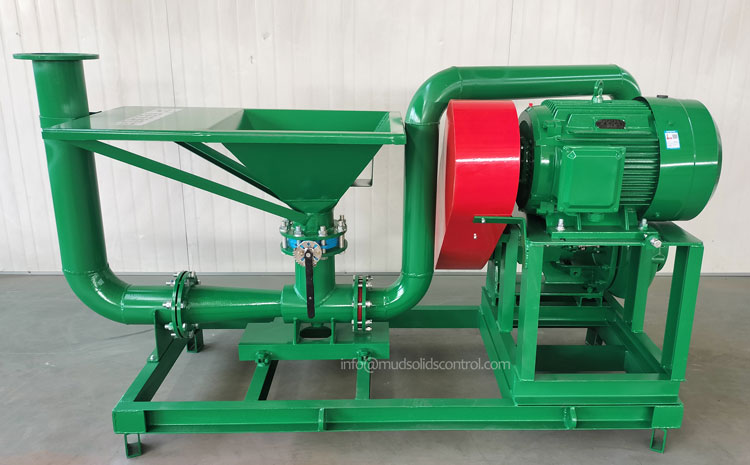
That is the clay a shear pump recovers. A sack that goes into the pit and comes back over the screens as a soft lump was bought, mixed and thrown away. Getting water into the parts of the particle the pit never reached is the whole job.
Shear pump benefits reach past the sack count. A batch that hydrates fully carries higher gel strength at the same clay concentration, and the filter cake it builds is thinner and tougher. Fluid loss falls with it, which matters most in sand and gravel where seepage is already costing you mud.
Polymers behave the same way. Long chain products form lumps of their own when they hit water, and the shear that opens a clay clump also wets a polymer particle.
Dilution shrinks with it. Clay that hydrates properly does not need correcting with more clay, and every sack you never add is a sack of solids the hydrocyclones never separate and the waste pit never has to hold.
Time is the other thing that moves. Gel that used to sit overnight before it was usable can often be run within one shift, though bentonite hydration still needs its rest afterwards. Shear shortens the wait. It does not remove it.
Water chemistry sets one ceiling. Hard makeup water can cut viscosity development by a wide margin before the pump ever sees the slurry, and no amount of shear puts that back. Test the makeup water, treat hardness with soda ash, and check pH before blaming the mixing.
Calcium bentonite that has not been activated will not reach API yield however hard you shear it. Soda ash activation is cheap, and it belongs in the mix water ahead of the pump.
Polymers need shear to wet them out, not to grind them. A batch that keeps recirculating through the pump long after the polymer has hydrated gives back viscosity you already paid for. Shear the clay and the polymer into solution, then take the pump out of the loop.
Fibrous and granular lost circulation material is built to bridge and plug, and a narrow shear gap is the wrong place for it. Keep LCM out of the pump and feed it downstream.
Rigs that already pipe their hopper through a shear pump have little left to gain. The thing worth checking there is clearance, because that is where the shear happens. Once the gap between the impeller and the fixed plate opens up with wear, the pump behaves like an ordinary transfer pump. Flow stays, and the shearing does not.
How much bentonite a shear pump can save on your rig is a number you can produce yourself, and the field work takes an afternoon. Pick a target Marsh funnel reading, draw from the same water source every time, and record how many sacks it takes to bring 100 bbl up to that reading across three or four batches. That average is your baseline.
Then run the same test with the shear pump in the loop, same water, same target, same shift. The difference is your number, and it is worth more than anything printed on a supplier page.
Watch the screens while you do it. Soft clay lumps riding over the shaker are unhydrated clay leaving the system. When they stop showing up, the clay is going into solution instead of into the waste pile.
Give it two weeks of batches, not one. Anything that changes your water source or your target viscosity partway through ruins the comparison.
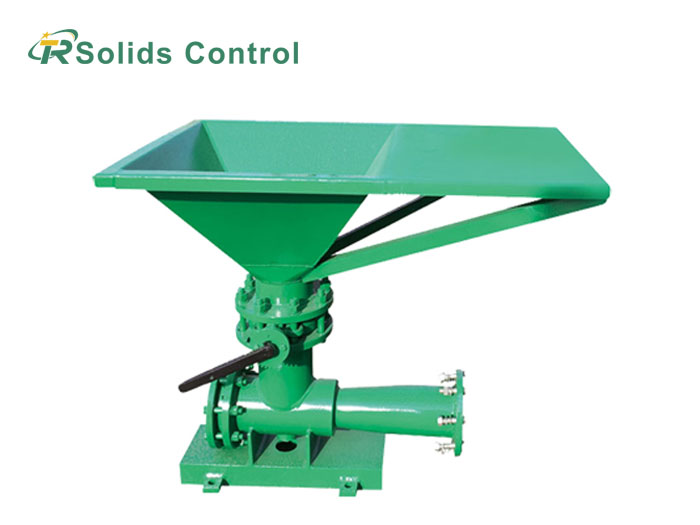
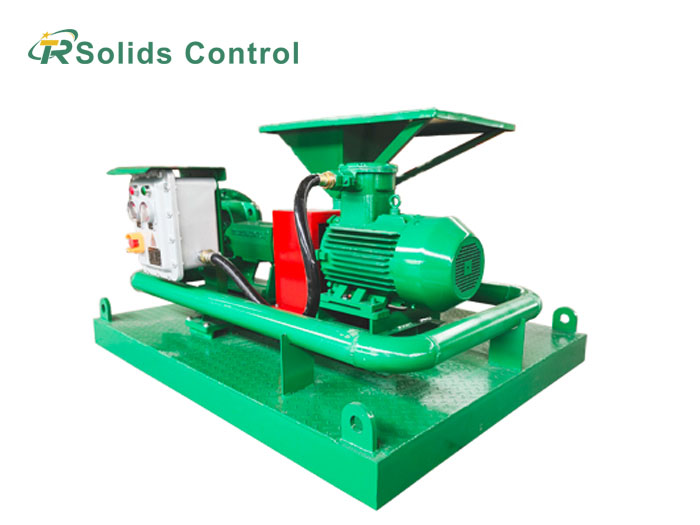
A mud mixing loop has three parts: the hopper that feeds dry powder, the pump that supplies circulation and shear, and the compartment the powder lands in. The pump has to turn that compartment over fast enough to keep solids moving while the hopper is feeding, because clay settled in a corner has stopped hydrating.
Feed rate matters as much as flow. Powder arriving faster than the pump can shear it makes lumps even with a shear pump running, so the hopper and the pump get sized together rather than bought separately.
Where it sits matters too. The pump belongs on its own loop off the mixing compartment, taking suction low and discharging back through the hopper, so dry powder enters the stream where the shear is highest. Tee it into a line that spends the day transferring mud to another tank and you get the circulation without the shearing.
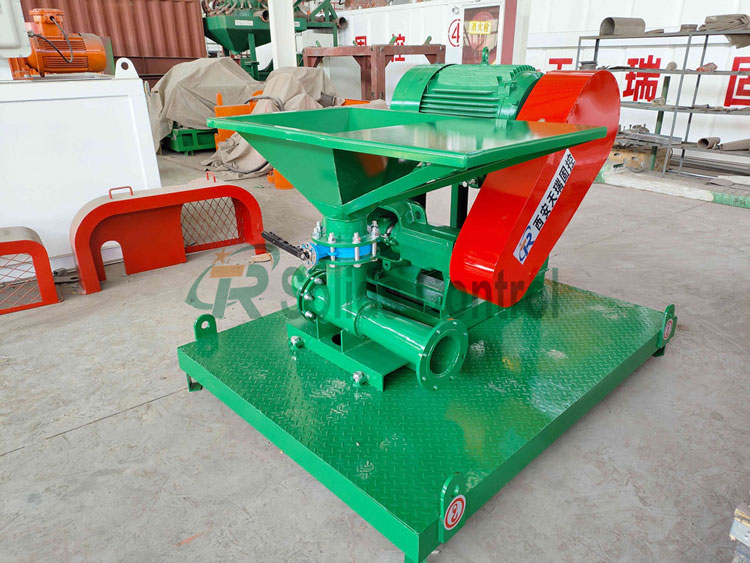
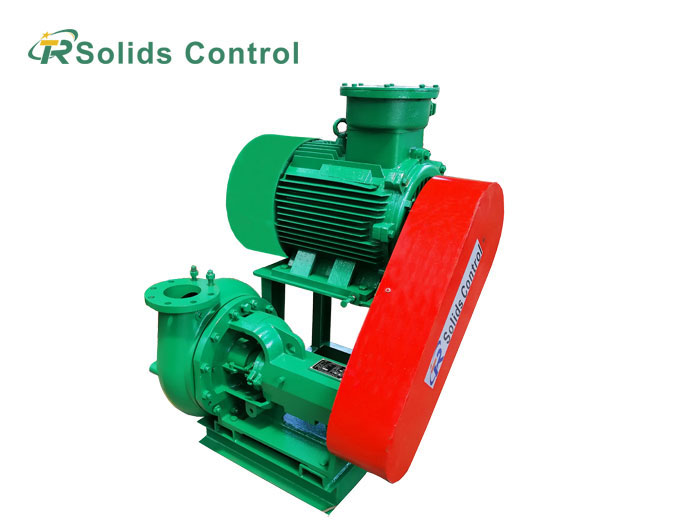
TRJQB shear pumps come in two ratings. The smaller unit delivers 100 m³/h at 35 m head, and the larger one is rated 120 m³/h against a 45 m head. Both carry full mechanical seals for continuous duty. Which one fits depends on compartment volume, hopper output and the power on site. Send us those three and we will do the matching.
Tell us what you are mixing and we will size the package to it. The things that matter are the volume of your mixing compartment, the mud type and bentonite concentration you build to, and the mud volume you build per day. Your site power matters too, by voltage and frequency. Add the makeup water source and hardness if you know it, because that number decides how much of the saving shear can reach.
We come back with the pump model, the hopper and piping layout, and the bentonite and polymer consumption you can expect on your drilling fluid programme. TR Solids Control has built solids control and mud mixing equipment for more than 15 years under ISO 9001, ISO 14001 and ISO 45001, and ships to more than 60 countries.

Address: No.2 Huochang Road, Yangling District,Xianyang City, Shaanxi Province, China
Tel: +86-18509252400
Wechat: 18509252400
Email: info@mudsolidscontrol.com
Contact: Mr.Li
 +86-18509252400