Contact Person: Mr.Li
Mobile: +86-18509252400
Wechat: 18509252400
Email: info@mudsolidscontrol.com
Address: No.2 Huochang Road, Yangling District,Xianyang City, Shaanxi Province, China
A shale shaker usually loses capacity because something upstream changed. In most cases, the incoming load has increased, or part of the available screening area is no longer working effectively.
That explains why the same machine can run clean for weeks and then start losing ground. The equipment did not change. The well did.
Most crews start with the screen, and the screen is often involved. But the more common story is that the drilling program moved on. Penetration rate may increase, the formation may start producing more fines, or circulation rate may move beyond the shaker's original operating range. The shaker is doing what it was built to do. It is simply facing a different job than the one it was originally selected for.
Changing screens without knowing what changed is how rigs spend money and get the same problem again.
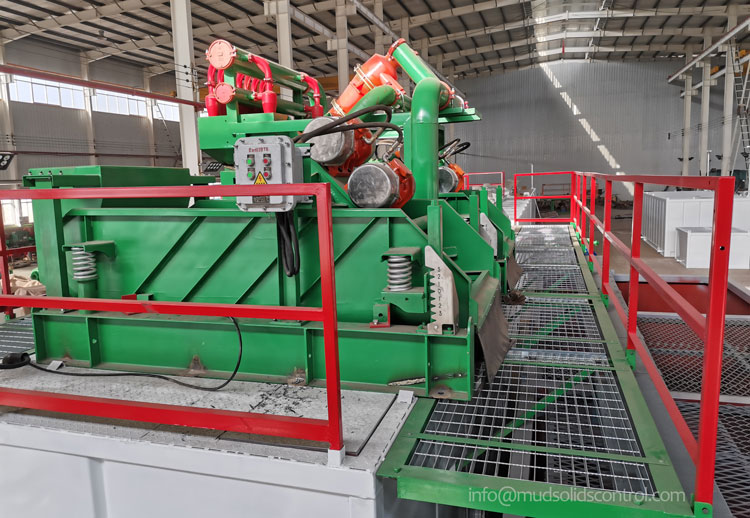
Start at the deck. If mud stays on the screen instead of passing through the mesh, the shaker is reaching its practical limit. Then look at the discharge. Wetter cuttings mean more mud is leaving with the solids. This increases fluid loss, raises dilution cost, and sends more load to downstream solids control equipment. If the desander, desilter, or centrifuge is handling more solids than before, the shaker may not be removing enough drilled cuttings at the first separation stage.
This does not usually point to a broken machine. It points to a mismatch between what the shaker was selected for and what it is being asked to handle now.
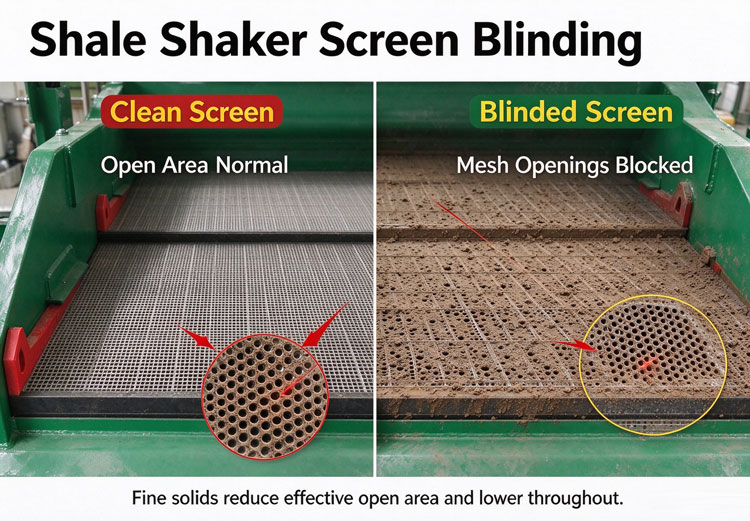
A screen panel can look normal from the walkway and still have lost most of its effective open area.
Fine solids, sticky clay, and near-size particles can pack into the mesh openings and reduce mud flow through the screen panel. The screen is not necessarily worn out. It may simply no longer match the current drilling section. This is a common reason for shaker screen blinding causes and fixes problems during drilling.
This usually appears after a formation change. A screen that handled the previous interval well can blind quickly when the size and shape of drilled solids change.
Screen damage and bypass create a different problem with the same symptom. A torn panel, poor sealing, or a section of the screen that is not working correctly allows mud to leave the deck without using the available screening area.
A different screen will not fix bypass because the shaker is not using the screen area it already has.
Start with four quick checks:
Is the mesh surface packed with fine solids?
Is any section of the panel allowing mud to bypass?
Did the problem begin after entering a new formation?
Does the current screen match the solids being generated today?
If the answer to the last question is unclear, review the current drilling section instead of simply reordering the previous screen specification.
A shaker that handled one drilling section comfortably can struggle in the next because the load has increased.
Faster drilling, higher circulation rates, or a more productive formation can push more cuttings and solids across the deck.
The machine may be fine. The job got bigger.
Feed distribution can create the same result without any change in drilling parameters. If mud reaches only part of the screen width, that section becomes overloaded while the remaining area sits idle.
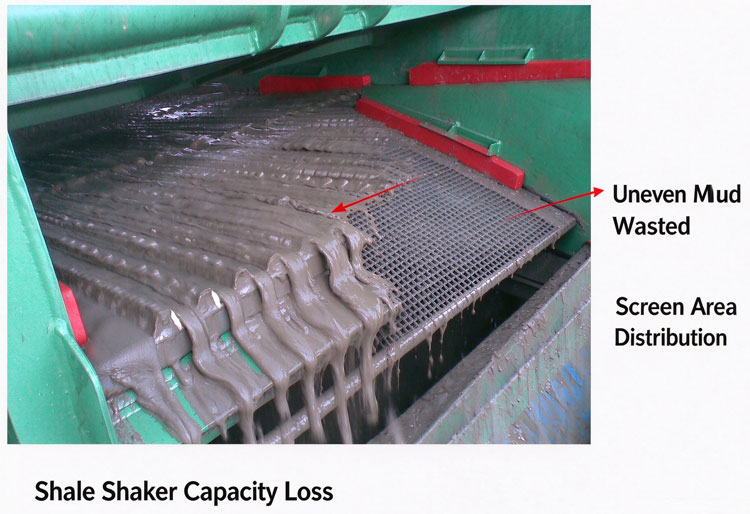
The rig may have enough screening area on paper, but only part of the deck is actually working.
Check the feed box, divider, and flow split between multiple shakers before deciding that a larger unit is required. Uneven feed is one of the cheapest problems to correct and one of the most commonly overlooked.
Sometimes the screen is correct, the shaker size is suitable, and the mud becomes the limiting factor.
Mud properties decide how easily liquid passes through the mesh. Higher viscosity slows drainage. Sticky clay covers openings. A rising fine-solids load makes separation more difficult.
The same shaker can behave very differently before and after a mud system or formation change.
When capacity drops, compare the current mud with the mud from the period when the shaker was working normally.
Look at whether viscosity has increased, whether more fine solids are staying in the system, and whether the change started after a treatment, dilution, or new formation. If the mud is the constraint, new screens only move the symptom. The mud condition needs to be addressed before expecting the shaker to regain capacity.
Vibration settings affect performance, but they are usually not the first place to look.
If the screen, feed distribution, and mud condition are already confirmed, then check whether the shaker is still operating with the expected motion.
Low vibration intensity, worn vibrator components, incorrect eccentric weight settings, or an unsuitable deck angle can reduce cuttings transport and allow solids to build up on the deck.
The purpose of these adjustments is not to compensate for a screen or feed problem. They are used to fine-tune a shaker that is already receiving the right load.
For most capacity problems, vibration adjustment comes after the basic causes have been checked.
There is a point where the shaker is working correctly and still cannot handle the drilling program.
This happens when the operating requirement moves beyond the original selection. Higher circulation rates, increased solids production, or a larger drilling load can exceed the available screening area.
At that stage, more screening area may be required through a larger shaker or an additional unit.
However, that decision should come after the screen, feed, mud, and operating conditions have been reviewed.
If the screens are suitable, the feed is evenly distributed, the mud is manageable, and the deck still cannot handle the required flow, the shaker capacity may no longer match the job.
Sizing should consider more than peak flow rate. The expected solids loading and future drilling requirements also matter.
Work in order because the low-cost causes are usually the first ones to find.
| What you see | Most likely cause | Check first |
| Mud pools on the deck after entering a new formation | Screen blinding or wrong screen selection | Screen surface and current solids |
| One side of the deck floods while another side is dry | Uneven feed distribution | Feed box and flow split |
| Capacity drops after a mud change | Higher viscosity or increased fine solids | Current mud properties |
| Screens look acceptable but the deck still cannot handle flow | Load beyond shaker selection | Flow rate and solids loading |
| Mud leaves without passing through the screen | Screen bypass | Panel edges and sealing |
This sequence helps identify the cause before changing screens or upgrading equipment.
A shale shaker loses capacity when the relationship between the equipment and the drilling operation changes.
Most cases come back to the screen, feed distribution, mud condition, or the solids load reaching the deck.
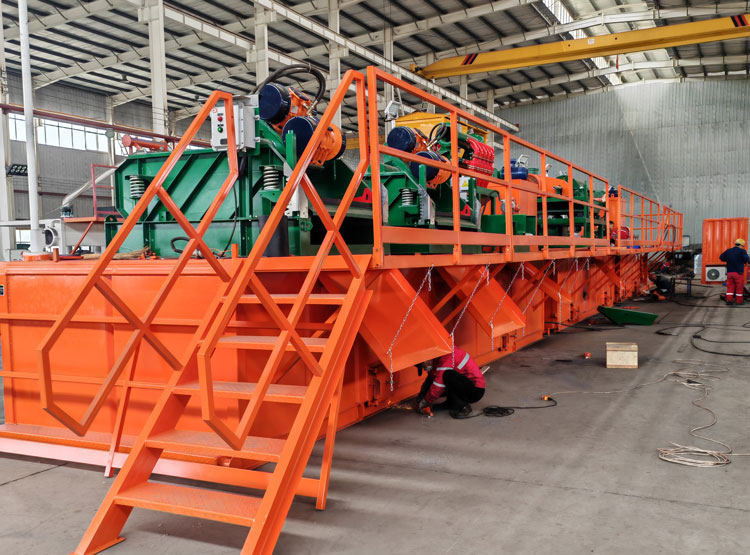
When a shaker starts losing capacity, the first question is not what to replace. It is what changed.
Checking those changes in order usually shows whether the rig needs a different screen, a feed correction, a mud adjustment, or additional screening capacity.

Address: No.2 Huochang Road, Yangling District,Xianyang City, Shaanxi Province, China
Tel: +86-18509252400
Wechat: 18509252400
Email: info@mudsolidscontrol.com
Contact: Mr.Li
 +86-18509252400