Contact Person: Mr.Li
Mobile: +86-18509252400
Wechat: 18509252400
Email: info@mudsolidscontrol.com
Address: No.2 Huochang Road, Yangling District,Xianyang City, Shaanxi Province, China
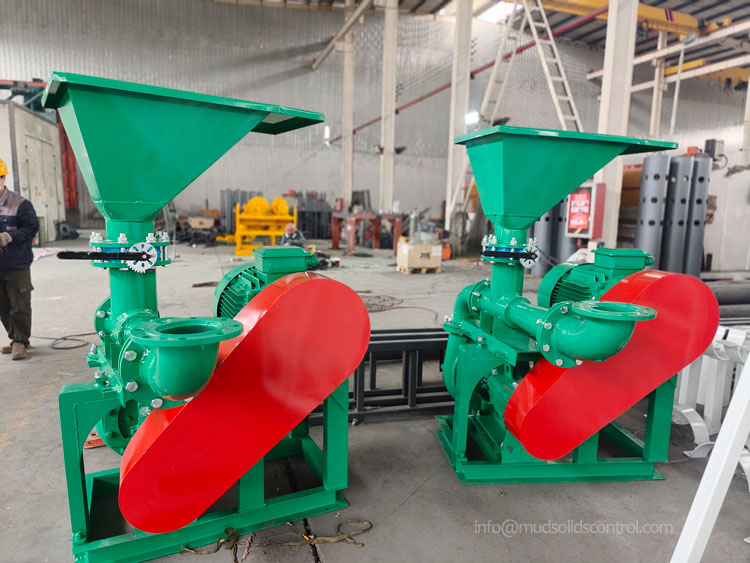
A jet mud mixer and mud shear pump are not alternatives to each other. That is the first thing we say when an enquiry arrives framed as shear pump vs jet mud mixer, sometimes written jet mud mixer vs shear pump. On a rig, the two run in series and handle separate parts of one mixing job.
Every mixing system runs into the same question sooner or later. Powder is going in through the hopper, so why is the mud still not performing as expected? Often, half of the required mixing work is never completed. This page explains the role of each unit, common contractor setups, pre-order questions we receive, and typical points where a mixing loop fails.
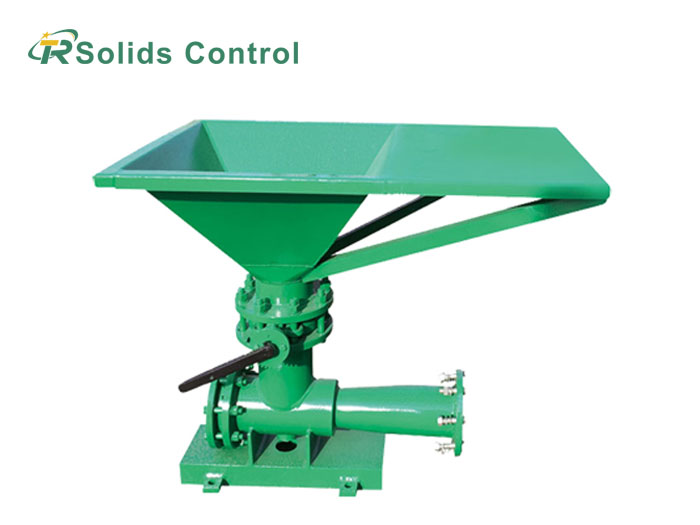
A jet mixing device works on a venturi section. Liquid accelerates through a narrow throat, pressure drops, and dry additive is pulled off the chute into the stream. Powder goes in at whatever rate the operator feeds it, and it goes in wet.
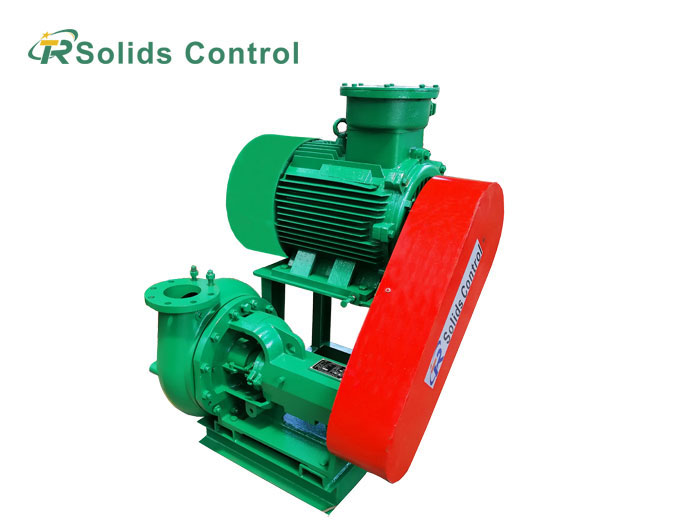
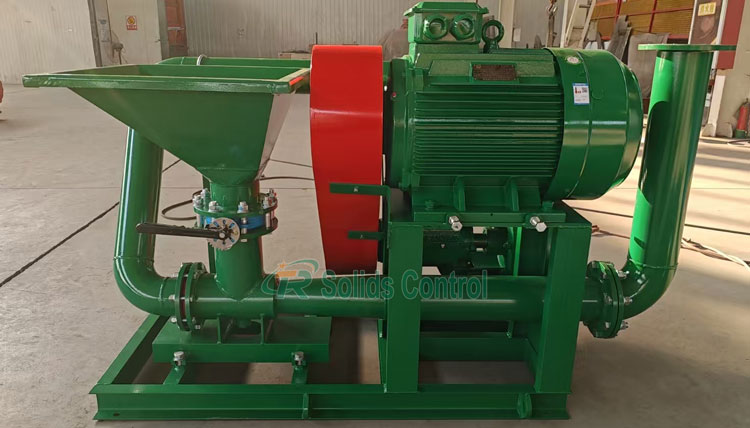
The shear pump handles the second stage. A mud shear pump runs the same liquid past a close-clearance impeller and shear plate, breaking apart the soft agglomerates that form when bentonite or polymer meets water. Its effectiveness depends on the pump design, operating conditions, and the properties of the material being mixed.
Poor dispersion is one route to fish eyes, the gelled skins around dry cores that anyone who has looked at a screen recognises. Addition rate, order of addition, water quality, screen selection and the recipe itself belong on the list too. When lumps appear, the mixing stage is where to start looking, not the only place to look.
Can a jet mixer replace a shear pump? Sometimes. The answer depends on the additives, the required mud properties, and how well the existing mixing arrangement performs.
Barite and bentonite are commonly introduced via a mud mixing hopper, but their handling requirements are not identical. A properly sized charging pump can feed dry material through the Venturi hopper at your target feed rate. The pump must supply the inlet pressure and flow rate specified for the jet mud mixer.
Polymers require a closer look at the formulation and feeding process. Some grades benefit from additional mechanical dispersion, while others can be damaged by excessive shear. Running the hopper for another hour increases the amount of material processed, but it does not necessarily correct a dispersion problem. This is the central point in the mud mixing hopper vs shear pump comparison: feeding and further treating the fluid are different functions.
| Setup | How it is piped | Fluid it suits | Why contractors pick it | Limitations |
| Hopper only | Charging pump feeding a venturi hopper on the mixing compartment | Bentonite, barite weighting, simple water-based mud | Lowest capital cost and the fastest weighting-up rate, adequate when nothing in the recipe needs shear | Not suitable for high-yield bentonite or shear-sensitive polymer grades; high risk of poor dispersion |
| Hopper plus shear pump | Hopper discharges into a compartment the shear pump draws from and returns to | Polymer grades that will not disperse on the hopper alone, high-yield bentonite | Additional shearing stage on fluid already going through the hopper, without changing how powder enters | Requires available suction/return connections on the tank; extra field piping work for retrofits |
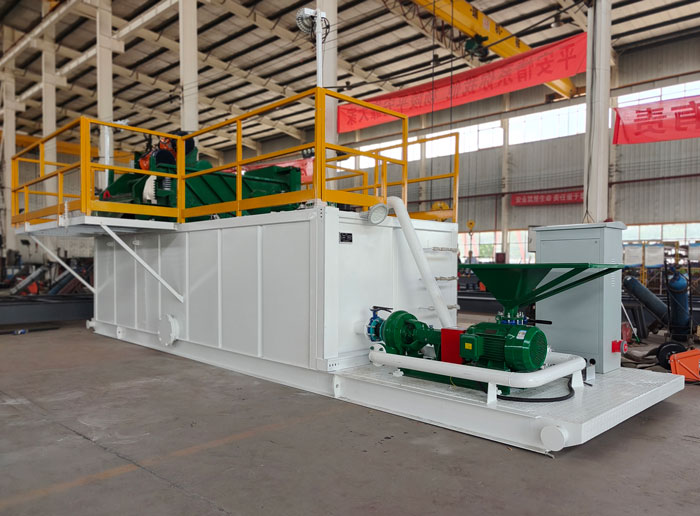
| One skid | Hopper, charging pump and shearing pump mounted and piped as a single mud mixing skid | Any of the above | No field piping, short hose runs, one lift onto a new build or a tight deck | Less flexible for existing tanks with fixed compartment layouts; higher upfront package cost |
Most contractors who contact us are not choosing between these setups from scratch. They already have a hopper on a tank that has been in service for years. Their question is what changes when a shear pump is added, and whether the existing hopper needs to be relocated.
In many retrofit projects, the hopper can remain in place. The final arrangement depends on the tank layout, the available suction and return connections, and the capacity of the existing charging pump.
How do a shear pump and a jet mixer work together on a tank that is already built? That is the practical form of the shear pump vs jet mud mixer question, and our sales desk at TR Solids Control answers it most days. It arrives in three parts.
"I already have a hopper. Where does the shear pump go, and does it need its own pump?"
On the tanks we see most often, the shearing pump takes suction from the compartment the jet mud mixer discharges, then returns fluid back into the same compartment. In flow terms, it sits downstream of the hopper and runs on a separate loop. Installation typically requires one new suction nozzle and one overhead return line.
We recommend this layout, though it is not a hard rule. The two stages place different demands on the pump: a venturi throat wants head at a given flow, while a shearing stage adds restriction downstream. A single charging pump may support both stages, depending on the pump curve, nozzle size and intermediate piping losses. Combined circuits work well when the pump was sized with the second shearing stage in mind. To validate for your tank, cross-check the hopper manufacturer's required inlet pressure against your pump's output at your operating flow.
"One skid, or two separate machines?"
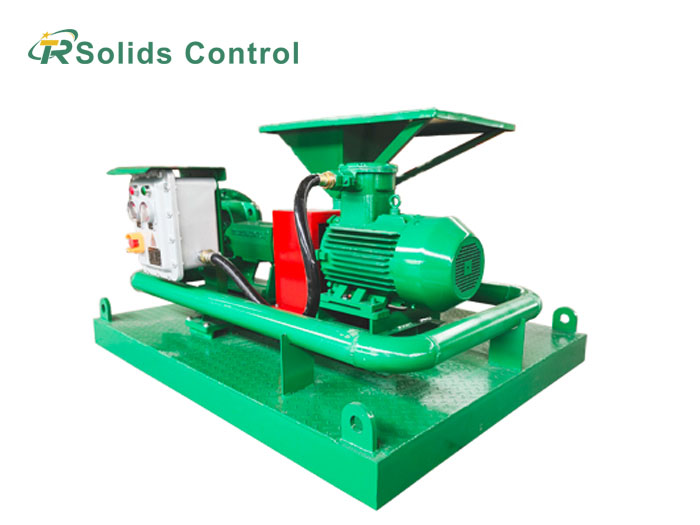
A jet shearing unit carries the hopper, the charging pump and the high-shear pump on one frame with the piping made up in the shop. It lands on deck, takes a power feed and a few hose connections, and it is mixing. Shop-built piping means the throat and the shear plate are matched before the skid ships. Separate machines win when the tank layout is fixed, when the hopper sits on a compartment away from where you want the shear loop, or when the second purchase comes a season after the first. Retrofits go separate.
"What size do I need?"
Less from the compartment than from what the circuit delivers. Effective volume is the place to start, and it is rarely the geometric volume: suction height, internal geometry and dead space below the suction nozzle all reduce it. Set that against what the pump delivers at the head your installation imposes, meaning piping losses, static lift and the restriction the shearing stage adds.
Then read the result against the mixing objective and the performance data from whoever built the machine. That goes further than any rule of thumb about kilowatts per cubic metre. As a reference point from our own deliveries, tanks with a 30 to 50 m³ mixing compartment end up with something in the 55 kW class, though that figure comes from a circuit calculation rather than the tank volume.
One thing gets decided before this question even comes up: whether the charging pump meets the hopper maker's inlet pressure requirement at the flow you need. That belongs to the errors below.
Four of these show up again and again. Our service people check for them first, and none of them is a diagnosis on its own. They are places to look.
Charging pump short of what the hopper needs. Powder backs up in the chute, the operator rakes at it, and a good part of it leaves as dust. The pump was bought on flow alone. Whether it falls short depends on the hopper's inlet pressure requirement and where your pump curve sits at that flow, so compare the two before drawing conclusions about the mixer.
Shear pump installed upstream of the hopper. Two installations we were called to had it this way round. Powder enters after the shearing stage, so whatever was meant to be sheared passes it before going in. If that is how your tank is piped, it is worth checking first.
Polymer poured straight into the tank. Someone tips XC or PHPA into the active compartment and walks off. Two hours later the mud still carries soft lumps. The check here is the addition path: through the hopper, then through shear, and note where the powder leaves it. Undispersed polymer is one candidate among several, alongside hydration time, order of addition, water quality and screen selection, and extra shear will not compensate for a recipe that is out of balance.
Weighting up on the hopper alone. Barite goes in, mud weight climbs on schedule, and then the viscometer reading drops. Dilution of the polymer already in the system is worth testing as an explanation, alongside the treating schedule and how much shear the fluid had seen before weighting started. Where the shear history turns out to be the weak link, running the shearing pump during weighting up rather than only at mixing time is the first thing to try.
Agitators and mud guns belong to keeping a tank in suspension, and how they are arranged sits outside this article. The mixing loop ends at the compartment.
Do I need a shear pump for polymer mud? Sometimes, and the decision is more nuanced than the question suggests. Polymer grades vary in dispersion behaviour and shear tolerance. Too much high shear will degrade sensitive grades instead of helping them. Consider adding a shear pump in two scenarios: your current setup fails to disperse polymer properly, or your existing mixing circuit cannot hit the rheology and yield required by the mud programme.
On a tank that is already working, five inputs decide it: target mud properties, evidence the present arrangement falls short of them, available suction head and return line routing, power budget, and deck space. Those are what our sales desk asks about before quoting, which hints at how much the answers move the recommendation.
Bentonite is where the money comes back, when it comes back at all. Contractors who added one to a hopper they already owned report bentonite consumption falling by between a fifth and a third for the same yield. Polymer consumption drops roughly 15%. Those are field reports rather than a promise, and they assume undispersed powder was the problem being solved.
Time is the second gain and the harder one to put a number on. Where dispersion was the limiting step, moving it into a shearing stage shortens the wait for usable mud. Where something else was limiting, nothing changes. Settling which of the two applies costs less than the machine does.
Leave a shearing stage out when the programme is bentonite and barite without polymer, or when the rig skids every few days and the deck will not take a second machine. Where neither applies and dispersion is the constraint, payback lands inside one well.
Sizes, motor ratings and nozzle dimensions for our mud shear pump range are on the product page.
Shear pump vs jet mud mixer turns out to be a question about order rather than choice. Powder goes in, then shear happens. After that the fluid is one more stream heading to the active system, and where a loop is broken shows up in ten minutes on a tank top, in the same place on most tanks we visit. Send us your tank layout and the fluid programme and we will mark where the second machine goes.

Address: No.2 Huochang Road, Yangling District,Xianyang City, Shaanxi Province, China
Tel: +86-18509252400
Wechat: 18509252400
Email: info@mudsolidscontrol.com
Contact: Mr.Li
 +86-18509252400