Contact Person: Mr.Li
Mobile: +86-18509252400
Wechat: 18509252400
Email: info@mudsolidscontrol.com
Address: No.2 Huochang Road, Yangling District,Xianyang City, Shaanxi Province, China
A desilter separates finer solids than a desander. In round numbers, a desander typically operates in the 45–75 µm range, while a desilter operates in the 15–44 µm range. These are typical equipment ranges, not fixed particle boundaries, and that difference matters more than the numbers themselves.
Both machines are banks of hydrocyclones, and neither behaves like a shaker screen with one opening size. Particles are distributed between the underflow and overflow according to their size and the cyclone's operating conditions. A catalogue micron value describes separation at one stated operating condition. It is not a threshold above which every particle is captured.
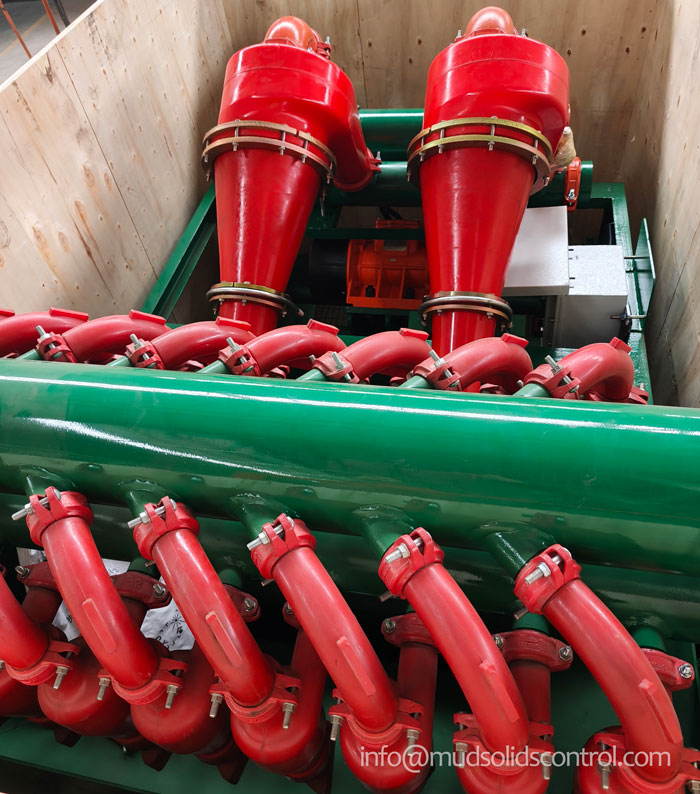
| Desander | Desilter | |
| Typical cone size | 8-12 in | 4-5 in |
| Typical separation range | 45-75 µm | 15-44 µm |
| Flow per cone | Higher | Lower |
| Cone arrangement | Fewer, larger cones | More, smaller cones |
| Position in the circuit | After the shale shaker | After the desander |
| Main duty | Coarse sand-sized solids | Fine silt-sized solids |
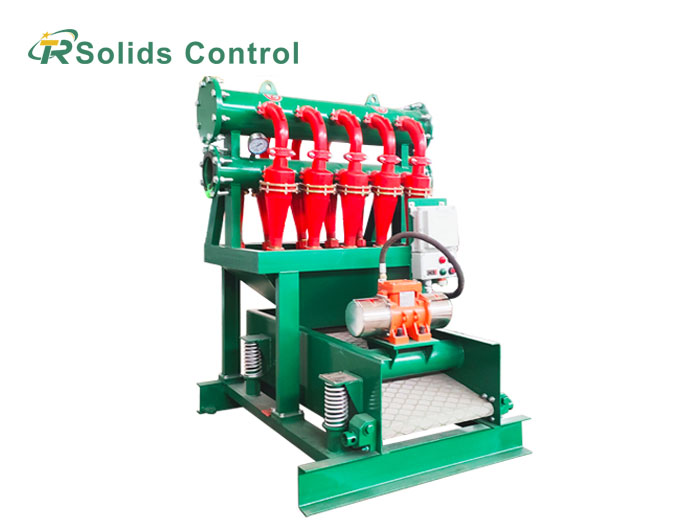
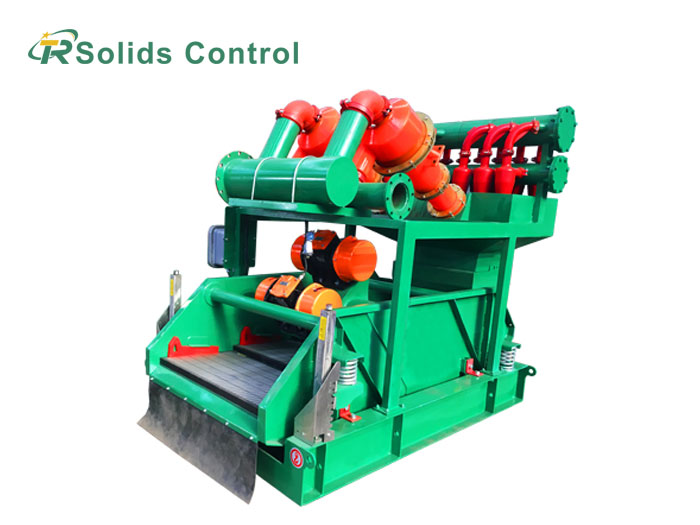
The solids control train runs shale shaker, then desander, then desilter. If finer solids removal is still required after hydrocyclone treatment, a decanting centrifuge is commonly used for further separation.
D50 is one point on a curve. It marks the size where half the particles report to the underflow and half leave with the overflow. One defined set of conditions, nothing more. A cyclone does not produce a sharp particle boundary. Recovery climbs gradually across the size range, so plenty of particles above the D50 still leave with the overflow. Some below it go out the apex.
Two consequences follow. A stated separation range and a stated D50 are not automatically the same specification, so check which one the manufacturer is quoting. A desilter sold at 40 µm does not remove every solid above 40 µm. Read the number next to the flow and pressure that produced it.
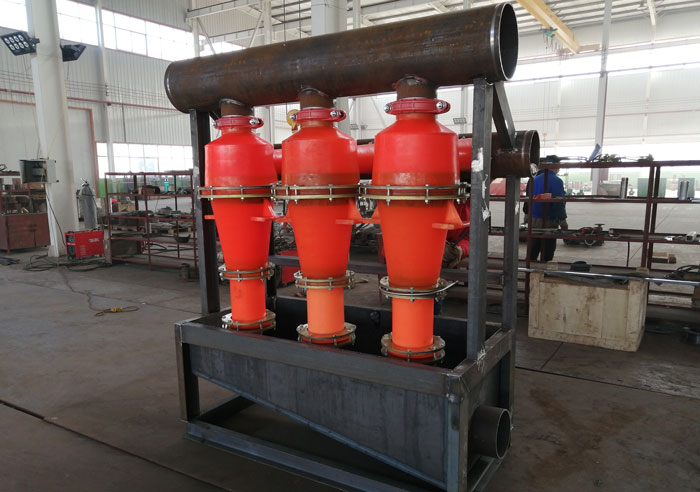
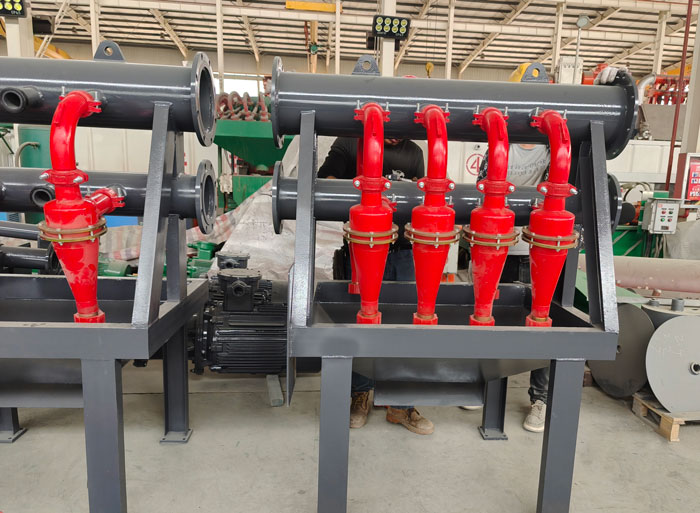
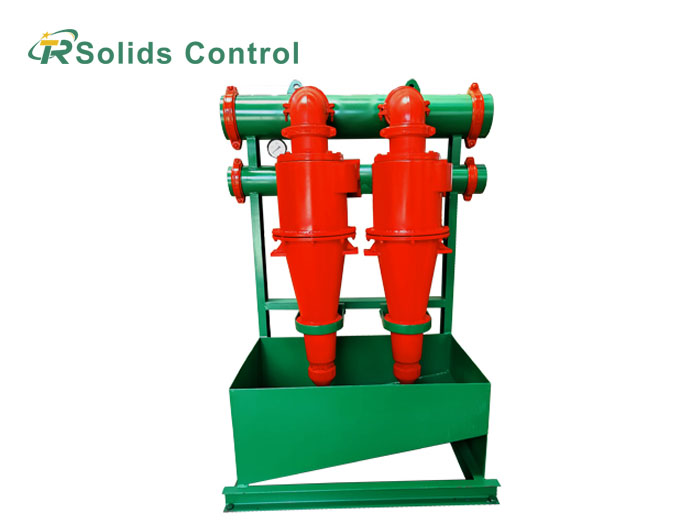
Cone diameter is the main reason. A desander normally runs 8, 10 or 12 inch hydrocyclones. A desilter normally runs 4 or 5 inch cones. Smaller cones produce the flow pattern that separates finer particles, and each one passes less volume.That is why a desilter uses many desilter cones in parallel to meet the required flow. Larger cones handle more volume per cone and target a coarser range.
A desilter is not simply an equal-scale scaled-down desander. Its vortex finder and apex geometry are separately optimized for fine solids separation. Cone diameter, flow per cone and intended separation range all differ, so the two stages are not interchangeable even when a catalogue shows overlapping micron figures.
Feed pressure and flow per cone come first. The inlet pressure is what creates the swirl, and when pressure drops the rotational velocity drops with it, which hurts fine separation most. Cone count and pressure have to be read together. Opening more cones splits the incoming flow among them. The pump and manifold still have to hold head for every cone in service.
Mud properties come next. Higher mud density changes how solids move relative to the liquid, and higher viscosity changes the internal flow in ways that make fine separation harder. A cut point measured on one mud system should not be carried over to a heavier or thicker one without rechecking it.
Solids loading, apex condition and wear matter just as much in practice. A cyclone fed heavily loaded mud behaves differently from one receiving relatively clean fluid, which is one reason coarse solids are taken out upstream before the finer stage. A worn, blocked or wrongly sized apex changes the underflow pattern and should be checked before any cone configuration is changed. Wear also changes the cone body, vortex finder and apex over time, so a worn cyclone will not perform like a new one of the same nominal diameter.
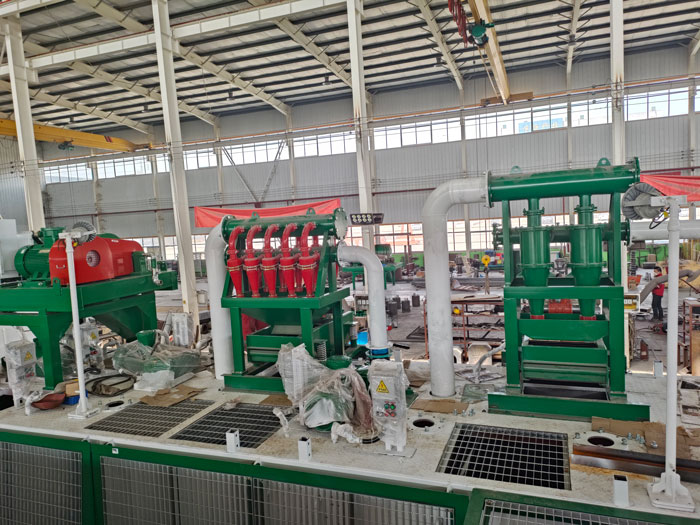
Start from the particle size you are trying to remove, then check it against the flow you have to treat.
Coarse sand is still showing up after the shaker, or sand is wearing out pumps and downstream equipment. Fit a desander as the first hydrocyclone stage.
The mud is already downstream of a desander and the fine fraction is the problem. Fit a desilter.
The stream carries both. Run a desander followed by a desilter. The desander takes the coarse load out first, which keeps the smaller cones working on the fraction they are built for.
Your target sits below roughly 15 to 20 µm. Cyclones are close to their practical limit there, and a decanting centrifuge is the usual answer.
Cone count should follow actual mud flow rather than the micron value you want. Adding cones does not make separation finer, and more cones than the flow can properly feed leaves each one starved and cuts separation efficiency.
Comparing two quotes comes down to one question: what flow, feed pressure and mud produced that micron figure. The number alone is only half the specification.

Address: No.2 Huochang Road, Yangling District,Xianyang City, Shaanxi Province, China
Tel: +86-18509252400
Wechat: 18509252400
Email: info@mudsolidscontrol.com
Contact: Mr.Li
 +86-18509252400