Contact Person: Mr.Li
Mobile: +86-18509252400
Wechat: 18509252400
Email: info@mudsolidscontrol.com
Address: No.2 Huochang Road, Yangling District,Xianyang City, Shaanxi Province, China
When the shale shaker screen area is short, the symptoms look like rig problems. Mud runs off the discharge end of the shaker deck. Fines pass through to the cuttings pile. Screens blind every few hours. The mud engineer chases weight with dilution water instead of fixing solids at the front of the train. The fix is rarely a new mesh number. The fix is more area in the right place, with a mud the deck can process without flooding.
Sizing screen area is one of the few decisions a contractor can lock in before the rig is built. It belongs on the same drawing as the pump rate, the mud weight, and the deck length on the shaker skid.
The decision starts at the pump, not at the mesh chart. Take the maximum output your mud pumps can deliver on this well, not the average over a connection or a stand. A pump rated at 1,000 gallons per minute will run at 1,000 GPM, sometimes a bit more, for the sections where the bit is making hole fast and cuttings loading is heaviest. If the shaker is sized to the average, it will overflow in those sections, not the others.
Add a margin on top of that peak. Twenty to thirty percent is the figure used in most rig floor practice. The reason is the surge, not the steady state. A connection adds a slug of mud, a trip adds another, and one of your shakers is going to be offline for a panel swap at the worst possible moment. The margin is not a luxury, it is the cost of staying on bottom.
This number is your "peak flow at the shaker." It is the left column of every table that follows.
Screen area below is the non-blanked open mesh, the part of the panel where mud passes through. The numbers are a starting reference: 12 GPM per square foot of non-blanked area for an average water-based mud, and 8 GPM per square foot for a viscous mud or an oil-based system. A short pond test on the rig, with the mud and the mesh you will run, will move the numbers either way.
| Peak flow at the shaker | Peak flow in m³/h | Non-blanked area, average water-based mud | Non-blanked area, viscous mud or OBM | Typical four-panel shakers (585 × 1165 mm) |
| 300 GPM | 68 | 25 ft² (2.3 m²) | 38 ft² (3.5 m²) | 1 / 2 |
| 500 GPM | 114 | 42 ft² (3.9 m²) | 63 ft² (5.8 m²) | 2 / 3 |
| 750 GPM | 170 | 63 ft² (5.8 m²) | 94 ft² (8.7 m²) | 3 / 4 |
| 1,000 GPM | 227 | 83 ft² (7.7 m²) | 125 ft² (11.6 m²) | 4 / 6 |
| 1,250 GPM | 284 | 104 ft² (9.7 m²) | 156 ft² (14.5 m²) | 5 / 7 |
| 1,500 GPM | 341 | 125 ft² (11.6 m²) | 188 ft² (17.4 m²) | 6 / 9 |
The two right-hand columns already carry the 25 percent surge margin, so read your raw pump number against the left column and stop trying to add the margin yourself.
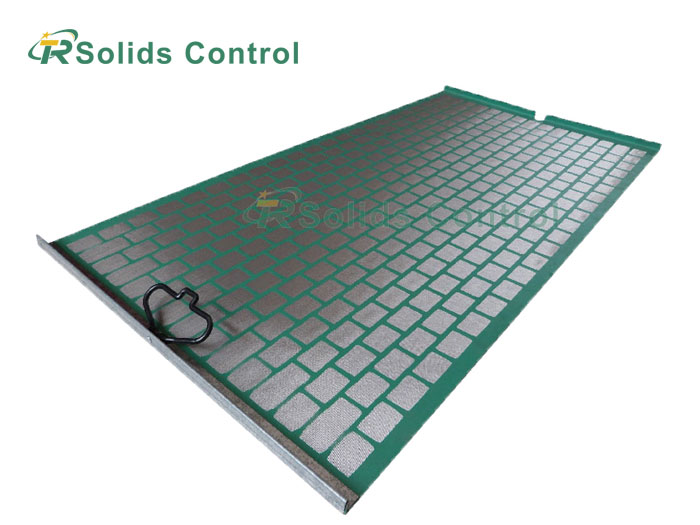
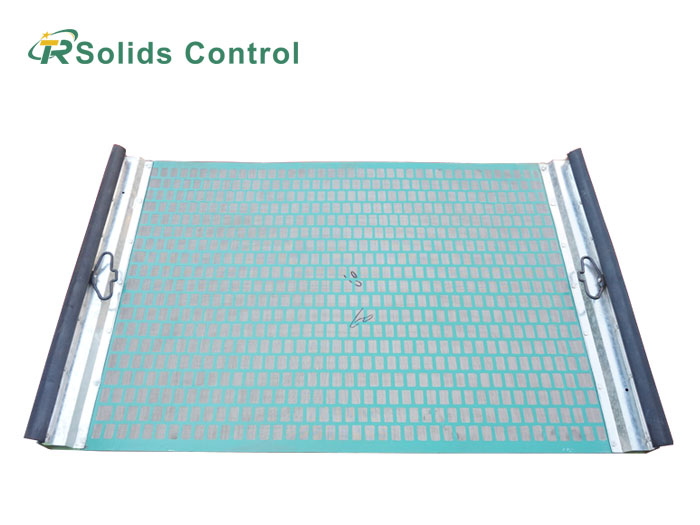
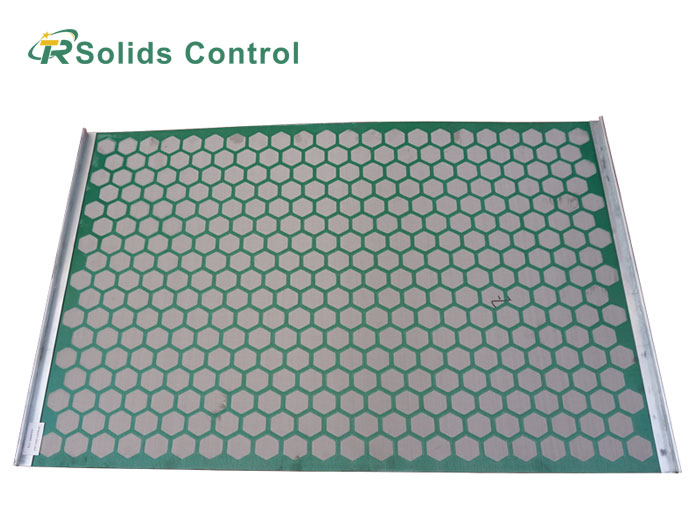
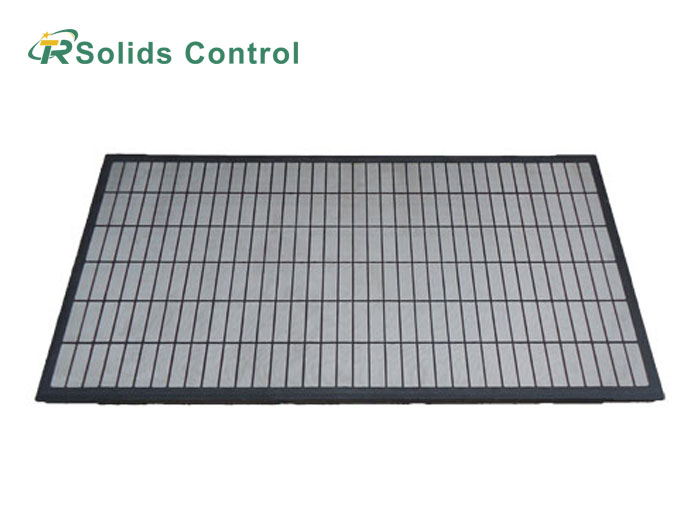
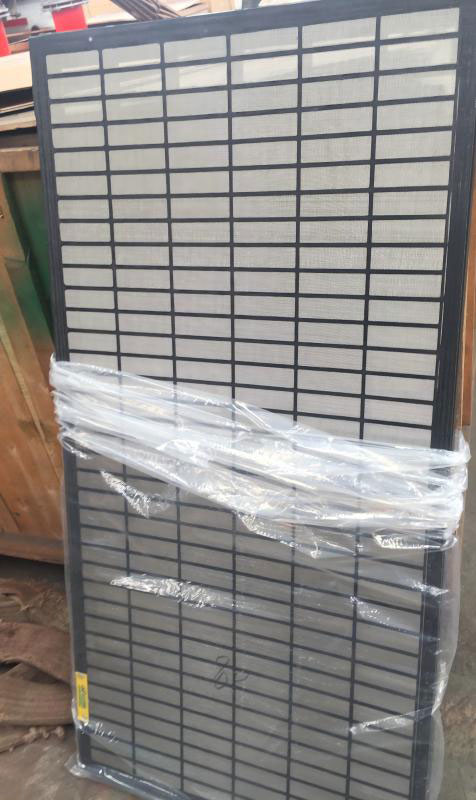
"Non-blanked area" is the open mesh, not the frame footprint. A 585 × 1165 mm panel of about 7.3 ft² of frame usually shows up as 5.3 ft² of non-blanked area on a flat steel-frame screen, depending on the panel type. The frame area is the easy number to quote in a brochure. The non-blanked area is the number that processes mud. The table uses non-blanked because that is the number that decides whether the deck floods or not.
If the rig lands between two rows, take the larger. The cost difference between a 4-panel and a 5-panel rig is small compared to the cost of an hour spent diluting mud because the screen was the wrong size.
The table is honest only if the screen is doing what its nameplate says. Four things eat into the area between the brochure and the deck.
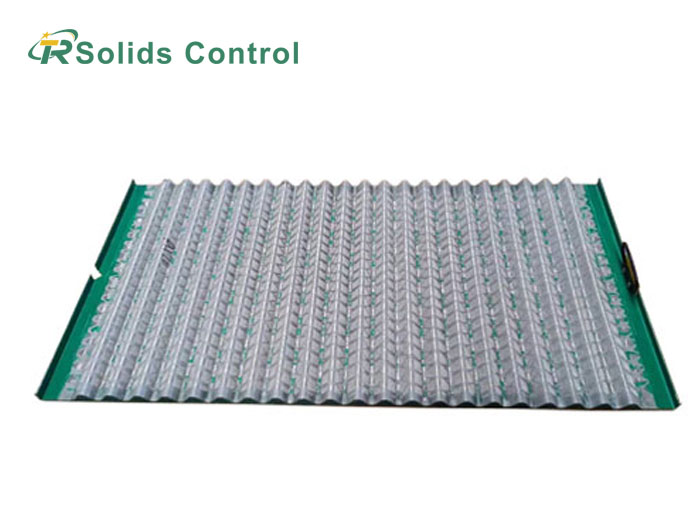
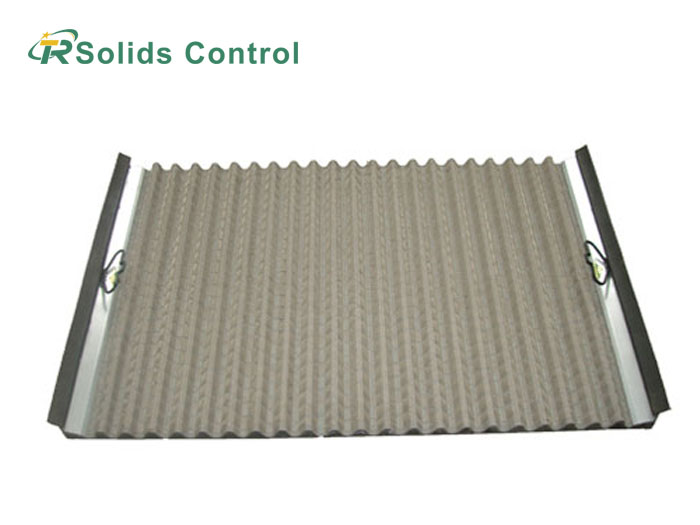
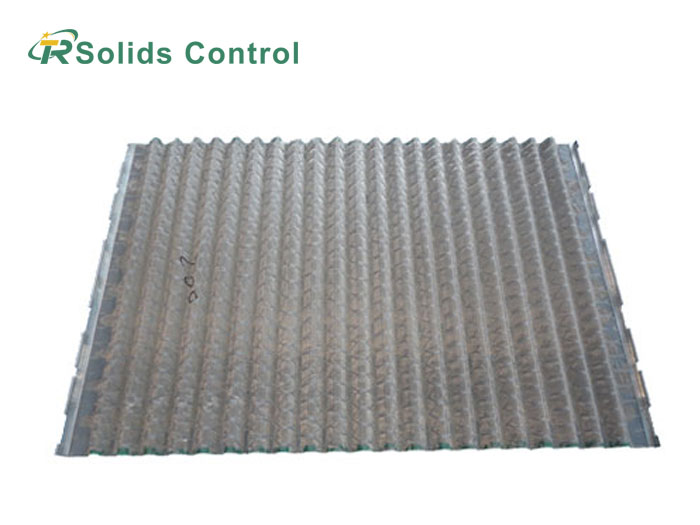
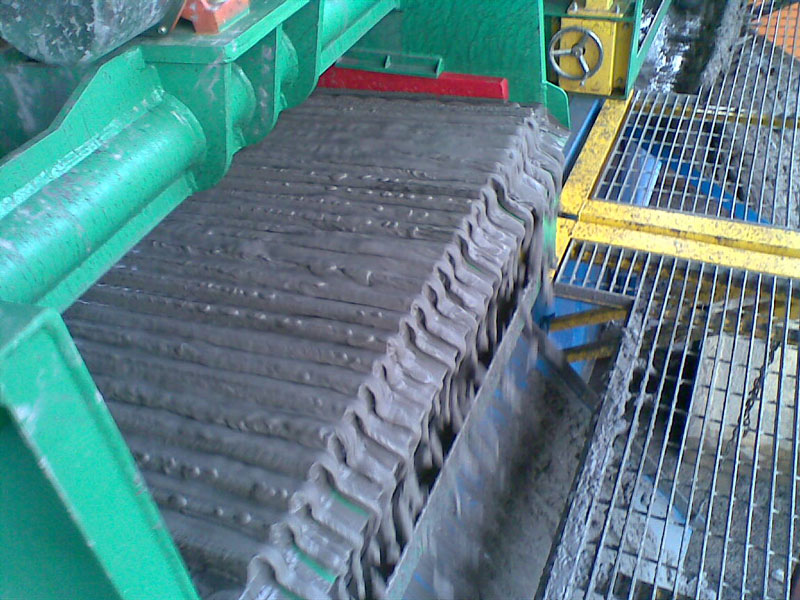
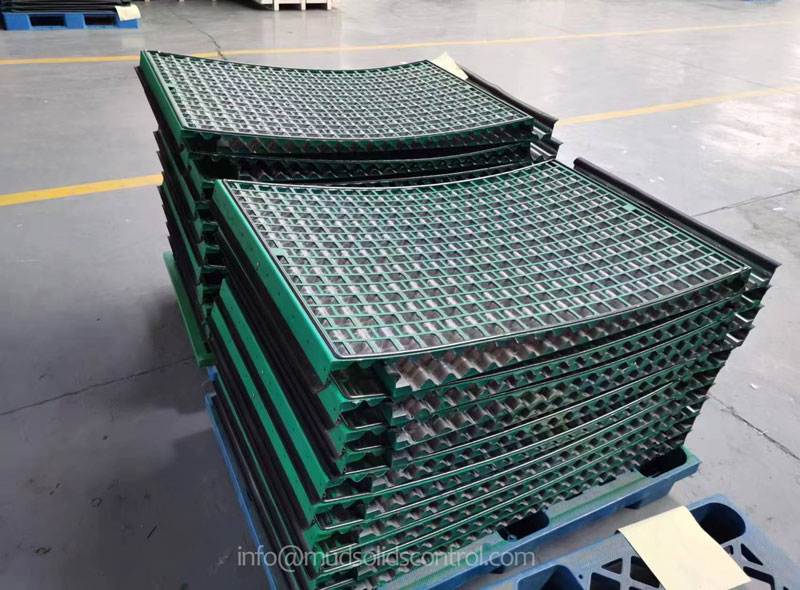
Blanking around the panel. Around the edges of every panel, a strip of mesh is sealed by the screen frame. The strip does not blind, but it does not process mud either. Pyramid and wave panel designs recover some of that loss on the same deck footprint.
The pool on the deck. Industry practice is to keep about 75 to 80 percent of the screen covered with mud at the discharge end. A too-short pool means the deck is not being used. A pool that is too long means the deck is flooded at the feed end and starved at the discharge. Both are common on the same rig, and both reduce the area that is working on the same deck.
The feed. A poor flow distribution manifold dumps two thirds of the mud on one parallel shaker and lets the others run dry. Three shakers in a row, all rated 500 GPM, will overflow at 1,200 GPM if the feed split is uneven. The area is there. The hydraulics is not. A balanced feed manifold is half the area question.
The mesh. API 200 on the same panel will not pass what API 120 passes. Conductance values published for the same steel-frame screen drop by about 40 percent from API 120 to API 200, so a finer mesh asks for more area to do the same job. The table assumes a mid-range mesh, API 120 to API 170. If you plan to run API 200 as a routine, go up one or two shakers on the table. Picking the right API mesh for the job has its own writeup.
This is the other half of the same question. Sizing a single shaker to handle the full peak flow is rarely the right answer, because it leaves nothing on deck when that shaker is down for a screen change or a vibration motor swap.
The rule on the rig floor is "N plus one." If the table says three shakers for a 750 GPM system, install four. The fourth runs as a standby, picks up the load while one is down, and keeps drilling on bottom. The cost of the extra unit is the cost of avoiding one full mud-up event per well.
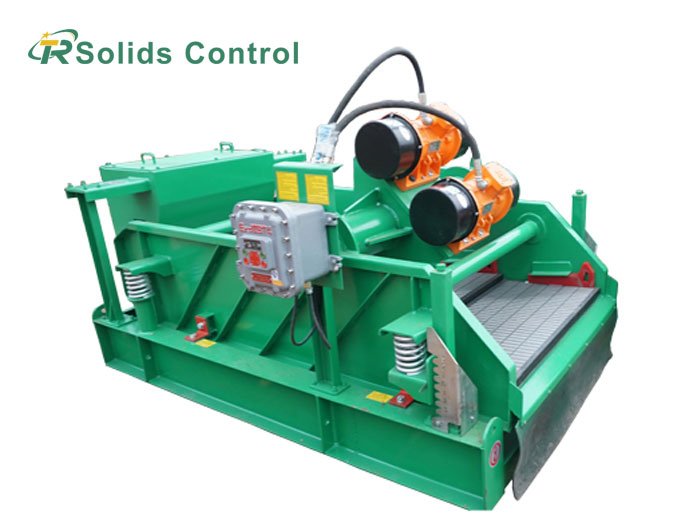
Where the shakers sit matters as much as how many. Three shakers in parallel must share the feed evenly, and the distribution box at the header has to be sized for the same peak flow. A 750 GPM manifold feeding three 250 GPM shakers does not feed them at 250 each. The geometry of the box decides who gets the surge. On most boxes, the port closest to the inlet takes the most of it.
If the deck is short on positions, three moves work: wider panels, more panels per shaker, or a double-deck. A 4-panel deck at 585 × 1165 mm gives roughly 21 ft² per shaker. On a 3-panel 700 × 1250 mm deck, you get about 16 ft². A double-deck with the same footprint closes most of the gap between them.
The opposite move, sizing the skid to the deck instead of the flow, is the most expensive square foot of steel on the rig.
The symptoms are visible long before the math catches up.
Mud over the discharge end. If mud is going over the back of the screen instead of off the weir, the deck is flooded. Either the pool is too long or the area is too small. The next stand will tell you which.
Wet cuttings on the conveyor. Cuttings leaving the shaker should be damp, not dripping. Dripping cuttings mean mud is leaving the system on the cuttings, which costs both mud money and, on an OBM, oil.
Short screen life. Screens that blind every two to four hours are running at the edge of their capacity. The move is a coarser mesh, not a replacement. If the mesh is already coarse, the area is the problem.
Downstream overloading. The desander is running full, the desilter cones are packed, the centrifuge is on for the whole trip. These are signs the shaker is not removing what it should, not signs that the downstream equipment is undersized.
More screen area alone is one input into a working front-end, not the only one. There are problems on a rig that look like a sizing problem and are not.
Gas-cut mud will not recover density just by adding more shaker capacity. This condition needs treatment upstream with a degasser.
If the cuttings are too fine for the mesh, the answer is a finer mesh or a second-stage shaker, not a wider deck. A primary shaker cannot reach the cut point of a desilter or a centrifuge, no matter how many panels are in the row. Fine and colloidal solids belong to those, not the front-end.
If the pool is wrong, more area makes the wrong pool larger. Deck angle and weir height are the two knobs that set the pool on the deck. Get those right before adding more area.
If the screen is run torn, no amount of area compensates. A torn screen is a bypass. Patch it, replace it, or take the shaker offline.
Three numbers have to land in the same conversation: peak mud pump output, mud weight and viscosity on the heaviest section, and the room the shaker skid gives you. If any of the three is a guess, the area number from the table above is a guess too.
Shale shaker screen area is a sizing decision, not a tuning decision. Lock it in on paper, before the rig is built, against peak flow and the surge margin. The mesh, the deck angle, and the feed split are second-pass decisions that decide whether the area you sized is doing the work.

Address: No.2 Huochang Road, Yangling District,Xianyang City, Shaanxi Province, China
Tel: +86-18509252400
Wechat: 18509252400
Email: info@mudsolidscontrol.com
Contact: Mr.Li
 +86-18509252400