Contact Person: Mr.Li
Mobile: +86-18509252400
Wechat: 18509252400
Email: info@mudsolidscontrol.com
Address: No.2 Huochang Road, Yangling District,Xianyang City, Shaanxi Province, China
If you know your maximum circulation rate, you can narrow a desander down to one or two configurations in about a minute. Hole size, mud weight and formation conditions still matter, but flow rate is what sets the starting point, and it is usually the number the driller already has.
The capacities below are rated at a feed pressure of 0.25 to 0.4 MPa (36 to 58 psi). Actual performance changes with mud weight, viscosity and solids loading, so treat the table as a starting point and confirm the configuration against the mud on the well.
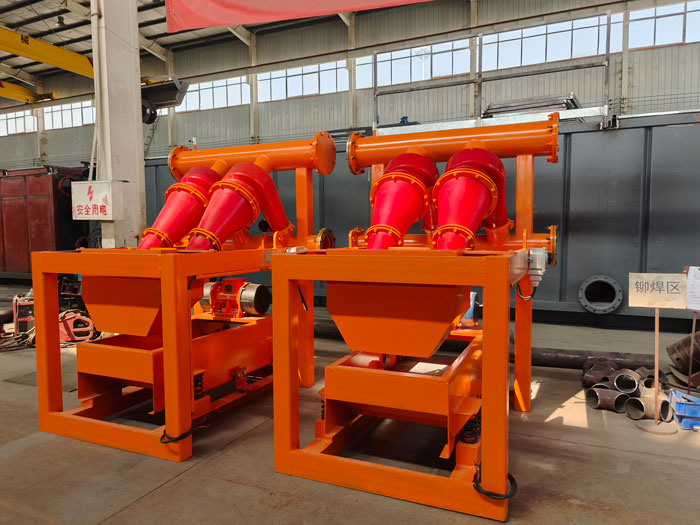
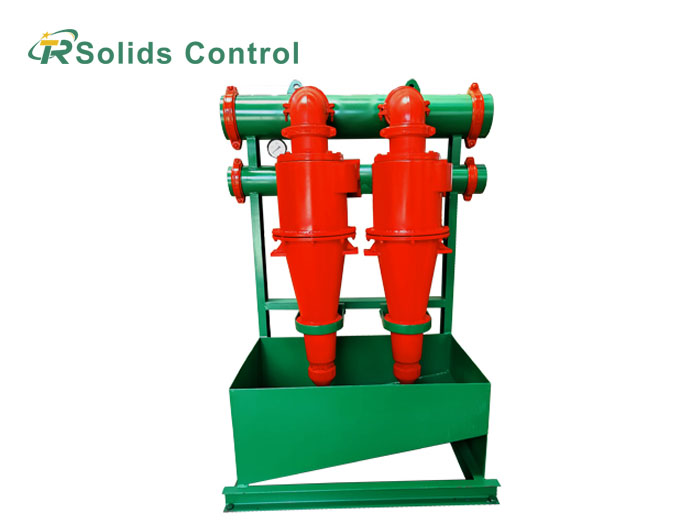
Match your maximum circulation rate to the table. Each rating is the total capacity of the cone configuration listed, not the capacity of one cone.
| Maximum Circulation Rate | Cone Configuration | TR Model | Rated Capacity |
| Up to 264 GPM | 1 × 8 in | TRCS200-1S | 60 m³/h (264 GPM) |
| 264–528 GPM | 2 × 8 in | TRCS200-2S | 120 m³/h (528 GPM) |
| 528–616 GPM | 1 × 12 in | TRCS300-1S | 140 m³/h (616 GPM) |
| 616–1,057 GPM | 2 × 10 in | TRCS250-2S | 240 m³/h (1,057 GPM) |
| 1,057–1,233 GPM | 2 × 12 in | TRCS300-2S | 280 m³/h (1,233 GPM) |
| Above 1,233 GPM | 3 or more cones | Built to order | On request |
The flow through a hydrocyclone depends on the pressure available at the manifold and the properties of the drilling fluid. If the feed pressure is below the rated range, do not assume the published capacity will be maintained.
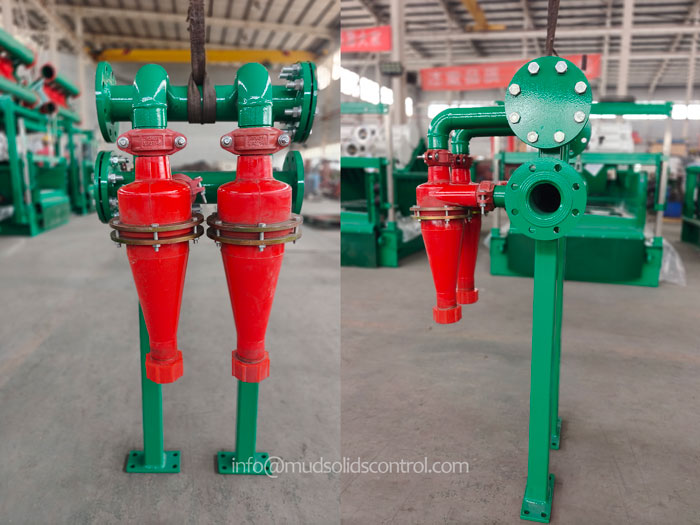
Hydrocyclone diameter is one of the main factors determining how much flow a single cone can handle. The 8-inch cone is rated at 60 m³/h and the 12-inch cone at 140 m³/h. Where your rate lands near a boundary, take the larger configuration. A rig circulating 510 GPM sits near the top of the two-cone 8-inch range, and the next size up leaves room for the days when circulation runs harder than planned.
A triplex pump with 6-inch liners might circulate 400 GPM for most of the day and reach 700 GPM during hole cleaning or bottoms-up. A desander chosen around 400 GPM becomes the restriction exactly when flow and solids load peak. Size from the highest rate the unit is expected to receive.
Pump displacement is not the same figure. Theoretical output from liner size and stroke assumes 100% volumetric efficiency. Actual delivered flow is normally lower. If you have the pump model and liner size, read the maximum rate off the pump curve or from rig operating data rather than from the displacement calculation.
Desander capacity and redundancy are separate questions. The second one only comes up on jobs where drilling cannot stop for maintenance.
Two 10-inch cones rated at about 1,057 GPM between them cover a 900 GPM circulation rate. Isolate one for inspection and the remaining cone cannot hold that rate, so a two-cone skid sized exactly to the flow has no margin for maintenance. If full-rate operation has to continue while a cone is offline, state that in the enquiry from the start. You may need additional cones or a parallel unit.
Most desander enquiries can start with four pieces of information. Send the maximum actual circulation rate, the mud weight and expected solids loading, and the feed pressure available at the cone manifold. Say whether full-rate operation has to continue with one cone offline. Installation space decides the layout once the cone count is known.
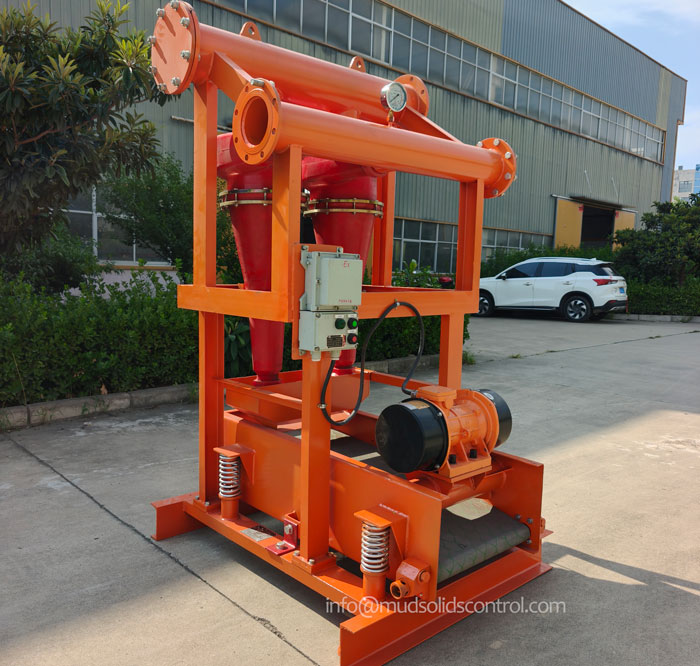
TR Solids Control builds the desander configurations listed above and confirms each selection against circulation rate, mud conditions and available feed pressure.

Address: No.2 Huochang Road, Yangling District,Xianyang City, Shaanxi Province, China
Tel: +86-18509252400
Wechat: 18509252400
Email: info@mudsolidscontrol.com
Contact: Mr.Li
 +86-18509252400