Contact Person: Mr.Li
Mobile: +86-18509252400
Wechat: 18509252400
Email: info@mudsolidscontrol.com
Address: No.2 Huochang Road, Yangling District,Xianyang City, Shaanxi Province, China
A shaker screen can blind while it is still new and undamaged. Fine solids lodge in the openings, sticky clay covers the mesh, or the deck is carrying more solids than it can pass.
Before you change anything, check three things: where it blinds, how quickly it happens, and what is blocking the openings.
A blinded screen loses open area. More fluid can stay on the deck or leave with the cuttings, while more solids-removal work is pushed downstream. That means more mud loss, more dilution demand, and a heavier load on the desander, desilter or centrifuge.
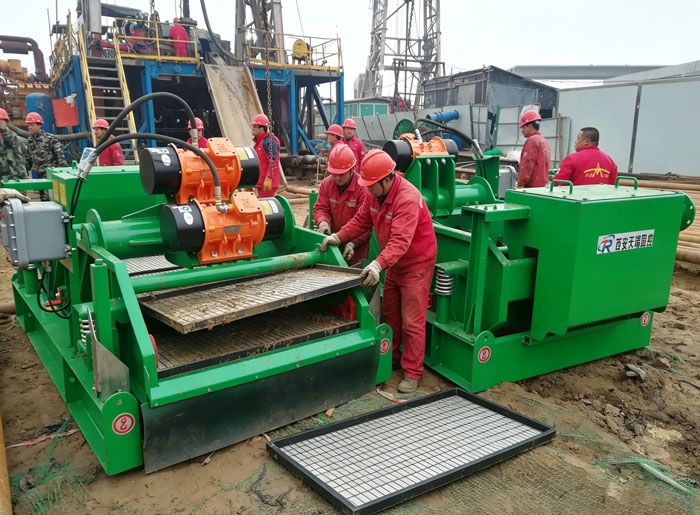
Shaker screen blinding is material blocking or covering the openings of a shale shaker screen. Two things do it.
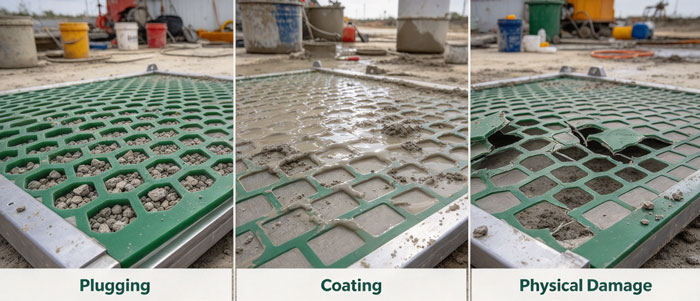
Plugging: particles lodge in the openings. Near-size solids are a common cause. They are too large to pass cleanly and small enough to wedge in and stay there.
Coating: reactive clay, gumbo and hydrated bentonite spread across the mesh and seal whole groups of openings at once.
Shut down and read the mesh. Plugging and coating look alike from the walkway and nothing alike up close.
Broken wires, tears and damaged sections are physical damage, not blinding.
A screen blinds when its opening is too fine for the solids arriving on the deck.
If a large share of the feed sits near the opening size, those particles wedge into the mesh and choke off fluid flow. The finer the opening, the less tolerance the panel has for that loading.
That is why a brand-new screen can plug within minutes. The panel may be working as specified, but its aperture does not match the feed solids.
If trouble began right after a screen change, compare the current API designation and the separation you need against the panel that was running before.
Even with a suitable screen specification, one particle size range can still keep packing the mesh.
Clean the panel and put it back on. If the openings clear and the same grit packs back into them, the feed is still carrying the problem size range. That is a feed problem, not a screen defect.
If the whole surface films over again instead, you are dealing with coating, not plugging.
If the shaker runs fine in one formation and starts blinding in the next, look at the cuttings.
Reactive clay takes on water, goes soft and sticky, and smears across the mesh. Gumbo does the same. Open area falls without the panel being damaged at all.
Changing screens rarely helps on its own here. The material has to be dealt with before it reaches the deck, which means clay inhibitors and hydration control in the mud system.
Do not change screens first. If the problem follows a clay-rich formation, review inhibition and hydration control in the mud system as well.
Flow rate alone does not tell you how hard the screen is working. The same shaker can handle 200 gpm very differently at a light solids load and a heavy solids load. The liquid flow is unchanged, but the amount of material sitting on the screen is not.
A higher penetration rate, more pump output, formation changes or poor solids removal upstream can all increase the load.
Check what changed before you change the specification.
A shaker can have enough total screen area and still overload one section.
Watch where the fluid and cuttings arrive. If most of the feed hits one area, that panel takes a much heavier load than the rest. It buries, and the downstream panels stay clean.
The panel is only half of it. The cuttings have to travel.
Material that sits on the mesh occupies open area and gets more chances to wedge in. Vibration intensity, motion type, deck angle and feed rate all set how fast solids move.
Watch the cuttings bed. If it is not moving toward discharge, check the shaker operation before blaming the panel.
Start with feed distribution and solids loading. Both come before the screen specification, and they are the first things to check.
Then work through three observations: when it started, where on the deck it sits, and what is in the mesh.
| What you see | Check first |
| Blinding starts within minutes of installing a new panel | Screen opening, near-size solids and feed loading |
| Blinding starts after entering a clay-rich formation | Cuttings, mud properties and sticky solids |
| Blinding gets worse as drilling or flow increases | Solids loading and available open area |
| The same panel blinds again soon after cleaning | Incoming solids, mud properties and screen specification |
Blinding in the first minutes points at the panel or the feed. Blinding that builds over a shift points at what you are drilling.
Across most or all panels: check the screen opening, solids loading, mud properties and solids transport.
Near the feed end: check local feed loading and how the material enters the deck.
On one side: look for uneven feed distribution or an operating condition affecting that section.
On downstream panels: watch how solids are moving and whether material is building up before discharge.
If only one area is loading up, stay focused on feed distribution before changing the screen.
Read the mesh rather than judging by how the shaker is behaving.
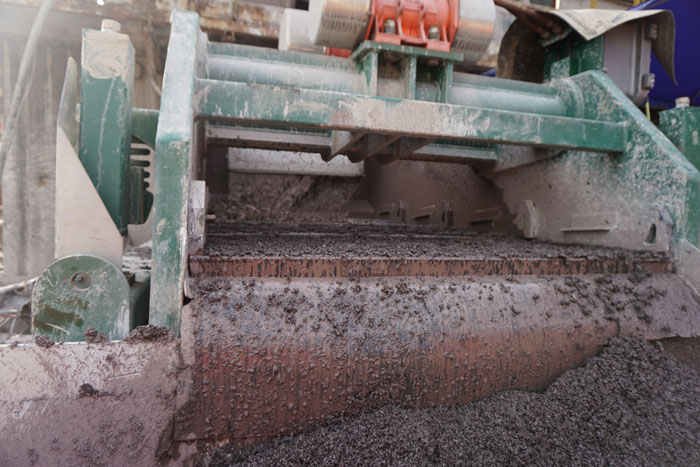
Hard particles packed into individual openings point toward near-size plugging.
Soft, sticky clay or gumbo spread over the mesh points toward formation and mud properties.
A thick layer of mixed solids points toward loading and solids transport.
Broken wires and tears mean physical damage, and no amount of cleaning will bring that panel back.
Clean the panel, put it back in service, and time how long the openings last.
If the openings stay open, the blockage may have been temporary. If they close again soon after the shaker starts, check the material coming onto the deck, the mud condition and the screen specification.
Cleaning restores open area. It does not remove the cause of the blinding.
Clean the screen without damaging the mesh or panel structure.
If one section is buried while its neighbours stay clean, the feed is not spread across the deck. Compare the loaded section with the rest before you order anything.
Replacing the whole set with the same specification blinds the same spot again.
Compare the conditions when the screen was running normally with the conditions when blinding started.
Check for changes in penetration rate, pump flow, formation, cuttings return or upstream solids removal.
If far more solids are reaching the shaker, the available area is being asked to carry more. Changing the specification without dealing with the loading moves the problem along rather than solving it.
Compare the current motion, deck angle and operating conditions with the settings used when the screen performed well.
Then watch the solids bed. Solids should move toward discharge instead of building up on the mesh.
The right setting depends on the shaker model, the fluid and the feed. Watch the bed and adjust from there.
If the feed is even, the loading is understood and the shaker is moving material properly, the specification is what remains.
Compare the API designation, opening size, usable open area, screen construction and fit with the shaker model.
Repeated blinding is a reason to review the screen specification, not simply to jump to a finer or coarser screen.
A different shale shaker screen may be appropriate when:
The current opening repeatedly plugs with near-size solids.
The available open area is too small for the solids load.
The required separation has changed.
The mud or formation has changed significantly.
The same blinding pattern returns after feed distribution and shaker operation have been checked.
For oilfield applications, API RP 13C provides a standard basis for comparing separation performance. Use it together with the shaker you run, the fluid you are circulating and the solids coming over the shaker.
The screen must meet the required separation without losing too much usable open area. The finest available screen is not automatically the right choice.
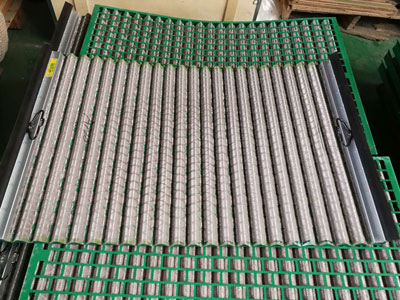
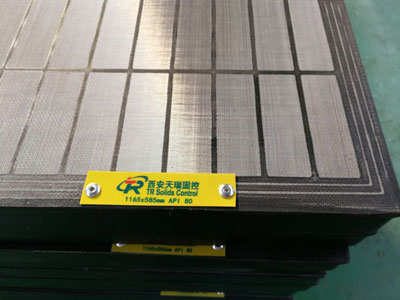
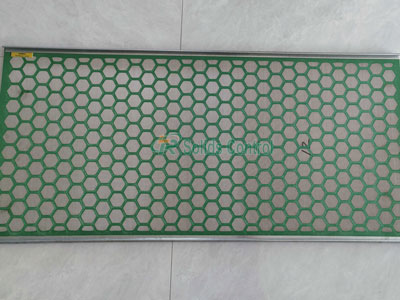
Replace the panel when it is torn, badly worn, structurally damaged, or no longer gives the separation you need.
Do not replace an intact blinded panel without checking the cause first. The replacement may develop the same problem.
Damaged means replace it. Intact and blinding again means keep looking for the cause.
If the cause is still unclear, do not send only the screen model and quantity. Send the field details that separate a screen problem from an operating problem.
Shaker make and model
Screen dimensions
Current API designation
Screen type
Drilling fluid type
Typical flow rate
Formation and cuttings characteristics
How quickly the screen blinds
Which part of the deck blinds
Photos of the blinded panel
A photo of one panel buried at the feed end tells a different story from a full deck under sticky clay. Where it blinds, how fast, and what it looks like usually say more than a mesh number on its own.
TR Solids Control manufactures shale shaker screens for oilfield solids control, with configurations for different shale shaker models and drilling conditions.
Send the list above with your enquiry. For recurring shaker screen blinding, that information tells us whether another panel is likely to help or whether the cause starts upstream. If the screen still needs to be replaced, give the manufacturer the field details before ordering a replacement shaker screen.

Address: No.2 Huochang Road, Yangling District,Xianyang City, Shaanxi Province, China
Tel: +86-18509252400
Wechat: 18509252400
Email: info@mudsolidscontrol.com
Contact: Mr.Li
 +86-18509252400