Contact Person: Mr.Li
Mobile: +86-18509252400
Wechat: 18509252400
Email: info@mudsolidscontrol.com
Address: No.2 Huochang Road, Yangling District,Xianyang City, Shaanxi Province, China
Gas can enter drilling mud while drilling through gas-bearing formations. Once mixed into the fluid, it can lower apparent mud density and change rheological properties. If the gas remains in the circulating system, density readings can become less representative of the liquid phase.
An oilfield vacuum degasser removes gas from the mud under reduced pressure. By taking gas out before the fluid returns to the active circulation system, the degasser brings the mud density closer to its target range and keeps its properties more consistent during circulation.
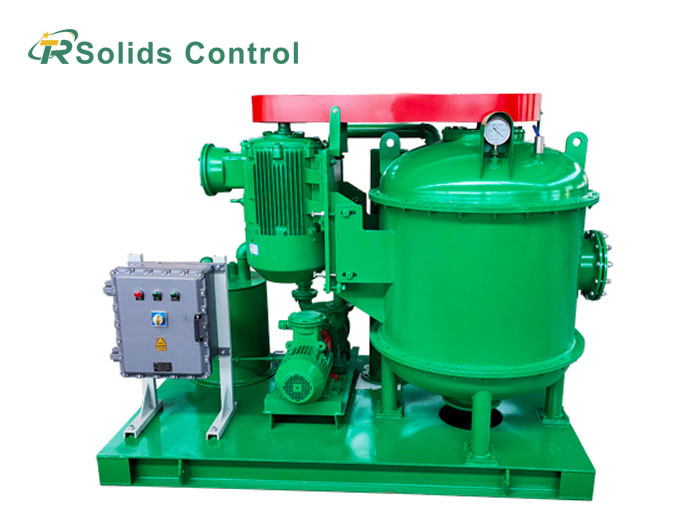
The TRZCQ series is designed for gas removal from oil drilling mud. It is commonly installed after the shale shaker, where larger drilled solids have already been removed.
A typical solids-control arrangement is:
Shale shaker → Vacuum degasser → Desander → Desilter → Centrifuge
The exact layout depends on the rig and mud system, but the degasser is generally placed between the shaker and downstream solids-control equipment.
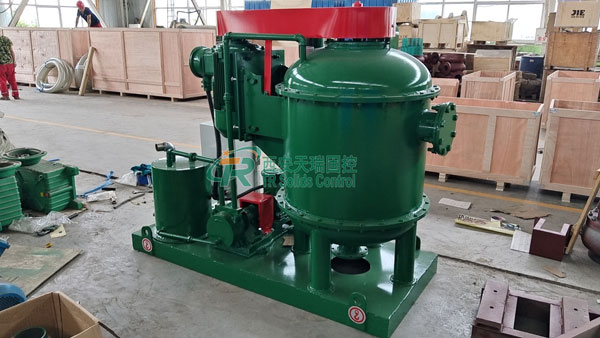
The TRZCQ series uses a vacuum pump to maintain -0.03 to -0.045 MPa (gauge) inside the vacuum tank. Drilling fluid enters the tank and is exposed to the reduced pressure.
A high-speed rotor spreads the incoming mud across the inside wall of the tank, forming a thin liquid layer. This gives the gas in the mud a path to escape.
The released gas is drawn through the gas-liquid separator by the vacuum pump and discharged through the exhaust line. Meanwhile, the degassed mud collects in the lower part of the tank and is discharged by the impeller back into the circulation system.
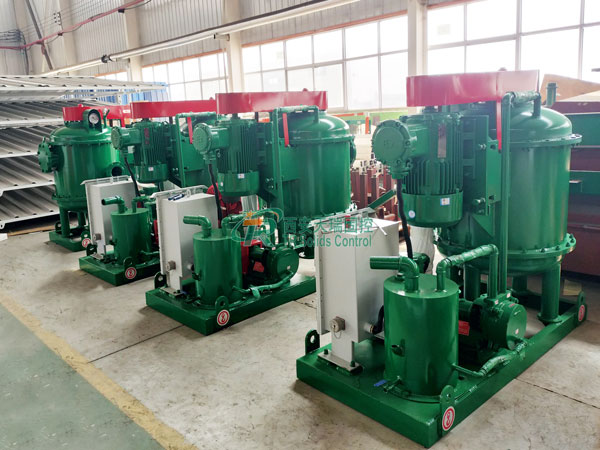
Gas takes up part of the fluid volume and can lower the apparent density of the mud. As gas content increases, the measured density can differ further from the density of the liquid phase.
Mud density is directly related to the pressure exerted by the fluid column. Removing gas brings the mud closer to its target density range and makes density monitoring more reliable.
The effect on rheology also needs to be considered. Gas in the circulating fluid changes how the mud behaves during circulation, while removing that gas returns the fluid closer to its intended condition.
A vacuum degasser also has a specific role within the solids-control process. The shale shaker removes larger drilled solids, followed by desanders, desilters, and centrifuges for progressively finer separation. The degasser handles a different part of the problem: removing gas from the mud.
The TRZCQ series provides a degassing efficiency of more than 95%, removing more than 95% of the free gas and part of the dissolved gas from gas-cut drilling mud.
Actual performance depends on gas loading, mud condition, operating pressure, temperature, and other operating factors.
The TRZCQ range is available in configurations for mud flow rates of 240 to 360 m³/h, depending on the model. Capacity should be matched to the actual circulation rate and expected gas loading. An undersized unit can restrict the mud treatment line, while excessive capacity can increase equipment cost and power demand.
Gas contamination becomes a concern when drilling through hydrocarbon-bearing formations. Methane, carbon dioxide, and other formation gases can enter the circulating mud and alter its apparent density and rheological behavior.
The vacuum degasser removes this gas before the mud returns to the active circulation system. This keeps the fluid closer to the density and rheological range specified for the drilling operation.
For drilling systems handling significant gas influx, the degasser works alongside other well-control and solids-control equipment rather than replacing them.
HDD and Other Closed-Loop Drilling Systems
Vacuum degassing can also be used in HDD drilling fluid systems when gas enters the circulating fluid.
In these applications, the degasser can be installed in the same treatment line as shale shakers, desanders, desilters, or centrifuges. Whether it is needed depends on ground conditions, fluid composition, and gas loading.
Explosion-Proof Configuration for Oilfield Use
Oilfield installations may require electrical equipment suitable for hazardous areas where flammable or toxic gases are present.
The TRZCQ series can be supplied with explosion-proof electrical equipment. The motor is positioned away from the main rotating assembly and drives the unit through a belt transmission. A gas-liquid separator between the vacuum tank and vacuum pump helps prevent liquid from entering the pump.
Electrical components and the control configuration can be selected according to the hazardous-area classification and project requirements.
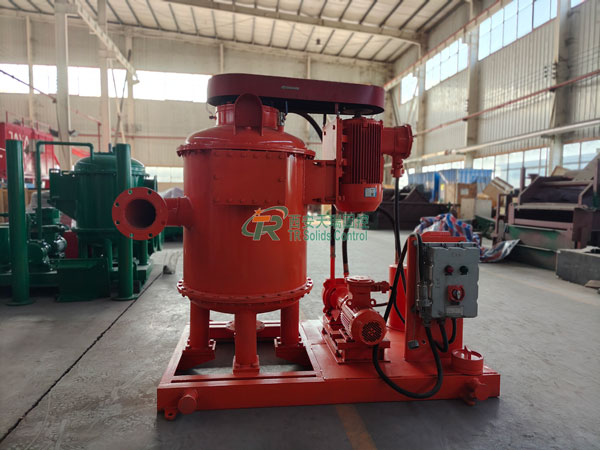
Vacuum degasser selection starts with mud flow rate and gas loading. These two factors provide the basis for determining the required treatment capacity.
Mud density, viscosity, solids concentration, temperature, and other fluid properties should also be considered because they affect degassing performance. The position of the unit within the solids-control layout and the electrical requirements of the installation also need to be checked.
Drilling depth alone does not determine the size of a vacuum degasser. Flow rate, gas loading, mud condition, and the overall treatment layout provide a more practical basis for selection.
A vacuum degasser and a mud gas separator (MGS) both deal with gas in drilling operations, but they are used for different purposes.
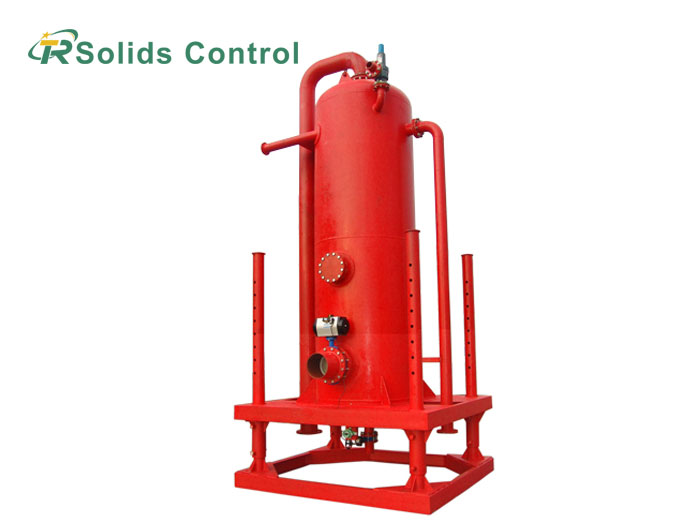
The MGS is part of the well-control system and is designed to handle large volumes of gas separated from drilling fluid, particularly when a kick brings gas to the surface.
A vacuum degasser works continuously on circulating mud during normal treatment. It uses vacuum to remove gas that remains dispersed in the fluid after it enters the mud system.
A drilling rig may use both. The MGS addresses gas separation during well-control events, while the vacuum degasser deals with gas remaining in the circulating mud.
The TRZCQ series degasser is designed for continuous gas removal from drilling mud in solids-control systems. Its application is determined mainly by mud flow rate, gas loading, mud condition, and the existing treatment layout.
For model specifications or a customized configuration, TR Solids Control can evaluate the operating conditions and recommend a suitable TRZCQ unit.

Address: No.2 Huochang Road, Yangling District,Xianyang City, Shaanxi Province, China
Tel: +86-18509252400
Wechat: 18509252400
Email: info@mudsolidscontrol.com
Contact: Mr.Li
 +86-18509252400