Contact Person: Mr.Li
Mobile: +86-18509252400
Wechat: 18509252400
Email: info@mudsolidscontrol.com
Address: No.2 Huochang Road, Yangling District,Xianyang City, Shaanxi Province, China
During oil and gas drilling operations, maintaining stable drilling fluid performance is essential for safe and efficient drilling. As drilling progresses, drilled solids and fine particles from the formation gradually accumulate in the mud system. If these solids are not effectively removed, they can affect drilling fluid density, viscosity, circulation performance, and equipment service life.
Centrifuges are commonly used in drilling solids control systems to remove fine solids that cannot be separated by conventional equipment such as shale shakers, desanders, and desilters. With high-speed centrifugal separation technology, centrifuges separate solid particles, typically ranging from 2-74 μm, from drilling fluids and help maintain stable mud properties throughout the drilling process.
TR Solids Control centrifuges are designed for drilling fluid treatment applications, providing reliable solid-liquid separation for oilfield drilling, trenchless construction, and other solids control operations.
.jpg "Drilling centrifuge - solids control system equipment")
In a drilling solids control system, each piece of equipment performs a different separation function. Shale shakers remove larger drilled cuttings, while desanders and desilters handle medium-sized particles. However, fine solids can remain in the drilling fluid and gradually affect mud performance.
Centrifuges use centrifugal force generated by high-speed rotation to separate these fine solids from the liquid phase. This process helps maintain cleaner drilling fluid, control mud properties, and reduce problems caused by excessive solids concentration.
By removing fine particles such as drilled cuttings, sand, and other suspended solids, centrifuges help maintain proper drilling fluid density and viscosity. Stable mud properties are important for drilling speed, wellbore stability, and cementing performance.
The drilling centrifuge separates solids from drilling fluid through centrifugal force. When mud enters the rotating bowl, the heavier solid particles move toward the bowl wall under high centrifugal force, while the liquid phase remains closer to the center.
The separated solids are discharged from the centrifuge, and the recovered drilling fluid returns to the circulation system.
This process allows centrifuges to remove fine solids that are difficult to capture with conventional solids control equipment. In drilling operations with high solid loading, deep wells, and complex formations, effective fine solids separation helps maintain stable drilling fluid performance.
Excessive solids in drilling fluid can increase viscosity, reduce hydraulic efficiency, and accelerate wear on drilling equipment such as drill bits, drill pipes, and mud pumps.
By continuously removing unwanted fine solids, centrifuges reduce solid buildup in the mud system, helping protect drilling tools and extend equipment service life.
Centrifuges also help reduce drilling costs by recovering reusable drilling fluid components and reducing mud consumption. At the same time, lower drilling waste volume means less material requires further treatment and disposal.
The separation performance of a drilling centrifuge depends on several factors, including rotational speed, separation factor, differential speed, bowl design, and drilling fluid properties.
High separation accuracy
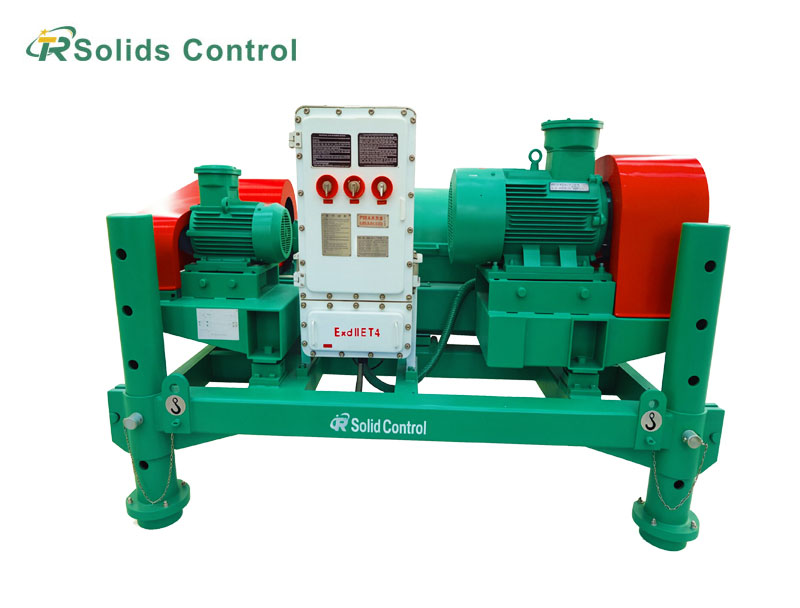
The TRLW450×1000N Decanter Centrifuge has an inner drum diameter of 450mm and a length of 1000mm. It generates a separation factor of 1210 times through high-speed rotation at 2200r/min, and has a single-unit processing capacity of 50m³/h. The centrifuge can remove harmful fine solids of approximately 2-5 μm from drilling fluids, making it suitable for applications such as deep wells and shale gas drilling.
TR variable frequency mud centrifuges are available in models including TRGLW355N-1V and TRGLW450N-2V. With adjustable speeds from 0-3200 rpm, separation factors ranging from 2578 to 2711, and separation points covering 2-5 μm, these centrifuges can handle drilling fluids with different densities and viscosities.
Intelligent control system
TR centrifuges use PLC control systems and explosion-proof touch screens to monitor operating conditions, including drum speed, bearing temperature, and equipment vibration.
The system allows stepless adjustment of rotational speed and differential speed, enabling operators to adjust centrifuge performance according to different drilling conditions, including shale gas wells and high-pressure, high-temperature (HPHT) wells.
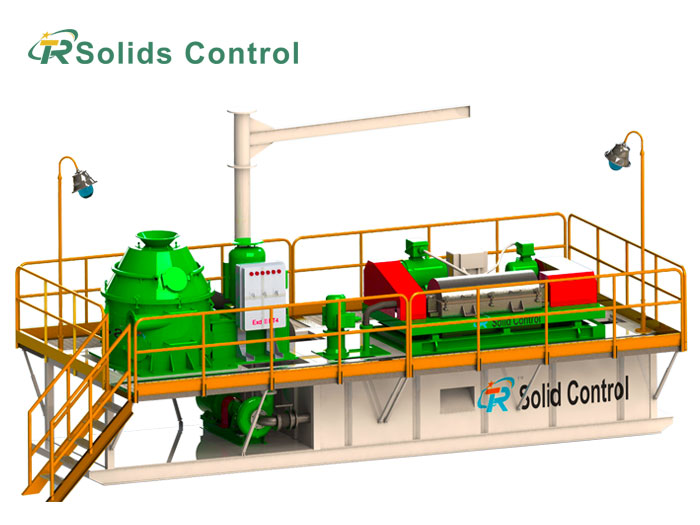
For example, during shale gas extraction in Xinjiang, centrifuges were combined with vibrating screens and desanders to achieve a drilling fluid recovery rate of more than 90%, reducing mud costs by approximately 20% per well.
Energy saving design
The equipment is also equipped with a 30 kW high-efficiency motor and lightweight structural design to reduce energy consumption compared with traditional equipment. Combined with barite recovery capability, it helps reduce drilling fluid costs during oilfield operations.
.jpg "Centrifuge Model 450 - Drilling Fluid Centrifuge|Mud Decanter Centrifuge|oilfield centrifuge - TR Solids Control")
Oil and Gas Drilling
In oilfield drilling operations, centrifuges are commonly used as a fine solids separation stage in the solids control system. They remove colloidal particles, barite particles, and other fine solids from drilling fluids while helping control mud density and viscosity.
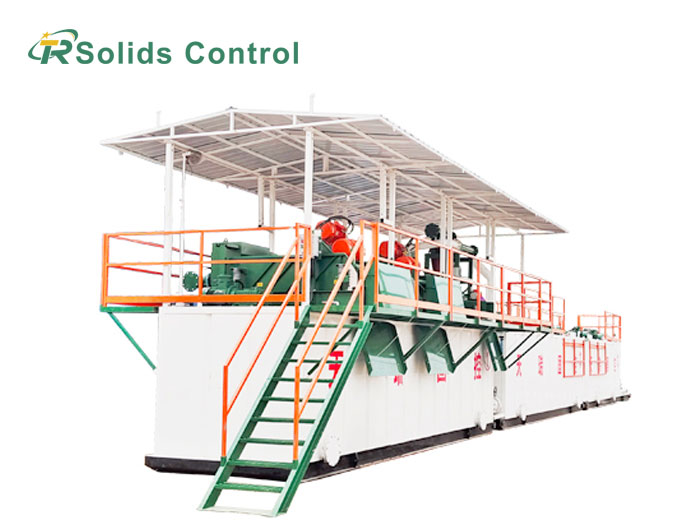
For example, in the solids control system of ZJ50 drilling rig, high-speed centrifuges process non-weighted drilling mud and separate 2-5 μm particles. Medium-speed centrifuges are used to recover barite and improve drilling fluid reuse.
HDD and Tunnel Construction
In horizontal directional drilling (HDD) and tunnel boring machine (TBM) construction, proper slurry treatment is important for maintaining stable mud circulation.
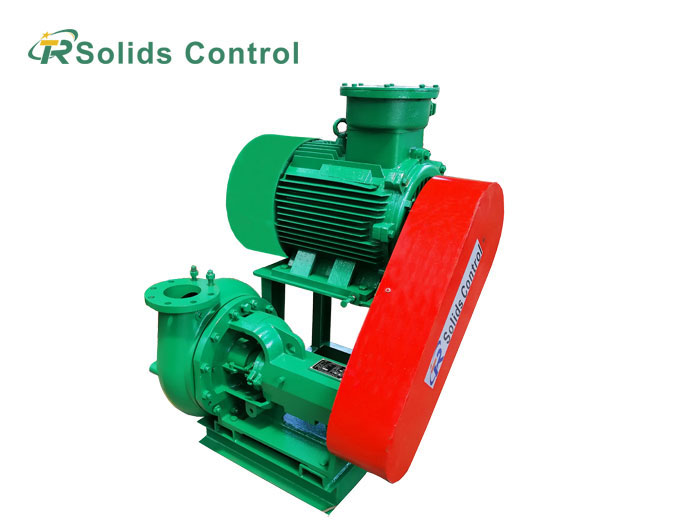
The combination of shear pumps and centrifuges can reduce slurry solids content from 30% to below 5%, helping prevent slurry pipeline blockage and improving construction efficiency.
Environmental protection and cost optimization
Efficient solid-liquid separation helps reduce drilling waste and increase drilling fluid recovery.
For example, TR Solids Control integrated solids control systems can increase mud recovery rates from 65% to 92%, reduce waste treatment costs by 55%, and shorten drilling cycles.
After adopting TR Solids Control centrifuges, companies including CNPC and CNOOC have achieved better drilling fluid performance, fewer equipment failures, and lower maintenance requirements.
During a shale gas horizontal well project, the TRSB series pumps operated continuously for 2000 hours without failure, extending service life by 50%.
TR Solids Control has obtained API certification, and its solids control equipment has been supplied to more than 60 countries and regions, serving applications including oil and gas drilling, trenchless engineering, and foundation construction.

Address: No.2 Huochang Road, Yangling District,Xianyang City, Shaanxi Province, China
Tel: +86-18509252400
Wechat: 18509252400
Email: info@mudsolidscontrol.com
Contact: Mr.Li
 +86-18509252400