Contact Person: Mr.Li
Mobile: +86-18509252400
Wechat: 18509252400
Email: info@mudsolidscontrol.com
Address: No.2 Huochang Road, Yangling District,Xianyang City, Shaanxi Province, China
A sack of bentonite tipped into a pit does not make drilling fluid. It makes lumps: dry cores wrapped in a slick skin that will not let water in, in a suspension that holds neither weight nor viscosity until something opens those lumps up.
Water hydrates clay, and no pump takes its place. What drilling fluid shear pumps change is how fast water reaches each particle, and how evenly the clay ends up distributed while that happens. Get those two things right and the same tonne of clay does more work.
That distinction matters on rigs where bentonite is mixed directly into the active system. The difference is not simply between more pumping and less pumping. It is between moving mud around the pit and applying concentrated mechanical action to break down clay agglomerates.
Bentonite is a clay whose swelling behaviour comes mainly from montmorillonite. Drilling-grade bentonite is commonly supplied in a sodium form because sodium ions readily hydrate between the clay layers.
When dry bentonite meets water, the outer surface hydrates first. Water enters the interlayer spaces, and the clay sheets begin to separate. As the particles disperse, more clay surface becomes exposed to water.
The trouble starts when dry bentonite forms a compact agglomerate. The outside becomes hydrated and slippery while the inside remains dry. These partially hydrated lumps are often called fish eyes, and the gel-like outer layer makes it harder for water to reach the material inside.
API 13A bentonite testing illustrates the same basic principle. Controlled mixing and hydration give the clay more uniform contact with water before the sample is tested. A rig does not have laboratory conditions, but the practical lesson is straightforward: breaking down agglomerates early gives water access to more of the clay.
Paddle and propeller agitators keep solids suspended and maintains circulation in the tank. It is important for preventing settled material and maintaining general mixing.
But an agitator does not normally provide the same concentrated mechanical action needed to break stubborn bentonite agglomerates. Away from the impeller, velocity gradients become much lower, so a lump can remain in the tank while its outside layer hydrates and its core stays relatively dry.
That can create a misleading mud-property problem. The crew sees low viscosity or poor yield and adds more bentonite, even though some of the original clay is still underhydrated.
| Equipment | Main job | Effect on bentonite |
| Pit agitator | Keeps mud moving and solids suspended | Provides general mixing but limited localized shear |
| Transfer pump | Moves mud between tanks or process equipment | Circulates fluid without being primarily intended to disperse clay |
| Drilling fluid shear pump | Applies concentrated mechanical action to clay-water mixtures | Breaks down agglomerates and speeds dispersion |
The difference is not that agitators or transfer pumps have no effect on clay. They do. A shear pump is simply built to generate much stronger local shear within the fluid path.
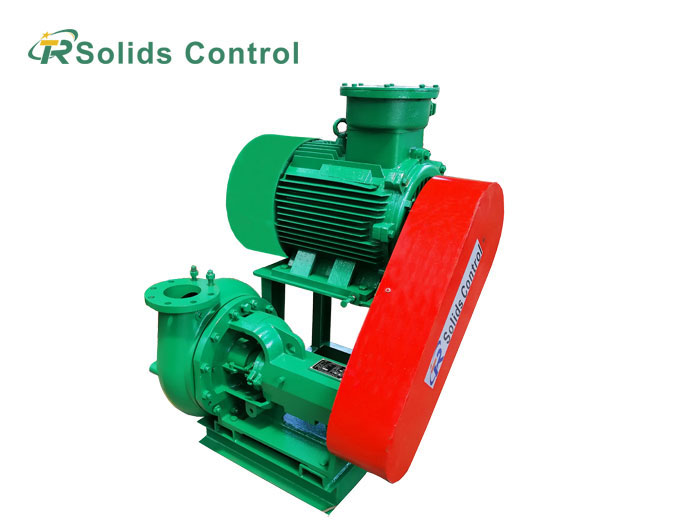
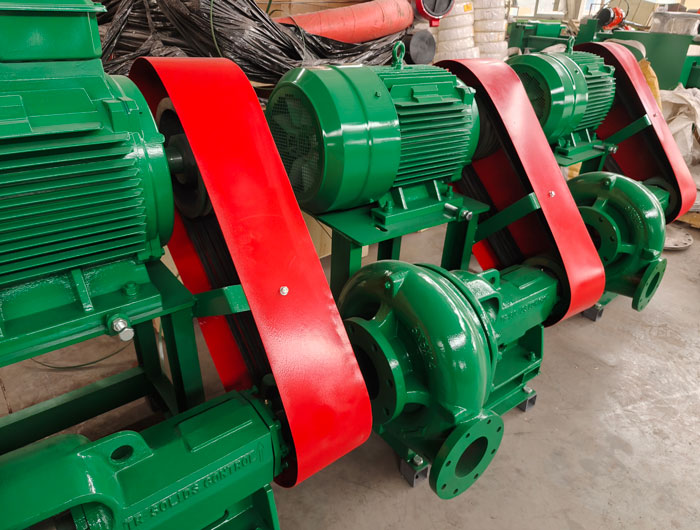
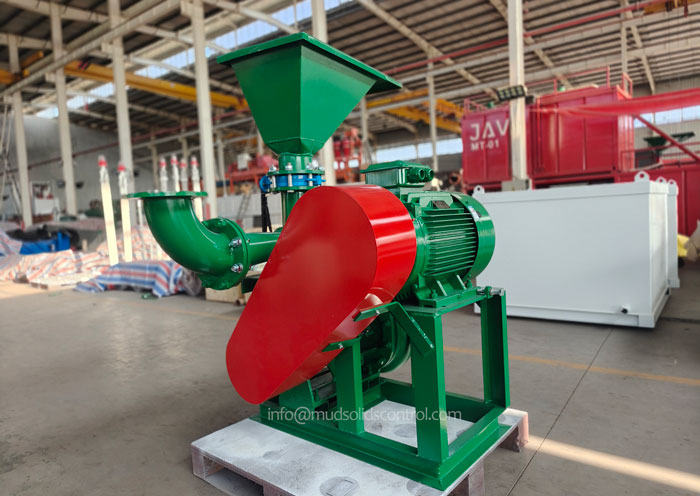
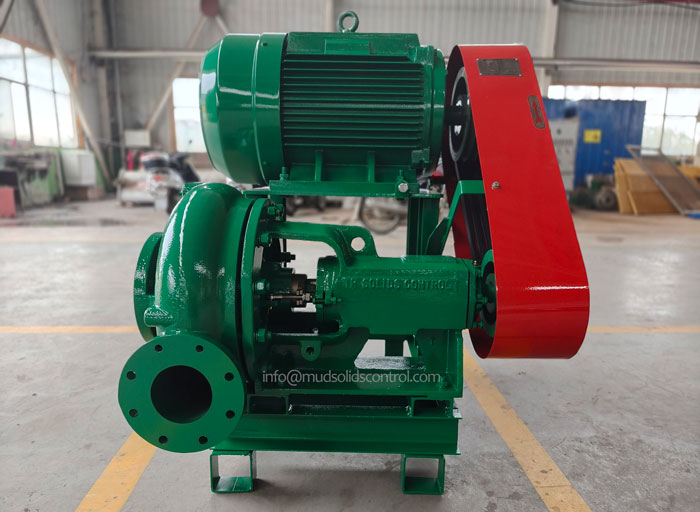
A drilling fluid shear pump is typically a centrifugal machine that uses high rotational speed and a closely controlled rotor-stator or impeller-liner clearance to create strong local shear.
As the mud passes through the narrow working zone, the high velocity gradient breaks down partially hydrated bentonite agglomerates. Fresh clay surfaces are exposed, allowing water to reach material that was previously trapped inside the lump. Continued circulation then gives the exposed clay more opportunity to hydrate and disperse.
The pump does not change the chemistry of bentonite. It changes how effectively the clay contacts water during mixing.
A shear pump works best as part of a controlled mixing circuit rather than as a standalone piece of equipment.
A typical arrangement is:
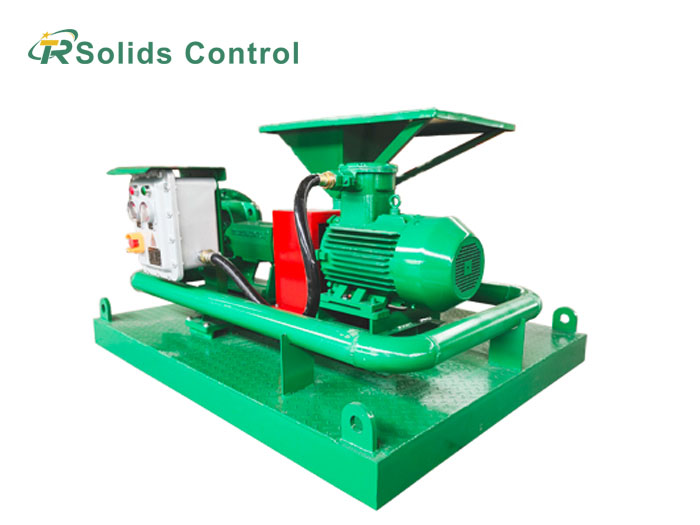
Charge Pump → Venturi Hopper → Shear Pump → Mixing Compartment
The Venturi hopper wets and draws in dry bentonite, while the shear pump provides the concentrated mechanical action needed to break down remaining agglomerates.
Several practical details affect the result:
Keep the shear pump suction flooded and avoid air entering the suction line.
Feed bentonite at a steady rate instead of dumping a large quantity into the hopper at once.
Maintain a stable flow through the shear pump.
Watch for persistent lumps or fish eyes during circulation.
Allow enough circulation time for the clay to continue hydrating after mechanical breakdown.
A Marsh funnel reading is useful for monitoring mud consistency, but it does not by itself confirm complete bentonite hydration.
Better bentonite dispersion does not automatically increase every mud property. The final result depends on bentonite quality, concentration, water chemistry, mixing time, temperature, and the rest of the mud formulation.
When bentonite is properly dispersed and hydrated, more of its available yield becomes usable in the drilling fluid. This can support the rheology needed to carry solids and maintain the desired mud properties.
Properly hydrated bentonite also contributes to a tighter, lower-permeability filter cake. In some formulations, better hydration means the desired mud properties can be reached with less unnecessary bentonite addition.
The important point is simple: a tonne of clay that is properly dispersed and hydrated can deliver more of its available yield than the same amount left partly hydrated.
Polymer systems are the clearest case. Xanthan, PAC and PHPA are chain molecules, and their viscosity comes from molecular size. Prolonged high shear cuts those chains, and the viscosity does not come back, so the crew adds more polymer, which raises cost and creates a solids problem from the other direction. Hydrate polymers gently in a separate compartment, then blend.
There are programs where high shear is used deliberately to disperse a polymer quickly. That is a legitimate choice when dispersion speed matters more than final molecular weight, but it should be a decision someone makes on purpose rather than a side effect of where the return line happens to point.
Lost circulation material and fibrous or flaky additives are the second case. They are designed to plug openings, and an impeller with a shear ring is a set of openings. Keep them on a low-shear transfer path, or accept a maintenance schedule built around cleaning out the pump.
Abrasive barite-laden mud is a cost rather than a mistake. A shear pump doing useful work on heavy mud wears faster, and you either buy the wear metal up front or buy it later in downtime and replacement.
Motor power alone does not tell you whether a shear pump will perform well for bentonite mixing.
Important factors include:
Rotor or impeller tip speed
Working clearance
Pump geometry
Number of shear stages
Circulation flow rate
Number of passes through the shear zone
Mud weight and viscosity
Piping losses
Required mixing time
As a starting point, a mixing system may be sized around 2–4 pit turnovers per hour when the goal is active circulation and bentonite mixing. For a 40 m³ mixing volume, that corresponds to roughly 80–160 m³/h of circulation flow.
That is only a starting estimate. Final pump selection should consider the pump curve, actual mud properties, piping arrangement, shear exposure, and how quickly the mud needs to reach the target properties.
The operating situation also matters. A site mixing dry bentonite directly into makeup water has a stronger reason to use a shear pump than a system that receives fully prehydrated or liquid mud.
Water temperature is another practical consideration. Low makeup-water temperature can slow bentonite hydration, while heating a large mixing pit is rarely practical. In such cases, effective mechanical dispersion becomes even more useful as part of the overall mixing process.
The gain from shearing is largest where pit volume is scarce or clay is expensive. Land rigs with a small pit farm and a single mixing compartment feel it most, and so does any program with one pit and one loop, from water wells to horizontal directional drilling. Coal bed methane builds mud in small batches and puts it downhole quickly, and where clay is trucked in, a tonne that under-performs has to be replaced at haulage cost.
A mix can sit most of a shift before a crew will put it downhole, and thinning the batch is the shortcut that follows. A shear pump sized to that pit, sitting on the hopper discharge, shortens the wait and gets more work out of the same tonnage. Nothing has been added to the clay; the pit just spends less of the shift waiting on it.
Bentonite is one of the cheaper parts of a mud program and one of the easier ones to waste. Drilling fluid shear pumps do not change what the clay is capable of. They change how much of it reaches the pit before the crew gives up and reaches for another sack. On a rig where an hour of makeup time lands in the cost per metre, that is what you are specifying for.

Address: No.2 Huochang Road, Yangling District,Xianyang City, Shaanxi Province, China
Tel: +86-18509252400
Wechat: 18509252400
Email: info@mudsolidscontrol.com
Contact: Mr.Li
 +86-18509252400