Contact Person: Mr.Li
Mobile: +86-18509252400
Wechat: 18509252400
Email: info@mudsolidscontrol.com
Address: No.2 Huochang Road, Yangling District,Xianyang City, Shaanxi Province, China
In a wastewater treatment plant's sludge dewatering room, a single screw pump (also known as a progressive cavity pump) was feeding a centrifuge. Its stator wore through after just three months. Replacing it means shutting down, pulling the pump apart, waiting for the spare part to arrive, then reinstalling and testing. A week gone, just like that. On a drilling site it's worse. The cuttings come out oily and sticky, the screw pump seizes up, and the rig is miles from anywhere. A replacement stator takes days to arrive, and the whole waste handling line goes down.
We build solids control equipment. We've spec'd both types of pumps. The sludge vacuum pump and progressive‑cavity pump operate best under very different conditions. Get that wrong, and you'll find out on site.
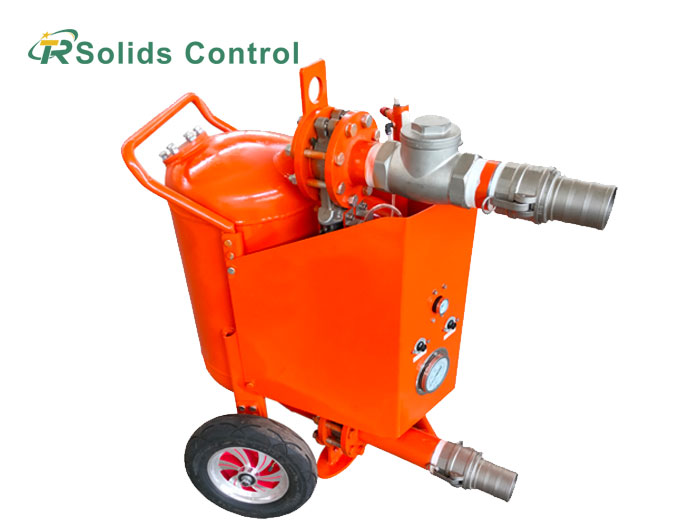
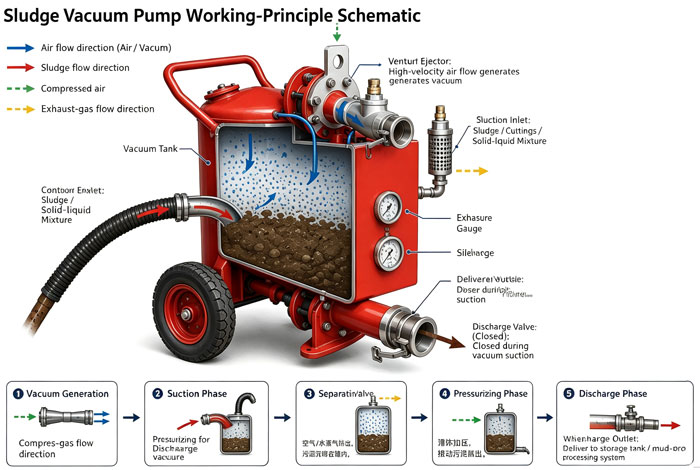
The sludge vacuum pump, also called a solids transfer pump or pneumatic vacuum pump, uses compressed air to create a vacuum. It pulls material into the pump chamber first, then switches to positive pressure to push it out. No impeller or screw ever touches the material, so solids, powders, liquids, and slurry all go through. Vacuum levels reach 25 inches of mercury (about 85 kPa), and conveying distance runs 500 to 1,000 meters.
You'll see it most often on drilling sites. Operators rely on it for cuttings transfer, oily sludge handling, tank cleaning, and long-distance waste transfer.
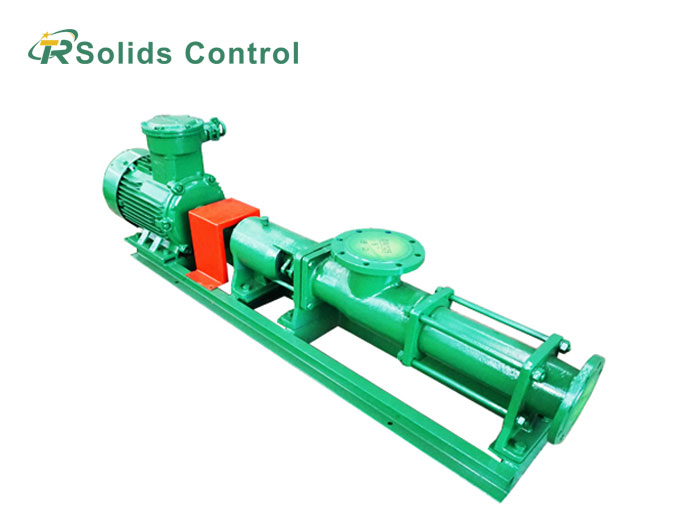
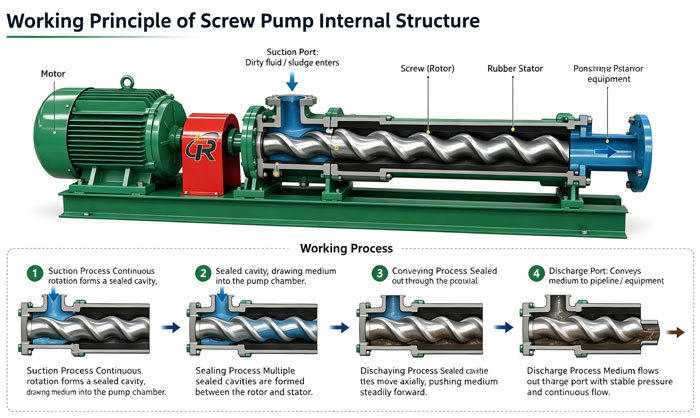
The screw pump is a positive displacement rotary pump. It moves fluid through the sealed cavities formed between the rotating screw (rotor) and the stator (liner). As the screw rotates, these cavities travel along the axis, pushing material from the inlet to the outlet.
For sludge transfer, the single screw pump is by far the most common. Twin screw and triple screw pumps are typically used with cleaner fluids such as lubricating oil and fuel.
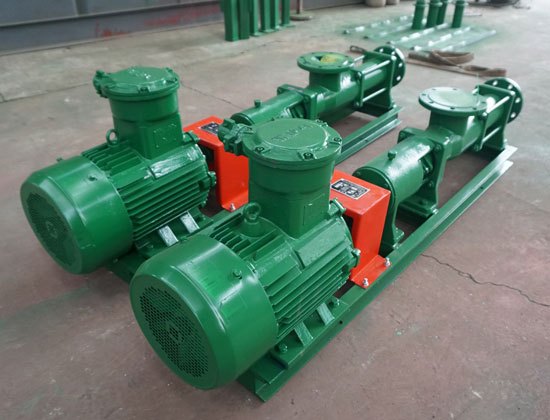
A single screw pump delivers steady flow, low pressure pulsation, and good self-priming capability. It handles high-viscosity media well. The stator is usually rubber or an elastomer, which wears quickly when the material contains hard particles. In oily sludge, the oil content can cause the rubber to swell and soften, cutting stator life even further. In solids control systems, the single screw pump is commonly used as the feed pump for a decanter centrifuge.
| Parameter | Sludge Vacuum Pump | Screw Pump |
| Solids tolerance | High: handles 60%+ solids content | Wear accelerates past 30% solids |
| Clogging risk | Low: no rotating parts contact the material | High: tight stator-rotor clearance traps debris |
| Wear parts | Essentially none | Stator is a wear item, replaced regularly |
| Flow stability | Pulsating, fluctuates | Continuous and smooth, works with VFD for metering |
| Drive | Compressed air | Electric motor |
| Maintenance | Minimal | Stator spares needed, scheduled replacement |
Once solids content goes above 30%, the rubber stator on a screw pump is subjected to more friction and wears noticeably faster. Above 40%, some sites replace the stator every two or three months. The spare part itself isn't expensive. But every change means two or three days of downtime, and on a remote rig, waiting for delivery adds even more. The sludge vacuum pump has no stator to wear out, so it can continue handling materials with 60% or even 80% solids. It just keeps pulling.
Drilling cuttings carry rock chips and fibrous material. Municipal sludge has plastic fragments, rags, hair. When these get into the stator-rotor clearance of a screw pump, you get anything from a blockage or pump shutdown to a torn stator.
On drilling rigs and remote projects, taking the pump apart for cleaning or repair can interrupt the entire waste handling process. These same materials go through a sludge vacuum pump without clogging. It just pulls them through.
If the process demands accurate metering, say dosing in a chemical treatment system, the single screw pump's continuous flow paired with a VFD gives you solid control. The vacuum pump's pulsating delivery isn't suited for that kind of precision.
The vacuum pump runs on compressed air. If the site doesn't have an existing air supply, you'll need a dedicated compressor. Factor both the compressor cost and energy consumption into the project upfront.
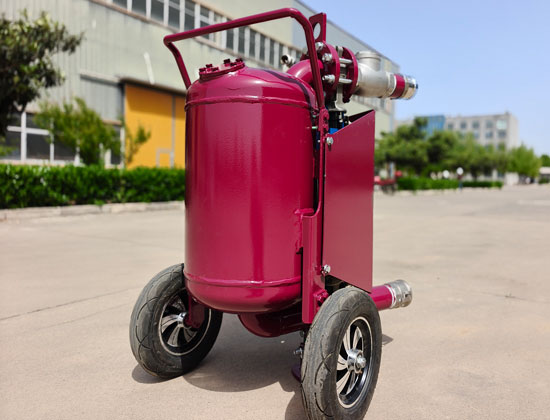
A drilling site is laid out differently from a wastewater treatment plant. When choosing a drilling sludge transfer pump, conveying distance quickly becomes a limiting factor. Solids control equipment is usually grouped around the mud tanks. The separated cuttings and waste mud need to be moved tens or even hundreds of meters to the waste handling or solidification area. A progressive cavity pump can't cover that distance on its own. You'd need to use multiple pumps in series or put a transfer tank in between. A pneumatic vacuum pump covers hundreds of meters in one go, pulling directly from under the shale shaker or the centrifuge discharge to the waste area without an intermediate transfer.
There's another constraint on a drilling rig. Many areas are classified hazardous zones where electrical equipment needs explosion-proof certification, and a pneumatic vacuum pump has no motor on the pump body. Run a compressed air line to it, and it's ready. That's simpler than wiring and certifying an electric pump for a classified area. The compressor cost and energy use we mentioned earlier are part of that calculation.
Once waste mud has been conditioned and diluted until it flows more like a liquid, a single screw pump is the standard feed pump for a decanter centrifuge. If you can, test the solids content and viscosity first. With that data in hand, the selection gets a lot clearer.
When we design a solids control system, the sludge pumps in the system are usually split into two roles: pneumatic vacuum pump for cuttings transfer and tank cleaning, and a screw pump for the centrifuge feed.
What material are you handling, and what's the solids content roughly at? That number drives stator wear, and that's what tips the selection. If you have questions about a sludge vacuum pump or a screw pump for your solids control setup, send us your operating data. We'll be happy to help you choose the right setup.

Address: No.2 Huochang Road, Yangling District,Xianyang City, Shaanxi Province, China
Tel: +86-18509252400
Wechat: 18509252400
Email: info@mudsolidscontrol.com
Contact: Mr.Li
 +86-18509252400