Contact Person: Mr.Li
Mobile: +86-18509252400
Wechat: 18509252400
Email: info@mudsolidscontrol.com
Address: No.2 Huochang Road, Yangling District,Xianyang City, Shaanxi Province, China
In deep and ultra-deep well drilling, solids control in drilling fluid is critical for safety and efficiency. As the first-stage solids control equipment, the shale shaker determines the performance of downstream equipment and the overall quality of the drilling fluid. Based on a real 3,000m deep well project for an oilfield, TR Solids Control presents this detailed case study of the TRZS series shale shaker.
The shale shaker is the primary treatment unit in drilling solids control system. It separates large cuttings from drilling mud so the cleaned mud can be recirculated. When mud carrying rock cuttings returns from the bottom hole, it first flows to the shaker. Through high-frequency vibration, the shaker screens separate coarse solids from the liquid, allowing clean mud to re-enter the circulation while cuttings are discharged.
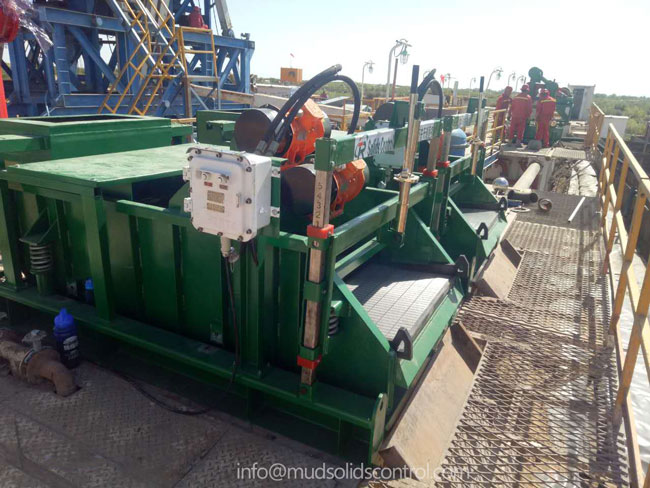
For this mud purification system project, supporting facilities including the blue drilling derrick, yellow safety ladders, anti-slip steel grating walkways, and yellow safety guardrails were configured to meet the customer's drilling platform layout requirements. Below are the details of the system solution.
The project adopted dual-motor, high-frequency linear motion shale shaker supplied by TR Solids Control. This type, with its high G-force excitation and large processing capacity, was ideal for the 3,000m straight well. Compared to conventional circular motion shakers, the linear motion trajectory helps cuttings move faster across the screen deck, reducing blinding and delivering greater stability under high-viscosity, high-flow-rate drilling fluid conditions.
TR Solids Control's shale shaker features modular design, allowing flexible adjustment of shaker screens specifications according to drilling progress. It enables quick switching from coarse to fine screens to meet cuttings separation requirements for different well sections. The entire equipment complies with API and ISO explosion-proof standards, making it suitable for the harsh operating environment of oilfield sites.
Green explosion-proof steel structure, meeting oilfield safety codes
Dual vibration motors providing high-frequency excitation force
Composite frame shaker screens for longer service life
Explosion-proof electrical control box for start/stop and parameter adjustment
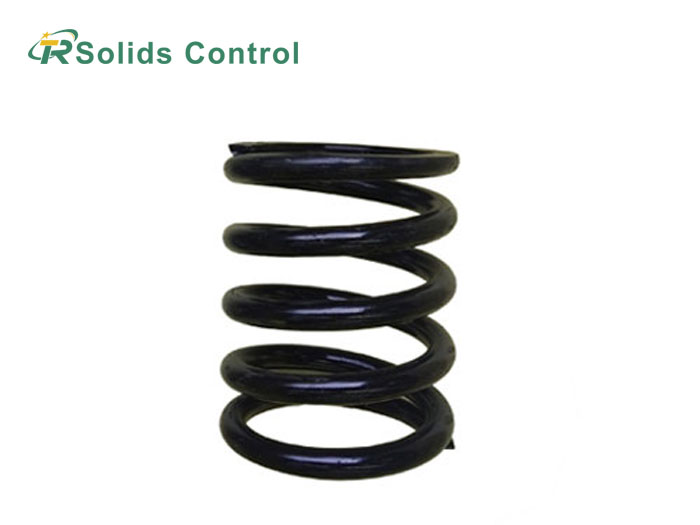
Spring damping system to reduce impact on the platform and extend equipment life
Adjustable screen deck angle via support columns, adapting to different drilling conditions
Matching mud feed piping to direct drilling fluid to the shaker
Based on the project's drilling flow rate (30L/s), mud density (1.2-1.4g/cm³), cuttings particle size, and other working conditions, the core parameters of the shale shaker were finely adjusted on-site as follows:
Excitation Force & G-Force: The excitation force of the dual vibration motors was adjusted to 7.5G, ensuring sufficient screening power while avoiding shortened shaker screens life and drilling fluid splashing caused by excessive G-force.
Screen deck angle: Adjustable from -1° to +3°. During spudding (large cuttings), set to +2° for faster solids discharge; in later sections (fine cuttings), reduced to 0°–+1° for higher separation accuracy.
Shaker screens selection: Composite screens with mesh sizes varied by well section – 60 mesh for the first spud, 80–100 mesh for the second, and 120 mesh for the third section, balancing throughput and cleaning efficiency.
Feed uniformity: A buffer feed trough controlled the feed rate, preventing local overloading and ensuring even load distribution across the screen surface.
During long-term operation of the shale shaker, the field team summarized several critical precautions:
Daily Shaker Screens Inspection: Check screen tension and damage. Replace torn shaker screens immediately to prevent untreated mud from bypassing into downstream systems.
Vibration motor maintenance: Regularly monitor motor temperature and lubrication. Add grease as scheduled to avoid overheating.
Adaptation to changing conditions: When mud viscosity or flow rate changes, adjust deck angle and excitation force promptly to avoid mud loss or screen blinding.
Safety procedures: Keep personnel away from vibrating parts during operation. Lock out and tag out before any maintenance, following oilfield safety rules.
Scheduled maintenance: Weekly checks of spring dampers and frame bolts. Full overhaul every quarter to extend equipment life.
With this advanced shale shaker solution, the project achieved >20% improvement in solids control efficiency and 15% longer shaker screens service life, significantly reducing drilling costs. The reliable field performance of TR Solids Control's shale shaker ensured smooth project execution, fully validating the feasibility and superiority of this solution.
TR Solids Control's shale shakers, featuring high G-force, large processing capacity, explosion-proof certification, and API/ISO compliance, are suitable for major domestic oilfields such as CNPC and Sinopec, as well as overseas drilling projects, serving as indispensable core equipment for oil and gas exploration and development.

Address: No.2 Huochang Road, Yangling District,Xianyang City, Shaanxi Province, China
Tel: +86-18509252400
Wechat: 18509252400
Email: info@mudsolidscontrol.com
Contact: Mr.Li
 +86-18509252400