Contact Person: Mr.Li
Mobile: +86-18509252400
Wechat: 18509252400
Email: info@mudsolidscontrol.com
Address: No.2 Huochang Road, Yangling District,Xianyang City, Shaanxi Province, China
Urban geothermal drilling often has limited space, making conventional layouts with separate mud tanks difficult to install and relocate. This was one of the main challenges on a geothermal well project in downtown Xi'an.
The formation contained both coarse sand and fine solids. The drilling site was also subject to strict environmental controls. At the same time, the well had to keep drilling continuously. The drilling team needed to keep the drilling fluid clean without taking up too much space or creating extra work at the site.
Four issues were particularly important:
Limited working space. Separate mud tanks would have occupied more of the site and taken longer to install and relocate.
Coarse sand and fine solids in the formation. The shale shaker could remove larger drilled solids, but it could not remove finer solids. Continued solids buildup could affect mud properties and increase the risk of hole instability, sand settling and stuck pipe.
High drilling waste disposal costs. Because the project was located in an urban area, transporting soil and drilling waste off site was expensive. Reducing solid waste was an important project requirement.
Continuous drilling. Fluctuations in solids control performance could lead to unexpected downtime and affect drilling progress.
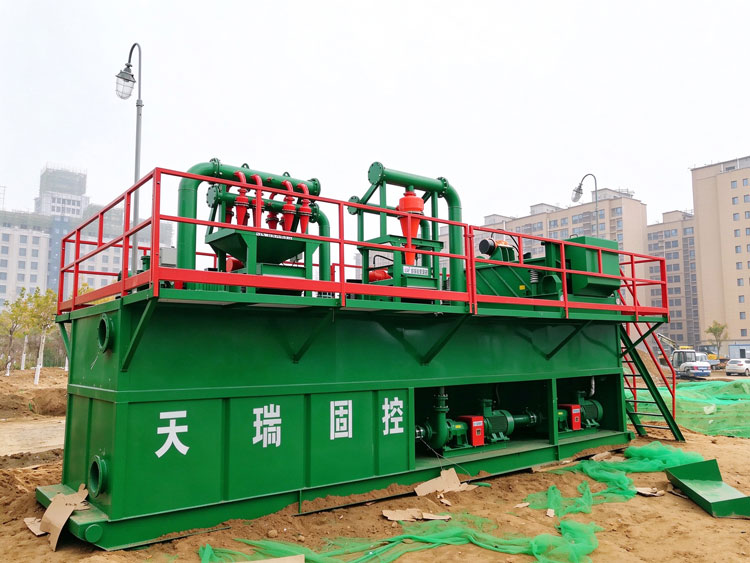
For this project, TR Solids Control supplied a factory-preassembled integrated skid-mounted solids control system for closed-loop drilling fluid circulation & solids removal. The system was configured around the site conditions and formation solids load.
Project location: Geothermal drilling project in downtown Xi'an
Project goal: Clean and reuse drilling fluid while reducing solids discharge
Basic operating conditions:
Designed circulation rate: 180 m³/h
Drilling depth: 2,600 m
Formation solids: Mainly fine sand and silt
Equipment configuration:
Integrated skid-mounted mud tank
Upper platform: Shale shaker, desander and desilter hydrocyclone assemblies, maintenance platform and safety guardrails
Lower tank compartment: Mud storage compartment and heavy-duty wear-resistant feed pump package
The main equipment and piping were preassembled at the TR factory before shipment.
After arrival, the skid was lifted into position. The remaining mud lines and power connections were then completed on site. This reduced the amount of installation work required in the urban drilling area.
Space was limited at the drilling site.
The integrated skid occupied only 28 m². Compared with a separate tank arrangement with similar treatment capacity, the footprint was reduced by nearly 50%.
The complete unit could be lifted into position in one operation. This avoided much of the welding and tank alignment work normally required for a separate tank layout.
After the well was completed, the skid could be moved as one unit and reused on other geothermal wells in the same area. This is useful for geothermal drilling programs with multiple wells.
The formation contained both fine sand and silt, so removing the coarse solids alone was not enough.
The shale shaker removed the larger drilled solids first. The desander then handled the coarser sand fraction. The desilter removed finer solids that would otherwise remain in the circulating drilling fluid.
The two hydrocyclone stages kept the solids content under better control. Less unwanted material continued through the pumps and other equipment.
Stable hydrocyclone separation requires steady feed pressure. Large pressure fluctuations can affect separation and lead to unstable discharge.
The project involved long periods of continuous geothermal drilling. TR therefore selected a heavy-duty wear-resistant sand pump to provide a steady feed to the hydrocyclone package.
The feed pumps were installed in the lower tank compartment, with the valves arranged together for easier isolation, flushing and maintenance.
The skid was lifted directly into position after arriving at the site. The platform, safety guardrails and main piping had already been assembled at the factory.
The remaining work mainly involved connecting the mud return lines and power supply. For an urban drilling project, this reduced the amount of welding, tank alignment and equipment assembly required around the rig.
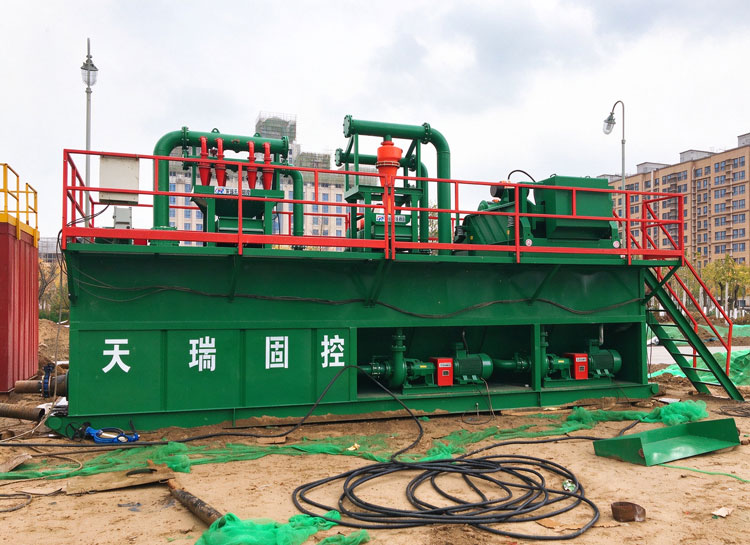
The skid includes an access ladder and safety guardrails around the maintenance area. The drilling crew can access the shaker and hydrocyclones for routine inspection during continuous drilling.
During commissioning, the main task was to set the hydrocyclone feed pressure and match the separation process to the actual solids load. The crew also checked the discharge condition to avoid unstable flow.
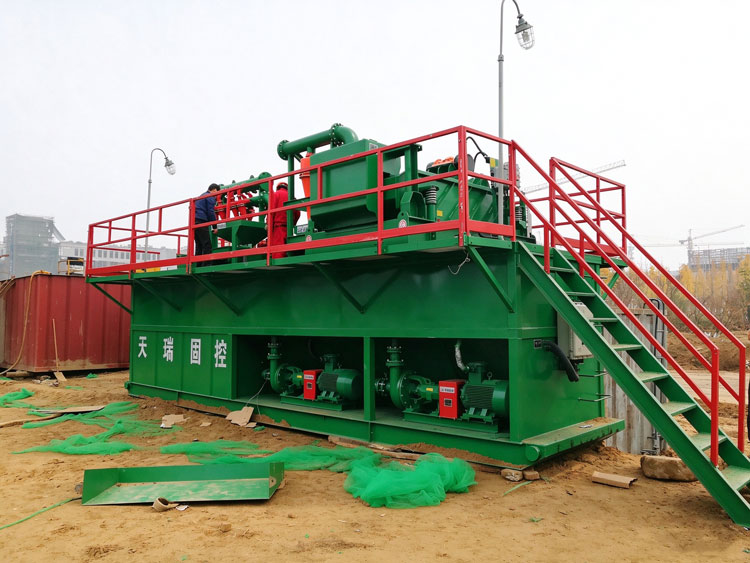
The feed pumps were concentrated in the lower tank compartment, with the valves arranged together for easier isolation and flushing.
Operating space was left around the piping so the crew could access the equipment for cleaning and maintenance. This arrangement was particularly useful for the high-sand formation encountered on the project.
The system was put into operation for the continuous drilling process. The project recorded several measurable results:
Bentonite and mud additives consumption decreased by about 32%. Mud density and rheological properties were easier to maintain during drilling.
Off-site drilling waste volume decreased by about 35%. Less waste had to be transported away from the urban site.
Screen replacement intervals increased from around 2–3 days to more than 5 days. This reduced screen replacement frequency and maintenance-related downtime.
Fine solids were better controlled, reducing wear on pump components, screens and downhole drilling tools.
The risk of sand settling in the wellbore was reduced, supporting continuous drilling.
The skid can be relocated and reused at other well sites. This is practical for geothermal drilling programs with multiple wells.
Suitable for: Urban geothermal wells, shallow geothermal drilling, hot spring wells, geothermal reinjection wells and similar drilling or slurry-handling projects where site space is limited and solids need to be removed before the fluid is reused.
Not recommended as a standard configuration for: High-pressure deep wells, very high mud weights or extremely large circulation rates. These applications require a customized modular solids control system with separate equipment packages.
If your geothermal drilling project has limited site space, high sand and fine-solid content, high waste transportation costs or difficulty maintaining drilling fluid properties, TR Solids Control can develop the solids control configuration around your actual drilling conditions.
Share your drilling parameters and site conditions with TR Solids Control. We can review the working conditions and recommend a suitable equipment configuration and layout for your project.

Address: No.2 Huochang Road, Yangling District,Xianyang City, Shaanxi Province, China
Tel: +86-18509252400
Wechat: 18509252400
Email: info@mudsolidscontrol.com
Contact: Mr.Li
 +86-18509252400