Contact Person: Mr.Li
Mobile: +86-18509252400
Wechat: 18509252400
Email: info@mudsolidscontrol.com
Address: No.2 Huochang Road, Yangling District,Xianyang City, Shaanxi Province, China
Much of Turkmenistan's onshore acreage lies deep in the desert. Sand blows year round, temperature swings hard between day and night, and plenty of multi-well pads have no mains power worth the name. Drilling waste management on a location like that starts with three questions. Where the power comes from, how fine sand is kept out of the electrics, and whether the paperwork gets through the operator's approval review and customs.
TR Solids Control has completed factory acceptance testing on a containerized water-based mud (WBM) treatment system built for those conditions and shipped it as one load to an onshore drilling program in the country. It handles returns while drilling continues, dewaters the cuttings for haul-off, and sends filtrate back to the active system instead of a reserve pit. Chinese and Russian speaking buyers often call this a non-landing system. In English specifications the same thing is written as zero discharge.
The program drills water-based mud onshore, well after well, on a rolling multi-well pad. The operator ruled out conventional mud pits, and ruled out assembling a treatment spread on location out of loose parts.
Desert pads have no grid to lean on, so the zero-discharge water-based mud system brings its own power. Wells go back to back, which means the treatment skid has to follow the rig and be running again soon after each move. Environmental rules in Turkmenistan are strict as well: cuttings get dewatered and reduced in volume, drilling fluid stays in a closed loop, no liquid discharge, no cuttings left in open piles.
Two more things mattered to the operator. Experienced field crews are hard to find locally, so commissioning work overseas had to stay small. And the nameplates and the complete technical file had to exist in Russian, for the operator's equipment approval review and for customs clearance.
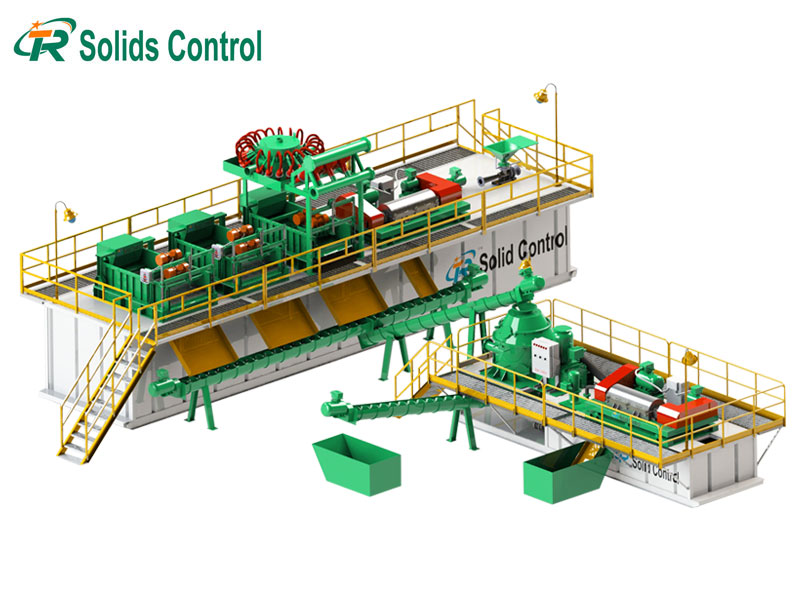
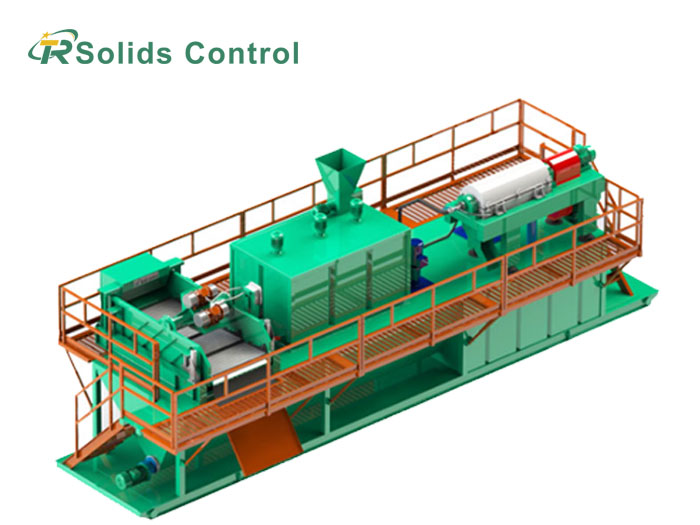
The plant TR Solids Control built is a split-compartment containerized skid for cluster-well mud treatment, rated at 30 m³/h.
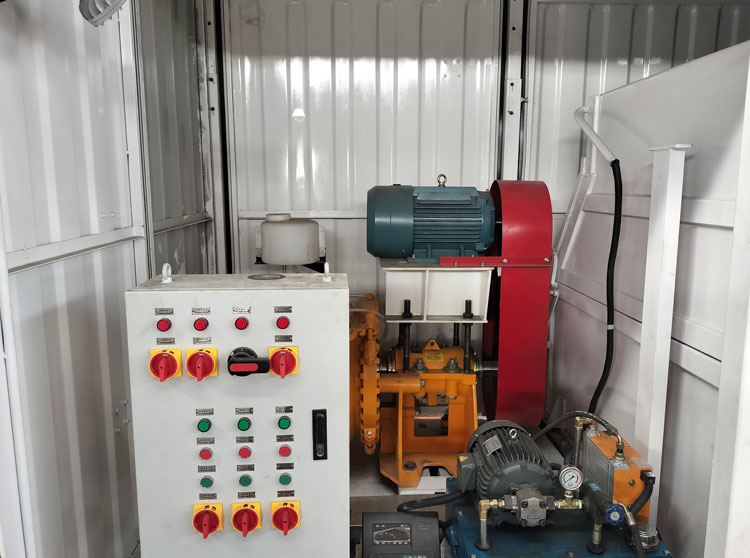
The pumping and control compartment holds the mud pump set, the hydraulic cooling unit and a central operating console. Functional units are electrically interlocked, with over-temperature and overload protection. The enclosure is compression-sealed with gaskets and rock wool insulation, and the components are rated for a wide temperature range, so wind-blown sand has trouble reaching the electrics. One person can run the plant from the console, which suits a small overseas crew.
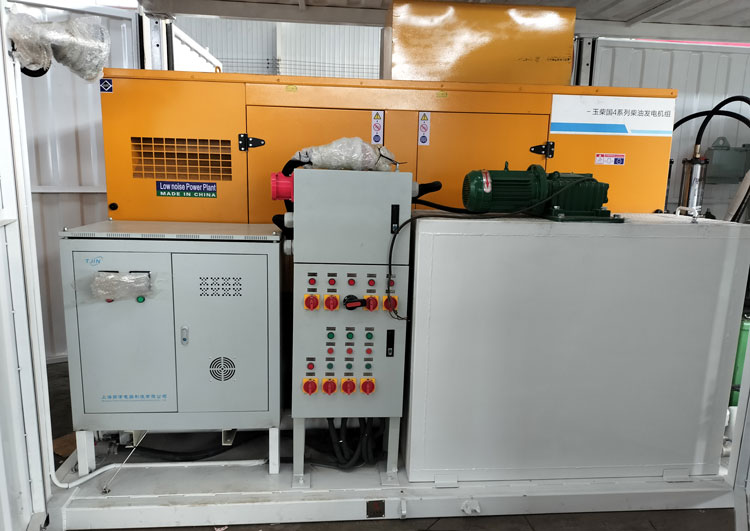
The generator sits in its own compartment, a Yuchai soundproofed diesel set rated at 250 kVA, powering the entire water-based mud treatment plant. Generator and control system were matched and tested together before shipping, so voltage swings under load never reach the main motors.
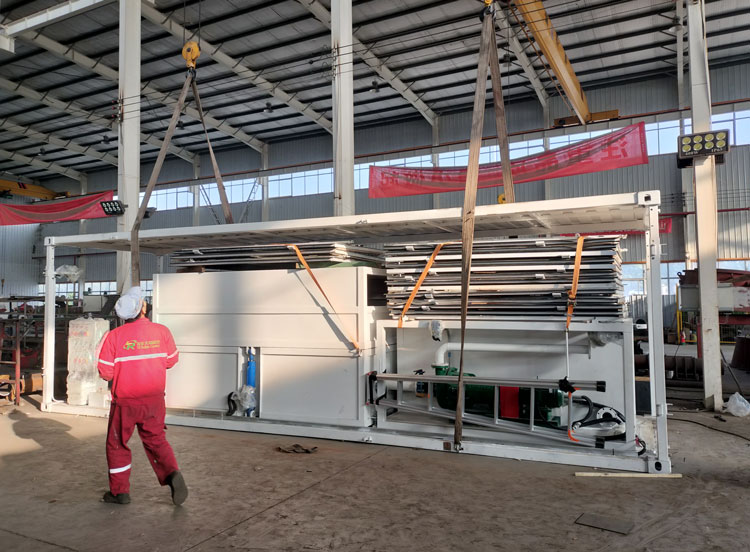
The plant is modular: everything rides on one container base frame, 4 in total. Standard lifting points and lashing to ocean freight rules are provided, so a crane on the pad can pick it up as it stands. Enclosures were insulated and sealed against dust before shipping. When a well is finished the whole skid lifts and moves to the next location without stripping and rebuilding piping, which matches the tempo of a back-to-back pad program. Where crane capacity is limited, it splits into separate compartments and travels in pieces.
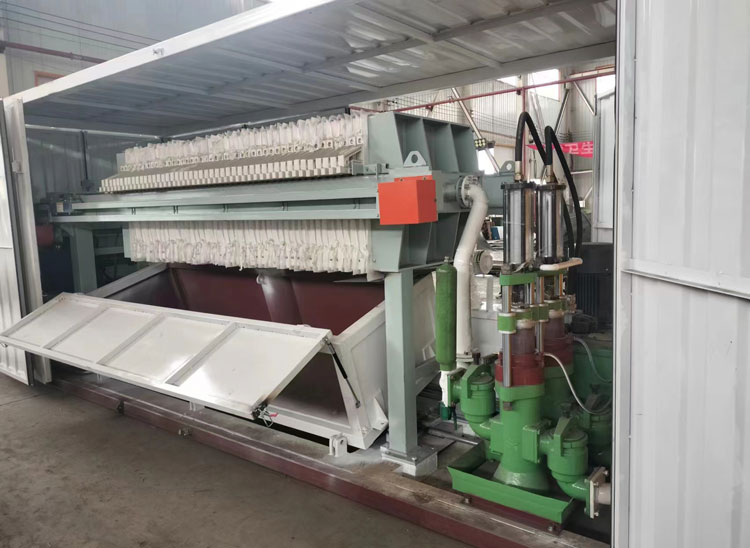
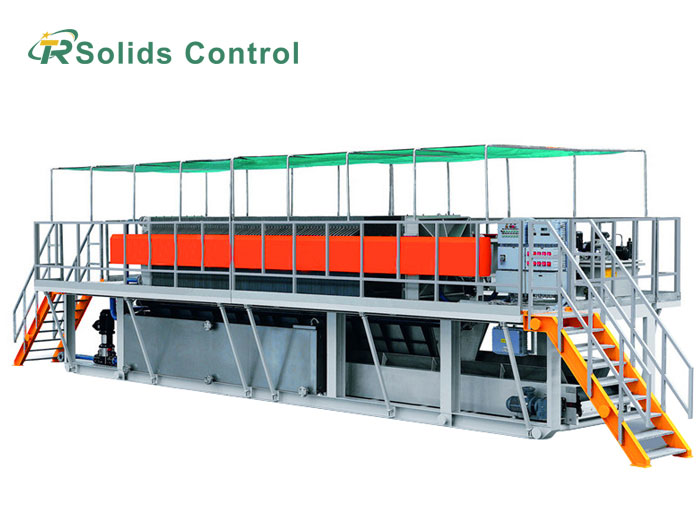
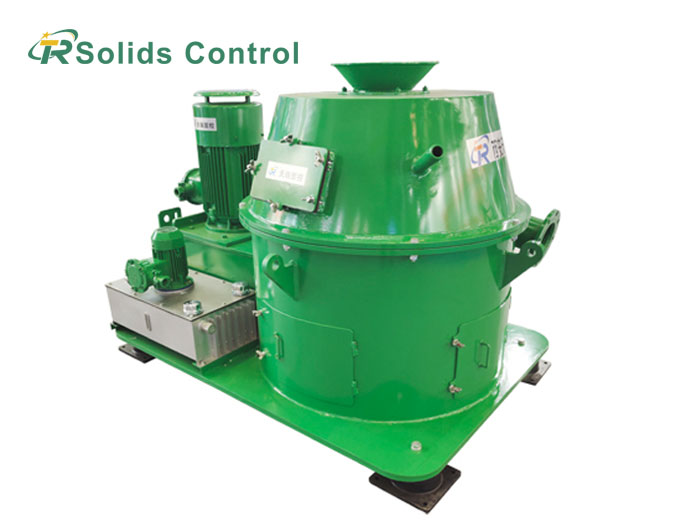
The filter press sits in a closed compartment and is the core of the solids control side. Mud is pressed at high pressure into a low-moisture cake, around 35–40% water by weight, that can be loaded and hauled, while the filtrate returns to the mud tanks for mixing. The project's HSE review criteria are met with no pit and no open cuttings pile. A vertical cuttings dryer paired with a decanter centrifuge is the more common answer for WBM cuttings, and we build that configuration too. This program specified a filter press because the priority was a cake dry enough for the haul-off road and a clear filtrate to reuse, not peak solids recovery.
Turkmenistan mud treatment projects lose most of their schedule before the plant ever ships, and solids control work elsewhere in Central Asia runs the same way. Documentation, the factory acceptance test, spares: miss one of them and the plant sits idle after it lands.
Russian documentation first. Nameplates, drawings, operation manuals and inspection certificates can all be issued in Russian, and export inspection and shipping paperwork is prepared early, so the plant is not sitting in customs while the pad waits for it.
The whole plant runs together before it leaves. Generator set, control system, pump set and filter press go through a full integrated test at the factory, the factory acceptance test (FAT), with protection logic and alarms checked item by item. Pre-commissioning happens here, not on the pad. After the plant reaches the destination port the site crew connects the mud inlet and outlet lines and little else, which is what keeps the overseas service visit short.
Spares travel with the plant. Filter cloths, seals and pump parts ship packed with the main equipment. Lead times in Central Asia are long and cross-border freight is slow, so a starter stock matters. One container for everything also avoids the usual trouble of loose parts going missing or taking damage in transit.
Self-generated power and a sealed, insulated enclosure take sand and temperature swings off the failure list, and drilling runs with fewer interruptions. Dewatered cuttings and a closed mud loop line up with what local environmental rules ask for, which keeps stop-work orders and fines off the table.
Putting filtrate back into the mud cuts chemical consumption, and the tonnage going out by truck drops. One lift per move, and the rig is not waiting on the skid.
The same containerized water-based mud treatment package fits onshore oil, gas and coalbed methane (CBM) programs in Kazakhstan and Uzbekistan, where the constraints are the ones this plant was already built around. It suits contractors running desert drilling programs on multi-well pads.
None of the equipment here is unusual. What makes it work on a pad like this is the order the decisions were made in: power first, dust second, paperwork third, process design last. Get that order wrong and a plant that ran well in the factory stops working on the pad.
TR Solids Control builds these zero-discharge mud treatment systems to the operator's specification and to the local discharge rules, so the drawings change from one country to the next.

Address: No.2 Huochang Road, Yangling District,Xianyang City, Shaanxi Province, China
Tel: +86-18509252400
Wechat: 18509252400
Email: info@mudsolidscontrol.com
Contact: Mr.Li
 +86-18509252400