Contact Person: Mr.Li
Mobile: +86-18509252400
Wechat: 18509252400
Email: info@mudsolidscontrol.com
Address: No.2 Huochang Road, Yangling District,Xianyang City, Shaanxi Province, China
In oilfield drilling fluid solids control systems, mud shale shakers play a critical role in removing drilled solids from circulating drilling fluids. As the first stage of solids separation, the shaker directly affects drilling fluid recovery, cuttings removal efficiency, and the overall performance of the solids control system.
During drilling operations, problems such as screen plugging, solids buildup, reduced processing capacity, and increased drilling fluid losses may occur due to improper screen selection, unsuitable vibration settings, uneven feeding, or insufficient maintenance.
To maintain stable shale shaker performance, operators need to consider the complete operating process, from shaker screen selection and vibration adjustment to feeding control and equipment maintenance.
Based on different shaker designs, including double-layer shale shakers, balanced elliptical motion shakers, and high-frequency linear motion shakers, the following solutions provide practical methods to reduce solids retention and improve drilling fluid separation efficiency.
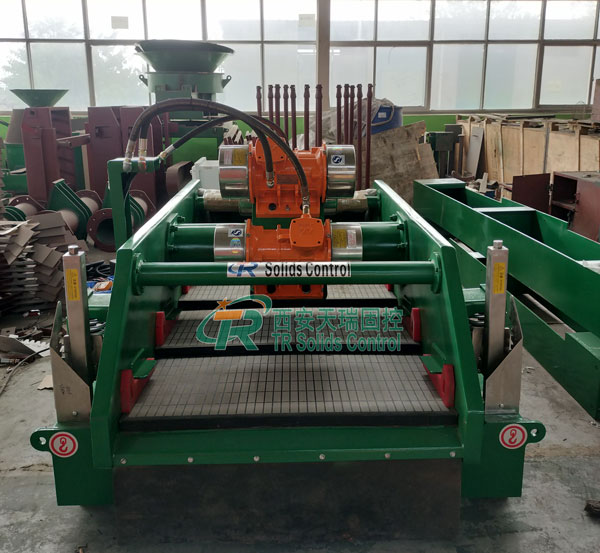
The shaker screen is one of the most important components affecting separation performance. Choosing the correct screen opening, material, and installation method helps prevent excessive solids accumulation and keeps drilling fluids moving efficiently through the screening surface.
The selection of shale shaker screen should be based on the size, hardness, and characteristics of solids contained in the drilling fluid.
Coarse Solids Above 74 μm
For larger drilled cuttings above 74 μm, 100-150 mesh stainless steel woven screen is commonly selected.
The larger open area provides efficient fluid flow while reducing screen loading when handling coarse solids. Stainless steel mesh also offers good wear resistance for continuous drilling operations.
Fine Solids Between 20-74 μm
For fine solids between 20-74 μm, a 200-325 mesh polyurethane screen or composite screen is suitable. These screens offer higher wear resistance and better resistance to screen blinding, especially when processing drilling fluids with a higher concentration of fine particles.
For applications requiring finer separation, a double-layer screen design can distribute solids loading between two screening surfaces.
The upper screen layer removes larger particles first, while the lower layer handles finer solids. This arrangement reduces the workload on each screen layer and supports more stable separation performance.
Drilling Fluids Containing Sticky Clay or Salt Crystals
In clay-rich formations or drilling fluids containing salt crystals, particles may easily stick to the screen surface and affect screening performance. Anti-stick coated screens can reduce particle adhesion and keep screen openings clear during operation.
Correct screen installation is essential for stable vibration and consistent solids movement.
During installation, the screen should remain flat and tightly secured to the screen frame without gaps. Improper installation may create uneven screening areas and increase the risk of screen plugging.
Regular tension inspection is also necessary during operation.
A loose screen cannot provide the required vibration response, which may slow solids movement across the screen surface and affect separation efficiency.
Different drilling fluids require different shaker settings. Proper adjustment of vibration frequency, amplitude, and movement direction allows the equipment to handle changes in viscosity and solids loading.
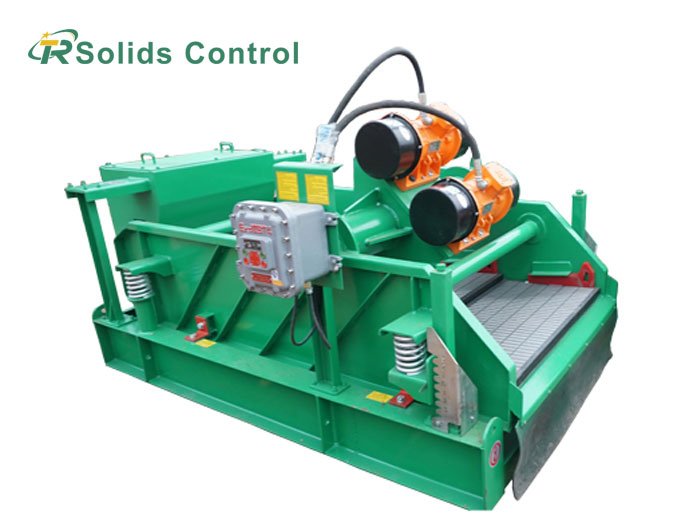
TR shale shakers use adjustable vibration systems, allowing operators to select suitable settings according to drilling fluid properties.
| Drilling Condition | Recommended Setting | Purpose |
| High-viscosity drilling fluid (>50 mPa·s) | Frequency: 55-60 Hz / Amplitude: 2-3 mm | Break particle adhesion and improve solids movement |
| High solids content (>15%) | Frequency: 50-55 Hz / Amplitude: 3-5 mm | Increase cuttings transport and reduce screen loading |
| Fine particle separation | Suitable fine mesh screen selection | Improve drilling mud separation efficiency |
For high-viscosity drilling fluids, higher vibration frequency helps separate sticky particles and keeps solids moving across the screen surface.
When solids concentration is high, increasing amplitude provides stronger movement and prevents excessive cuttings accumulation on the screen.
For linear motion shale shakers, vibration direction affects how solids travel across the screen surface.
Adjusting the vibration motor phase angle allows the movement direction to match the material flow more effectively. A vibration angle of approximately 30-45° helps distribute solids evenly and prevents localized buildup.
For double-layer shale shakers, synchronized vibration between the upper and lower screens is important.
The lower screen can operate at a slightly higher frequency than the upper screen, usually with a difference of 5-10 Hz. This helps prevent solids from accumulating after passing through the first screening layer.
Uniform feeding is important for maintaining stable shale shaker performance. Uneven distribution of drilling fluid across the screen surface may create local overload areas, causing solids buildup and reducing separation efficiency.
A suitable feeding device, such as a spiral feeder or diffuser-type inlet, helps distribute drilling fluid evenly across the full width of the screen. This prevents excessive loading in one area and allows the entire screening surface to work effectively.
The feed flow rate should also match the rated capacity of the shale shaker. For TR TRZS series linear shale shakers, the processing capacity ranges from 50-200 m³/h depending on the model and operating conditions. In practical operation, the feed rate should not exceed approximately 85% of the rated capacity.
Overfeeding can create a liquid pool on the screen surface. When drilling fluid remains too long in one area, solids may settle, reducing screen efficiency and increasing residue retention.
For drilling operations with high solids content, pretreatment equipment can reduce the workload on the shale shaker.
A desander and desilter installed before the shaker can remove larger particles, especially solids above 200 μm. This reduces the amount of cuttings entering the shaker and is particularly useful for deep wells and complex formations.
Drilling fluid viscosity also affects solids movement. When viscosity becomes too high, typically above 60 mPa·s, adding a suitable diluent can reduce particle agglomeration and improve separation through the screen.
Regular maintenance plays an important role in maintaining mud shale shaker performance and extending equipment service life. Screen condition, vibration components, and sealing parts should be checked according to operating conditions.
Screen cleaning should be carried out after each shift to prevent solids from drying or blocking the screen openings.
A high-pressure water gun with a pressure of 0.3-0.5 MPa can be used for cleaning. Washing from the bottom toward the top helps remove trapped particles from the openings.
Special attention should be given to screen edges, corners, and areas where solids are more likely to collect.
If local plugging occurs, a soft brush can be used for cleaning. Hard tools should not be used because they may damage the screen surface and change the original opening size.
For severe blockage, the screen can be removed for deeper cleaning.
The vibration motor is one of the most important components affecting screening performance.
Operators should regularly inspect motor mounting bolts and eccentric blocks to confirm stable vibration output. Incorrect eccentric block positioning may cause uneven vibration and increase solids retention in certain areas.
Lubrication should also be performed according to operating requirements. For TR vibration motors, lubricant replacement is recommended every 500 hours.
The screen frame and supporting springs should also be inspected regularly. A deformed screen frame or aging spring can reduce vibration transmission and affect separation performance.
Damaged components should be replaced in time. TR provides original replacement parts to maintain equipment compatibility.
Sealing strips around the screen frame should be checked as well. Worn seals may allow drilling fluid leakage and cause solids accumulation inside the equipment.
Some drilling applications involve fine mesh screens, sticky solids, or high concentrations of difficult-to-separate particles. Additional systems can improve screening stability under these conditions.
For applications using fine screens above 200 mesh or drilling fluids containing sticky particles, an ultrasonic anti-clogging system can be installed.
The system generates ultrasonic vibration at 20-40 kHz, creating additional movement on the screen surface. This reduces particle adhesion and can decrease screen clogging by more than 30% under suitable conditions.
A clear discharge path is necessary for continuous solids removal.
The discharge outlet and discharge plate angle should be checked regularly to prevent solids from accumulating at the outlet area.
For applications requiring additional assistance, scraper devices or customized discharge accessories can be installed to improve waste solids removal.
For drilling fluids containing a high concentration of fine particles, a negative pressure assistance system can be considered.
The system creates slight negative pressure below the screen surface, allowing drilling fluid to pass through faster. This reduces the residence time of solids on the screen and lowers the possibility of retention.
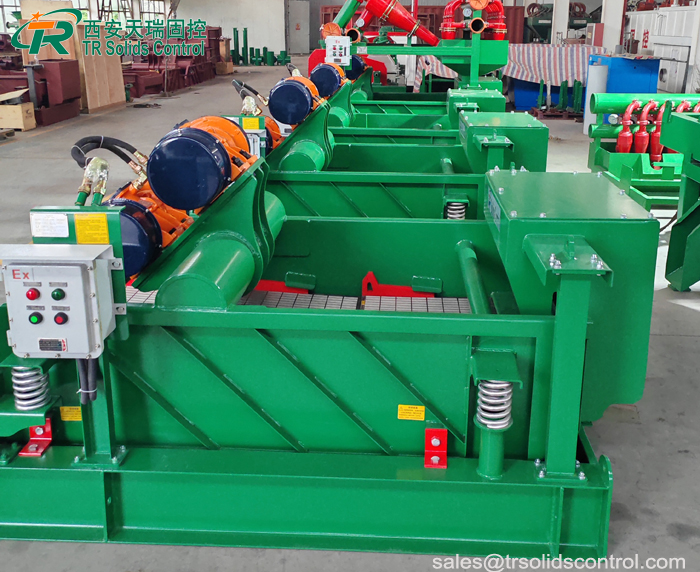
Reducing solids retention in mud shale shakers requires proper equipment selection, suitable operating parameters, and regular maintenance.
The key approach is to match the shaker screen with drilling conditions, adjust vibration settings according to mud properties, control feeding conditions, and keep critical components in good working condition.
By combining the high-frequency vibration design and efficient screening structure of TR solids control shale shakers, operators can improve solids separation efficiency, reduce screen plugging, extend screen service life, and lower drilling fluid losses and maintenance costs.
For specific models, including TRZS series linear shale shakers and TRBS series balanced elliptical motion shale shakers, TR provides technical support and customized solutions based on different drilling requirements.

Address: No.2 Huochang Road, Yangling District,Xianyang City, Shaanxi Province, China
Tel: +86-18509252400
Wechat: 18509252400
Email: info@mudsolidscontrol.com
Contact: Mr.Li
 +86-18509252400