Contact Person: Mr.Li
Mobile: +86-18509252400
Wechat: 18509252400
Email: info@mudsolidscontrol.com
Address: No.2 Huochang Road, Yangling District,Xianyang City, Shaanxi Province, China
The oilfield waste treatment system serves as core of modern drilling waste management. It enables oil and gas operators to properly process drilling cuttings, waste slurry, and other byproducts produced during drilling operations.
Instead of simply storing or hauling waste away for off-site disposal, a professionally engineered system recycles valuable drilling fluids, cuts down waste volume, and ensures continuous, efficient field operation.
Since 2010, TR Solids Control has specialized in manufacturing reliable waste treatment systems, serving clients across more than 40 countries with cost-effective solutions that combine high operational efficiency with strict environmental compliance.
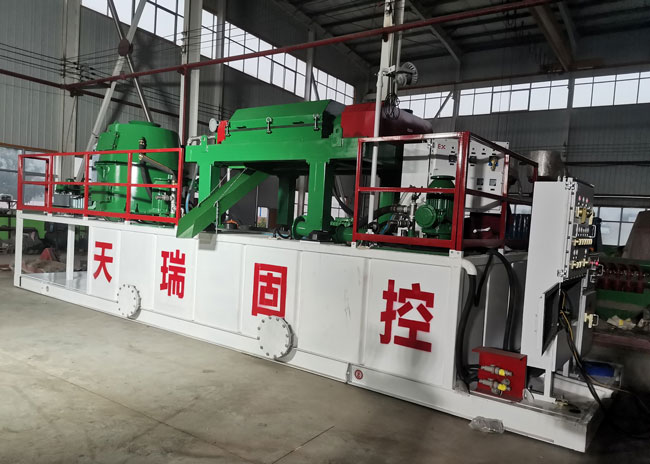
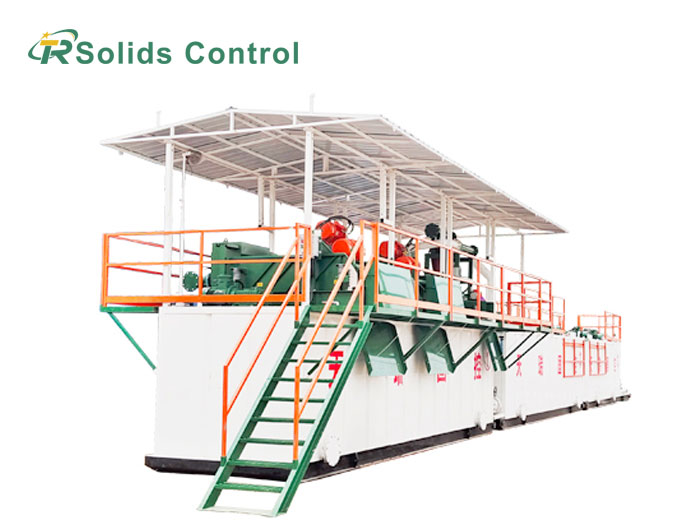
TR Solids Control offers a complete line of oilfield waste treatment equipment designed to handle both water basedand oil based mud systems. The core idea is simple: take the drilling cuttings coming off your solids control system, extract the usable liquid phase, and leave behind a dry solid that meets regulatory requirements for handling or further processing.
The mud system is modular. You can configure it for different well conditions, different mud types and different site constraints. Whether you are drilling a shallow water based well or deep oil based well, TR Solids Control can put together a configuration that works for your specific situation.
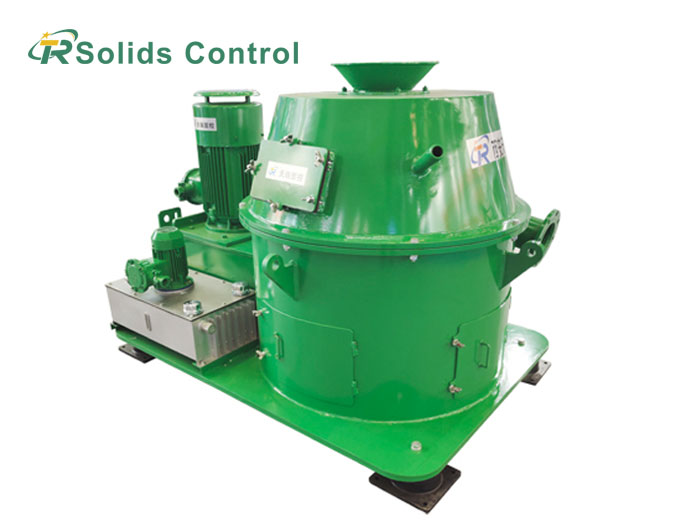
The vertical cuttings dryer is the workhorse of oil based mud waste treatment. TR Solids Control's TRCD Series vertical cuttings dryer uses centrifugal force to separate drilling fluids from drill solids. It spins at up to 900 RPM standard (or up to 1200 RPM with variable frequency drive), generating up to 750 G of centrifugal force. The liquid is forced through a stainless steel screen while the dry solids are extracted by angled flights.
For oil based drilling cuttings, the TR cuttings dryer typically reduces the oil content on the cuttings to between 3% and 5%. With the right configuration, it can even bring oil content below 3%, meeting most international environmental standards. The TRCD930 model handles 30 to 50 tons of cuttings per hour, which covers most drilling operations comfortably.
The dryer features an independent oil lubrication system with automatic pressure alarms. The flights on the rotor are hard faced to HRC 65 for longer wear life. The stainless steel screen is balanced individually and can be replaced without changing the entire frame, which saves on maintenance costs. VFD control panels come with Siemens drives and Schneider electrical components, all housed in pressurised explosion proof enclosures for safe operation in hazardous areas.
After the vertical dryer recovers most of the liquid, the decanter centrifuge polishes that recovered fluid further. The TR decanter centrifuge uses centrifugal force to separate fine solid particles down to 2 to 5 microns. This fine polishing step ensures that the recovered drilling fluid has a clean liquid phase that can be fed back into the active mud system.
TR offers decanter centrifuges ranging from 355mm to 600mm bowl diameters, with processing capacities from 40 m³/h up to 90 m³/h. The main body and collection box are made of 2205 duplex stainless steel for corrosion resistance. Spiral propellers get tungsten carbide or ceramic protection to guard against abrasive solids. Bearings are from FAG or SKF, and the control systems use Siemens or Schneider components.
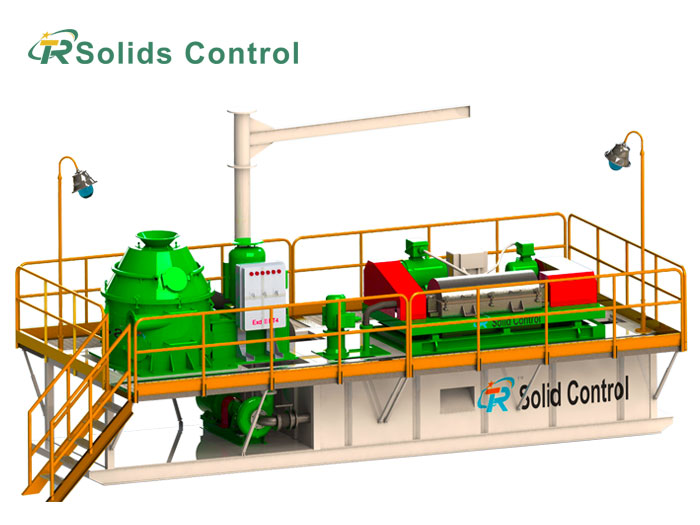
One smart feature of the TR waste management setup is how the centrifuge is mounted. In typical drilling waste management system, the decanter centrifuge is placed on a telescopic skid at a higher elevation so that the discharged fluids can flow by gravity directly into the active mud system. That reduces the need for additional transfer pumps and simplifies the whole operation.
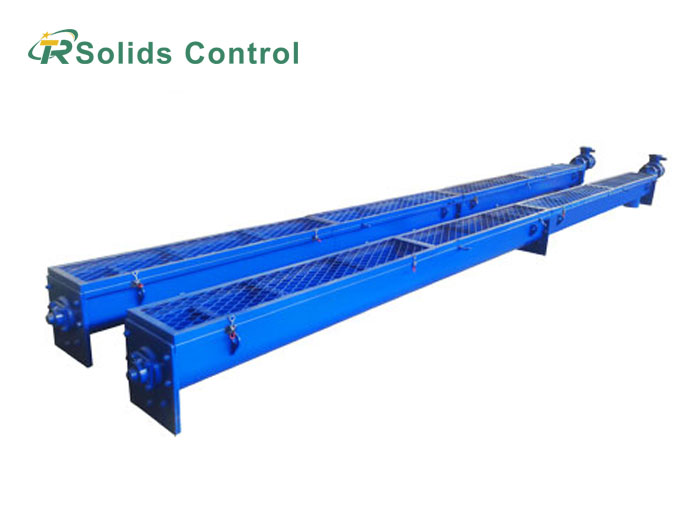
Moving waste material around the site efficiently matters just as much as the separation itself. The TR system uses screw conveyors to collect cuttings from shale shakers, desanders, desilters and centrifuges, then feed them into the vertical cuttings dryer. Screw pumps (usually two units) handle liquid transfer. One pump feeds the decanter centrifuge from the catching tank. The other provides flush water for the vertical dryer.
The catching tank beneath the vertical cuttings dryer collects the liquid that comes off the dryer. A skid mounted tank with around 4 m³ capacity sits under the dryer, catching fluid before it gets pumped to the centrifuge for secondary processing. Additional mud tanks provide storage for recovered drilling fluid, keeping it available for immediate reuse in the active mud system.
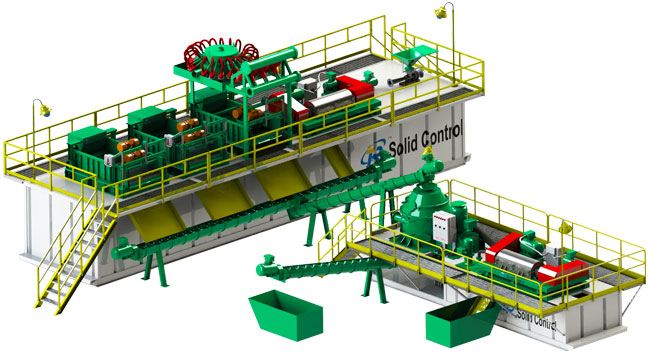
Here is the step by step workflow of typical TR oilfield waste treatment system.
Collection. The drilling cuttings separated from the mud shaker, desander, desilter and centrifuge of the solids control system get collected by screw conveyor.
Primary Drying. The conveyor feeds the cuttings into the vertical cuttings dryer. The dryer spins the material, forcing liquid through the screen basket while solids move toward the discharge end. The separated liquid goes into the catching tank. The dried solids are discharged for bagging or further processing.
Secondary Polishing. A screw pump transfers the liquid from the catching tank to the high speed decanter centrifuge. The centrifuge spins out any fine solids still suspended in the liquid, down to 2 to 5 microns.
Fluid Return. The cleaned drilling fluid discharges from the centrifuge and, thanks to the telescopic mounting, flows by gravity back into the active mud system for immediate reuse.
Solids Disposal. The dried solids from the vertical dryer and the fine solids from the centrifuge are bagged or conveyed away for final disposition. The whole system is designed to operate without anything falling on the ground. That is why TR calls it "non landing" system.
Oil based mud waste treatment is where this system really proves its value. OBM cuttings are notoriously difficult to handle because regulations often require very low oil content before they can be transported or disposed of. The TR vertical cuttings dryer, when combined with decanter centrifuge, consistently reduces oil on cuttings to below 5%, and in many cases below 3%.
For customers running water based mud, the same system focuses on moisture control rather than oil removal. The TR system can reduce moisture content in water based cuttings down to 6% to 15%, making the cuttings much easier and cheaper to transport off site.
Zero discharge does not mean zero waste. It means nothing from your drilling operation gets released into the environment without proper treatment. Every stream gets processed. Liquids get recovered and reused. Solids get dried to the point where they meet regulatory requirements for transport or further treatment. TR oilfield solids control system is built around this principle. It recycles the liquid phase back into the drilling process, minimises the volume of waste that leaves the site, and reduces the toxicity of whatever solid waste remains.
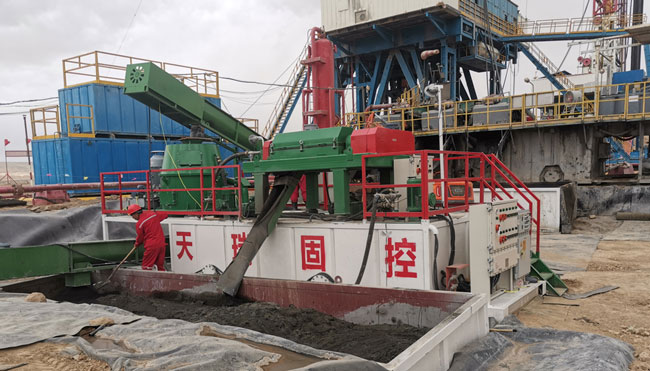
TR Solids Control systems are widely deployed across diverse global drilling environments.
One unit delivered to Malaysian oilfield was tasked with extracting and purifying drilling fluids from drill cuttings for recycling. The operator achieved maximum fluid recovery while significantly lowering costs for mud procurement and waste disposal.
Another TR system was supplied to the African market for water-based mud project, proving our unified technology platform delivers reliable performance for both OBM and WBM operations. A German client conducted an on-site inspection of TR solids control equipment and gave outstanding reviews on our system quality and performance.
Our systems have also been applied in Xinjiang, China, for oil-based mud non-landing treatment projects, steadily keeping residual oil content below 3% and solid-phase water content under 6%.
Beyond conventional oil and gas drilling, TR waste treatment solutions serve broader industries including HDD horizontal directional drilling, geothermal drilling, tunneling engineering and municipal sludge disposal. The high-efficiency separation technology used for drilling waste management is also fully applicable to shield tunnel slurry separation, river dredging and industrial sludge dewatering projects.
TR Solids Control is certified to API Q1 by the American Petroleum Institute and holds ISO 9001 quality management certification. Our vertical cuttings dryers comply with ATEX and IECEx explosion-proof standards, rated ExdIIBT4.
For drilling operators operating under stringent environmental regulations across North America, Europe, the Middle East and Asia Pacific, these authoritative certifications provide full credibility with regulators and third-party auditors.
TR Solids Control is based in Xi'an, China, with a manufacturing plant in Yangling District. Our product covers shale shakers, mud cleaners, decanter centrifuges, vacuum degassers, centrifugal pumps, and fully customized oilfield waste management systems.
What makes TR Solids Control stand out is our solid technical expertise combined with field-proven practical design. TR also works with customers to customise systems rather than pushing one size fits all solution. Whether you require a complete skid-mounted waste management system or only vertical cuttings dryer to upgrade your existing setup, our team provides accurate, project-matched quotations and professional support.
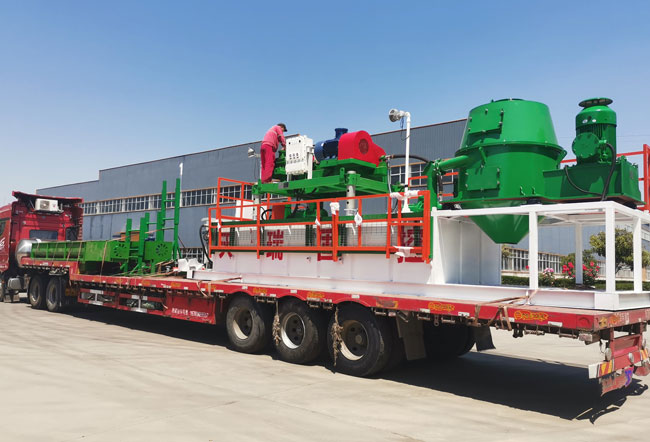
If you run oil-based mud operations and face stricter disposal restrictions, tighter hauling regulations, or rising logistics costs, investing in an oilfield waste treatment system can greatly improve your bottom line. Every barrel of recovered drilling fluid eliminates the need to purchase new mud, while every ton of dried cuttings cuts expensive special waste handling fees. In most cases, operators see a faster return on investment than anticipated.
TR Solids Control provides free professional consultations to help you select the ideal system configuration for your unique drilling conditions. Get in touch via our official website trsolidscontrol.com or email info@mudsolidscontrol.com. Our team will evaluate your mud type, well depth, site layout, and local environmental regulations to design a fully tailored solution that fits your project perfectly.

Address: No.2 Huochang Road, Yangling District,Xianyang City, Shaanxi Province, China
Tel: +86-18509252400
Wechat: 18509252400
Email: info@mudsolidscontrol.com
Contact: Mr.Li
 +86-18509252400