Contact Person: Mr.Li
Mobile: +86-18509252400
Wechat: 18509252400
Email: info@mudsolidscontrol.com
Address: No.2 Huochang Road, Yangling District,Xianyang City, Shaanxi Province, China
Mud Solids Control System is the essential equipment train that cleans drilling fluid returning from the wellbore. Without a properly functioning setup, drilled solids quickly accumulate in the mud, raising density, increasing viscosity, wearing out pumps and bits, and slowing penetration rates. Every modern drilling operation depends on a well designed solids removal system to recycle mud and control costs.
In this guide, TR Solids Control provides a detailed explanation of the working principle of the drilling mud solids control system, including key equipment, process flow paths, the API RP 13C standard, and how to select the suitable mud system.
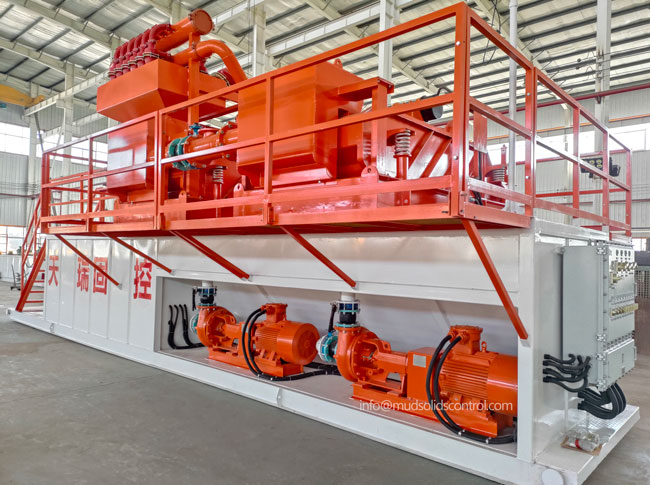
Drilled solids, mainly rock cuttings generated by the bit, are the most harmful contaminant in drilling fluid. If left in the mud, they increase abrasion on pumps and drill string components, reduce bit life, and make it harder to lift cuttings out of the hole. A good solids removal system removes these solids progressively, allowing the same mud to be reused hundreds of times. This dramatically reduces fresh mud purchases, lowers disposal volumes, and prevents downhole problems.
A standard drilling fluid cleaning system uses four or five stages of mechanical separation. Each stage targets a specific particle size range, from coarse cuttings down to ultrafine colloidal particles.
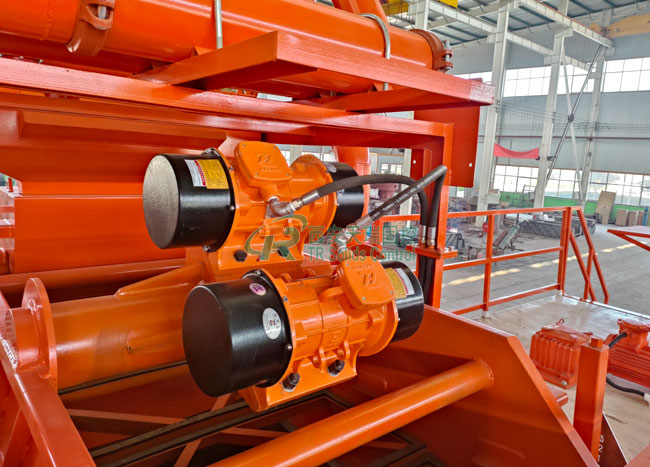
Dirty mud from the well first enters the shale shaker. Large cuttings larger than about 100 microns cannot pass through the screen mesh. They are vibrated off the end into a cuttings bin. The remaining mud, still containing finer solids, falls into the first tank compartment. Shaker Screen mesh choice is a trade-off: finer screens remove more solids but handle less flow and blind faster.
If gas is present, it reduces mud density and hydrostatic pressure, increasing kick risk. The degasser pulls mud into vacuum chamber, where gas bubbles expand and are vented. Degassed mud returns to the tank. Not every solids control system requires continuous degasser operation, but when gas is encountered, this stage becomes critical.
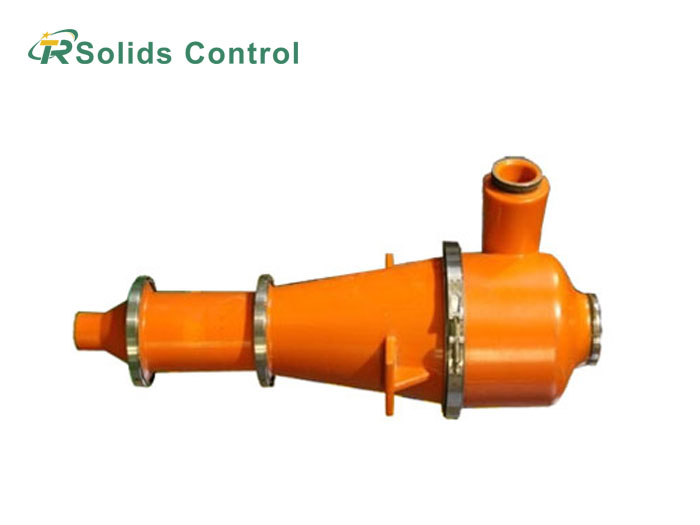
Centrifugal pump transfers mud from the shaker compartment to the desander, which uses several 6–12 inch hydrocyclones. Inside each, tangential flow creates a high‑speed vortex. Heavier solids (sand) are thrown outward, spiral down to the apex nozzle, and go to a fine screen for dewatering. Cleaner mud spirals upward to the next compartment. The desander removes particles down to roughly 40–76 microns.
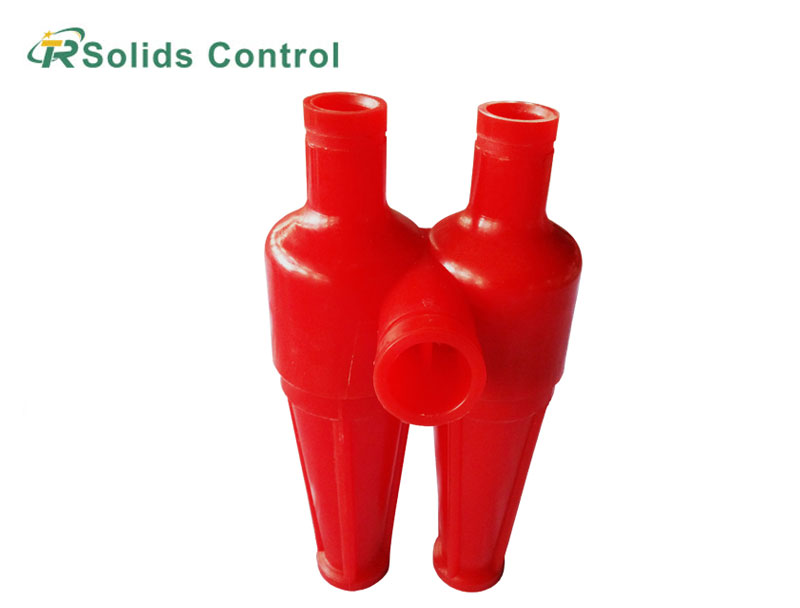
The desilter works the same hydrocyclone principle but with smaller 4‑inch cones, generating higher centrifugal force to remove particles down to 15–44 microns. Many modern mud purification systems combine the desander and desilter into a single mud cleaner, which includes its own shaker screen for dewatering discharged solids.
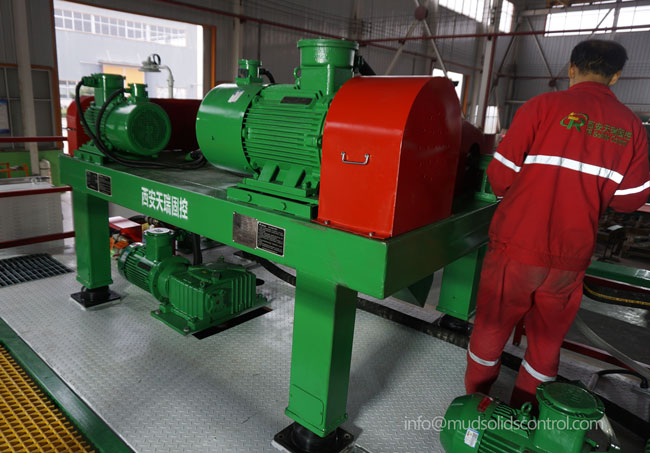
Hydrocyclones alone can't remove ultrafine solids (2–7 microns), which cause uncontrolled viscosity. Decanter centrifuge uses a high speed rotating bowl (1,600–3,200+ RPM), generating centrifugal force thousands of times gravity. Fines are thrown to the bowl wall, where a screw conveyor pushes them to the discharge, while clean mud flows out the opposite end. In weighted mud systems, the centrifuge can return barite to the active system and discard only light drilled solids, making the process much more cost‑effective.
Mud solids control system is not just a collection of machines. It also includes a series of connected mud tanks or compartments. Each compartment corresponds to one separation stage. Mud flows by gravity or is pumped from one compartment to the next. Proper tank design prevents short circuiting, which occurs when mud bypasses a piece of equipment. Mud agitators in each compartment keep solids from settling and reducing usable volume. Jet mixers or hoppers are used to add bentonite, barite, or chemical additives when conditioning the mud. All these components work together as a single integrated unit.
Before API RP 13C, also known as ISO 13501, each screen manufacturer used their own naming system and dimensions. You could not easily swap screens between different shaker brands. API RP 13C changed that. It defines two key parameters: cut point (D100) and conductance. Cut point is the largest particle size that can pass through the screen. For example, any screen with a cut point between 165 and 196 microns receives the designation API 80. Conductance measures how much fluid can pass through the screen. Higher conductance means higher throughput. With API RP 13C compliant screens, any screen bearing the same API designation will fit and perform similarly on any shaker.
Selecting the correct solids control equipment requires answering four practical questions.
First, what is the maximum circulation rate of your mud pumps? The total processing capacity should be at least 1.5 to 2 times the pump rating. This margin handles surge flow during connections or high rate of penetration intervals.
Second, how deep is the well? For shallow wells less than 3000 meters, three stage solids control system with shaker, desander, and desilter is often sufficient. For deep wells beyond 4500 meters or for horizontal wells, you should add decanter centrifuge.
Third, water based mud or oil based mud? Oil based mud typically requires zero discharge package that includes vertical cuttings dryer and a high speed centrifuge to reduce oil on cuttings below 5 percent. Water based mud is simpler but still needs correct sizing.
Fourth, what are the transport and space constraints? For urban drilling or mountainous sites, you may need a modular system that breaks down into smaller pieces for shipping.
Mud cleaning systems fail slowly. Watch for:
Shaker screen – Check for holes or blinding (dirty mud bypassing first stage).
Desander/desilter underflow – Umbrella spray is good; thick, rope‑like discharge means worn apex nozzle.
Centrifuge – Unusual vibration or knocking may indicate hard deposits inside.
Mud weight – Use a mud balance; little density difference between compartments means poor separation.
General – Replace screens/wear parts as needed. Keep agitators running when tanks contain fluid.
Solids control system isn't only for oilfields. Horizontal directional drilling (HDD) for pipelines and utilities uses small two or three tank systems to recycle bentonite slurry, reducing water consumption and bentonite costs by over 90 percent. Geothermal drilling, coalbed methane, shield slurry tunneling, and large diameter piling also rely on similar equipment. The principle is always the same: separate solids from liquid using density or size difference.
Mud Solids Control System is not an accessory. It is a core part of safe and economical drilling. By progressively removing solids from largest to smallest, a well designed setup extends bit life, protects mud pumps, reduces mud costs, and minimizes waste disposal. Whether you are drilling shallow water well or a deep oil and gas well, selecting the right solids removal system and maintaining it daily will pay back many times over in drilling performance and lower operating expenses.
TR Solids Control has been engineering and manufacturing solids control equipment since 2010, based in Xi'an, China. Our mud systems are now operating in North America, Europe, the Middle East, Southeast Asia, Africa, and Australia. If you need a reliable mud solids control system or want to improve an existing setup, contact us. We focus on practical solutions, not marketing promises.

Address: No.2 Huochang Road, Yangling District,Xianyang City, Shaanxi Province, China
Tel: +86-18509252400
Wechat: 18509252400
Email: info@mudsolidscontrol.com
Contact: Mr.Li
 +86-18509252400