Contact Person: Mr.Li
Mobile: +86-18509252400
Wechat: 18509252400
Email: info@mudsolidscontrol.com
Address: No.2 Huochang Road, Yangling District,Xianyang City, Shaanxi Province, China
An offshore drilling contractor asked us for a mixing package ahead of a well cementing campaign. They already knew their slurry volume and the rate they needed to deliver it. What they wanted to avoid was a second mobilization because the skid on deck could not keep pace. Here is what we built and where each figure came from.
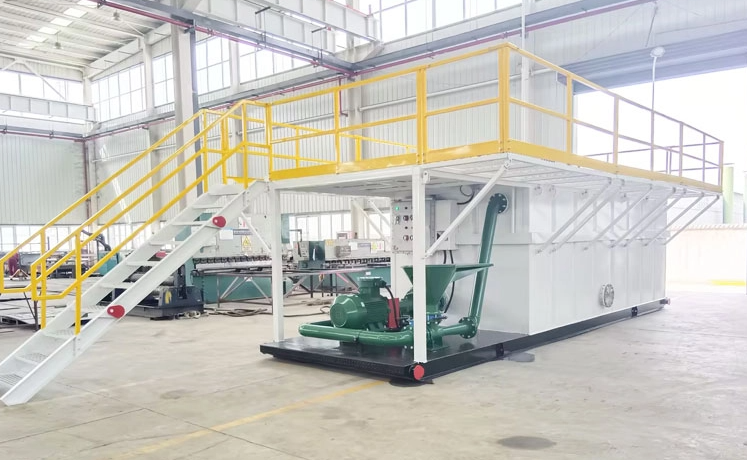
mud mixing system
Six numbers settle most of a mixing skid, and you already have most of them from your own program.
What you know | What it decides in the skid |
Slurry volume per stage (m³) | Tank volume, single or two-compartment |
Required delivery rate (m³/h) | Pump size and hopper nozzle |
Hazardous area classification | Explosion protection and enclosure rating |
Deck space and crane limit | Skid footprint, or a split module |
Available power (V/Hz, electric or diesel) | Motor and starter configuration |
Mix water source (seawater, return mud) | Wetted-part material |
This unit came out as 30 m³, 180 m³/h, electric drive, ductile iron wetted parts, and an Ex d IIB T4 build rated IP55. None of those are catalogue defaults. Each one is the answer to a line above.
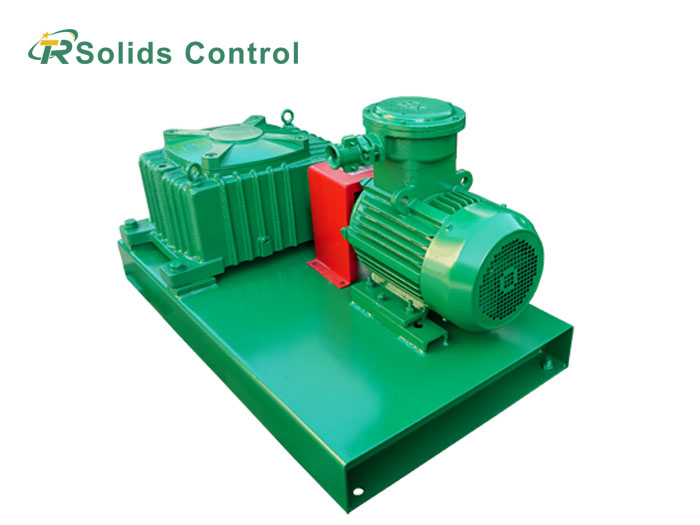
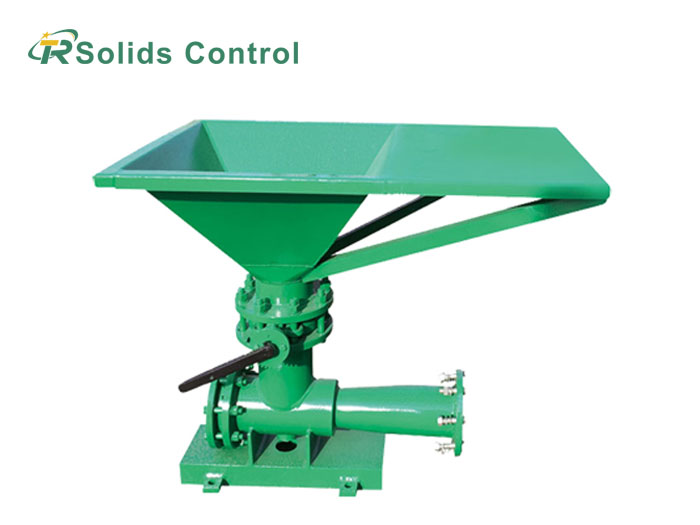
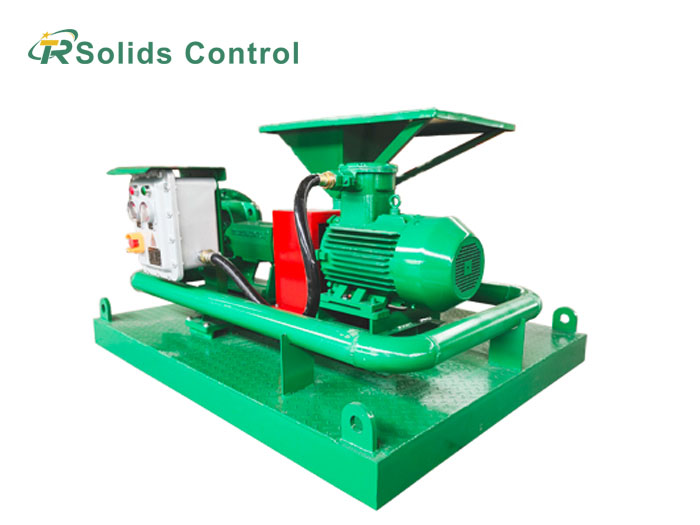
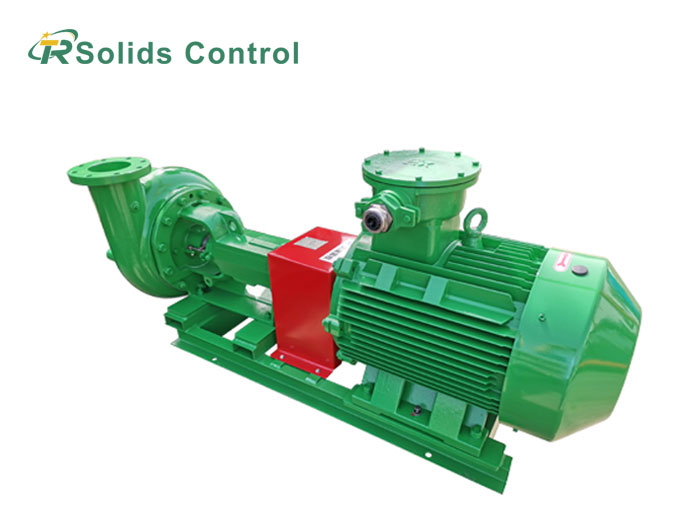
A hopper, a centrifugal pump and a set of agitators are one train, not three accessories. The hopper pulls dry material into the stream, the pump moves mixed fluid out of the compartment, and the agitators hold the rest in suspension until it is needed. If the hopper can induct faster than the pump can clear the compartment, heavy mud builds up where you are mixing and thin mud goes to the cement pumps. It is the most common reason a skid that looked generous on paper underperforms on deck.
All three here are sized to the same 180 m³/h, with two 15 kW agitators on the tank top. There is no slowest link for the crew to plan around.
The tank shell is corrugated and split down the middle, and each compartment has its own cleanout door. Settled solids get cleared from one side without draining the whole tank. That matters because once a cementing program is running, you rarely get a clean window to stop and clean.
The corrugation serves the same purpose. A flat floor in a tank this size lets material bed down into a layer the agitators will not lift again.
BT4 is shorthand on our side of the supply chain. On a purchase order it needs to read Ex d IIB T4, together with the zone it is certified for and the certifying scheme behind it, whether GB 3836, IECEx or ATEX. A mismatch does not surface in the workshop. It surfaces when the platform's HSE team opens the certification pack and finds it does not match the rest of the deck.
Settle it before you ask for a quote. The cost difference sits in paperwork and lead time, not in steel. Ex lighting and the control panel carry the same rating as everything else on the skid.
Three GB 20# I-beams run under the tank as crossbeams, and the tapers at both ends let a crew drag the unit short distances across the site without waiting on a trailer. Tow eyes are fitted front and rear. Along three sides there is a one-metre walkway behind a matching guardrail, with a stair at one end, and each compartment has a manhole for checking level and for getting inside during maintenance.
If your program needs automatic density control to a tight tolerance on primary cementing, this is not the machine. That job calls for a dedicated cementing unit with a high-energy mixer and an inline densitometer. This skid mixes and moves fluid. It does not measure it, and saying so early saves everyone a round of emails.
Everything above started from someone else's six numbers. Send us yours and we will size a mud mixing system to match.

Address: No.2 Huochang Road, Yangling District,Xianyang City, Shaanxi Province, China
Tel: +86-18509252400
Wechat: 18509252400
Email: info@mudsolidscontrol.com
Contact: Mr.Li
 +86-18509252400