Contact Person: Mr.Li
Mobile: +86-18509252400
Wechat: 18509252400
Email: info@mudsolidscontrol.com
Address: No.2 Huochang Road, Yangling District,Xianyang City, Shaanxi Province, China
Every drilling operation produces waste. Cuttings come up, drilling fluid gets contaminated, and someone has to handle the leftovers. That is where well site solids management comes in. It means separating drill cuttings from usable fluid right at the rig, recycling what you can, and sending out the smallest possible volume of waste.
TR Solids Control has been making solids control and drilling waste equipment since 2010. With API and ISO certification. The mud system is widely used for land rigs and offshore platforms across the United States, Europe, the Middle East, Africa, and Asia Pacific.
If you leave cuttings wet with drilling fluid, you pay to haul that extra liquid weight. Also pay for new fluid to replace what went out with the cuttings. Good solids management keeps you legal and lowers your operating cost.
The global market for drilling waste management reflects this reality. Tighter environmental rules and deeper wells are the main drivers.
A complete system uses several machines in sequence. Each one removes finer solids than the last.
Shale shakers separate large cuttings first. Shaker screens catch rock and debris while clean fluid passes through. Drying shakers go a step further. They recover extra fluid from the cuttings before the solids leave the system. TR Solids Control offers linear and balanced elliptical drying shakers.
Decanter centrifuges handle fine and ultra fine solids that shakers cannot catch. These machines spin at 300 to 4000 G to remove particles down to 2 to 5 microns. You need them for both water based and oil based mud.
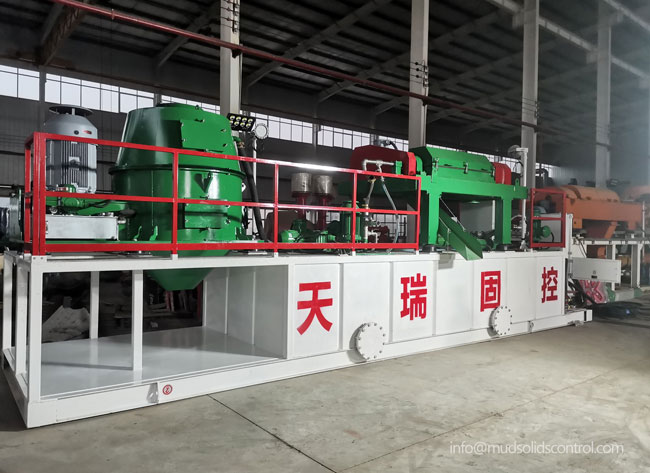
Vertical cuttings dryers take the coarse solids from shakers and squeeze out remaining liquid. On oil based mud, a good dryer leaves cuttings with 3 to 5 percent oil content. On water based mud, moisture can drop low enough for easy trucking. TR Solids Control reports water content under 6 percent and oil under 3 percent after treatment.
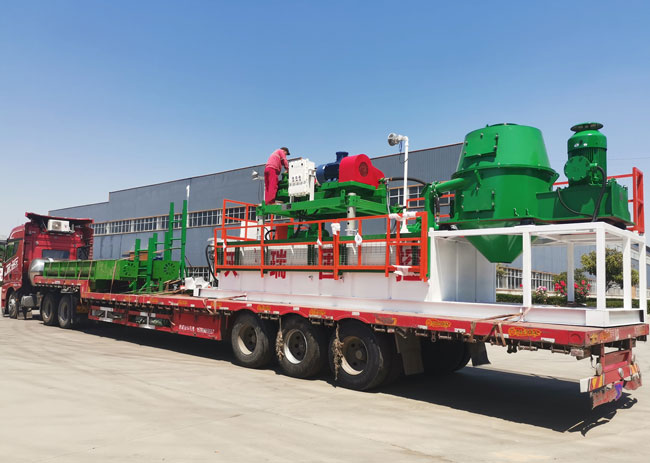
The full system includes screw conveyors or vacuum transfer pumps, mud tank for recovered fluids, decanter centrifuge, and electric control panel. Skid mounted designs with walkways and handrails are common. They move easily from one well to the next.
Water-based mud is straightforward: dry drill cuttings for transport and recycle usable fluid back to the active system.
Oil based mud is more regulated and cannot discharge it. Sensitive areas adopt non-landing systems to keep all drilling fluid off the ground.
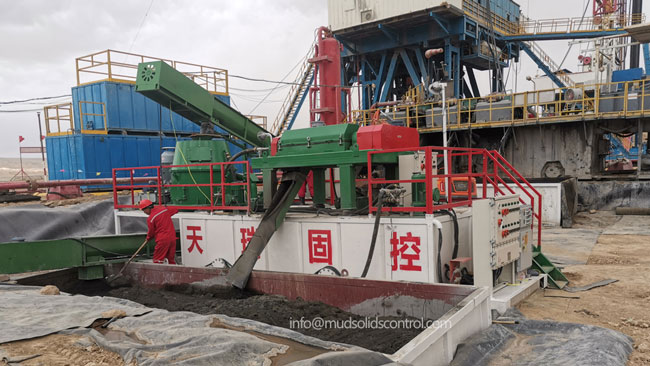
Cuttings come from the shale shaker, desander, desilter, and centrifuge. A screw conveyor moves them to vertical cuttings dryer. Cuttings dryer to separate oil-based mud from solids. Recovered fluid is purified via high-speed centrifuges and returned to the rig, while dry cuttings are sent for disposal.
Reduced fluid costs: Effective separation cuts offshore makeup fluid expenses by up to 35%.
Lower waste haulage: Dried cuttings are lighter and more compact, reducing transport, landfill costs and paperwork.
Improved drilling efficiency: Clean mud maintains optimal density and rheology, boosting penetration speed and extending downhole tool life.
Full compliance: Complete data records make regulatory inspections hassle-free.
Match design to well depth and mud type; TR Solids Control customizes systems for 2000–9000m rigs, jack-ups and offshore platforms.
Adapt to site layout with telescopic skids and compact equipment for limited space.
Comply with local rules on non-landing requirements and oil content limits for cuttings.
Select equipment capacity to match drilling rate, avoiding processing bottlenecks.
Solids control and waste management follow a simple logic. Separate the big stuff first. Keep going down to fine particles. Then dry cuttings before leaving the rig.
The best time to plan your well site solids management is before you spud. Get the right equipment in the right configuration. Train operating crews, and document fluid recovery and waste delivery. This controls costs while maintaining full regulatory compliance.
TR Solids Control supplies complete systems built to API and ISO standards. With industry experience since 2010, we help operators cut fluid loss and reduce waste disposal volume.

Address: No.2 Huochang Road, Yangling District,Xianyang City, Shaanxi Province, China
Tel: +86-18509252400
Wechat: 18509252400
Email: info@mudsolidscontrol.com
Contact: Mr.Li
 +86-18509252400