Contact Person: Mr.Li
Mobile: +86-18509252400
Wechat: 18509252400
Email: info@mudsolidscontrol.com
Address: No.2 Huochang Road, Yangling District,Xianyang City, Shaanxi Province, China
In the oilfield drilling industry, desanders and desilters are both solid control equipment used for drilling fluid screening. Both are used to treat suspended solid particles in drilling fluid to achieve fluid purification, but they differ in processing accuracy, applicable scenarios, working principles, and equipment specifications. TR Solids Control will detail the differences and specific functions of the two in accordance with industry standards.
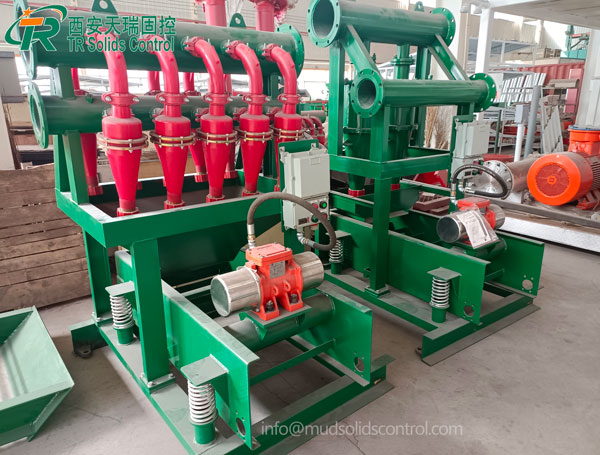
The function of the desander is to perform coarse solid-phase separation of the drilling fluid, removing larger solid particles, reducing the load on subsequent solids control equipment, preventing large particles from wearing down or clogging subsequent equipment, and laying the foundation for subsequent fine treatment of the drilling fluid.
In shallow drilling, large-diameter drill bits are typically used, generating a large amount of coarse drill cuttings. Desanders provide a larger volume capacity to separate these coarse cuttings, preventing high-concentration, large-particle fluids from directly entering subsequent equipment and affecting the overall efficiency of the solids control system.
Desanders are widely used in oil and gas extraction, drilling fluid treatment, sewage treatment, geothermal engineering and other fields.
The function of the desilter is to further purify the drilling fluid after it has been processed by the desander, removing fine, harmful solid particles that the desander cannot separate. This optimizes the drilling fluid's performance and creates favorable conditions for subsequent centrifuges, ensuring the stability of the drilling fluid's density and viscosity, and meeting the requirements of drilling operations.
When the desander removes large drill cuttings from the fluid, the desilter efficiently separates the smaller particles. However, if the desander is bypassed and the desilter is used directly, the large particles will quickly wear down its core components, leading to equipment failure and ineffective purification.
Particle Size Processing
The core difference between the two lies in the different particle sizes of the separated solid phases, allowing for precise differentiation between "sand" and "mud" particles in drilling fluids, which conforms to the classification standards of the oilfield solid control equipment industry.
● Desander: Removes larger particles such as gravel and sand; the particle size range is typically 44-74 μm.
● Desilter: Removes smaller particles such as sand, clay, and mud, typically with a particle size range of 15-44 μm.
Working Principles
Both take hydrocyclones as the core component, but they differ in their separation principles, adapting to their respective particle separation needs and conforming to industry equipment design standards.
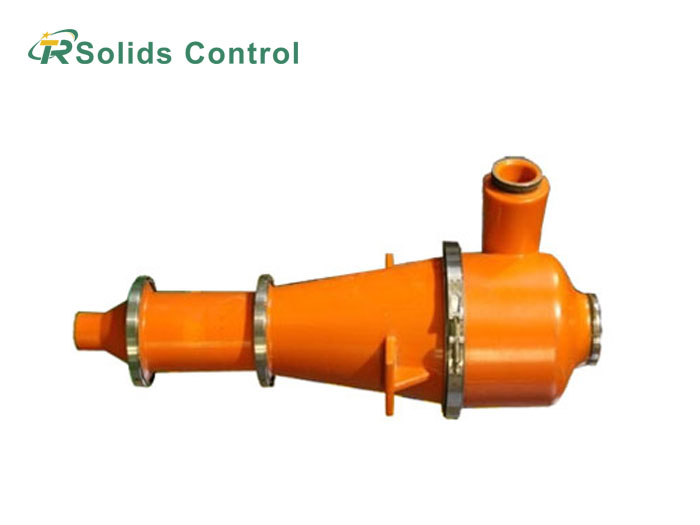
● Desander: Based on centrifugal separation technology, it achieves separation by adjusting the fluid flow rate and changing the direction of motion, causing the denser, coarser solid particles to settle at speed exceeding the water flow velocity. The specific process is as follows: drilling fluid carrying a large amount of cuttings and sand enters the hydrocyclone tangentially under a certain pressure, then rotates at high speed inside. Under the action of centrifugal force, the coarse particles are thrown towards the wall of the hydrocyclone, move spirally downwards along the wall, and are discharged from the bottom sand discharge nozzle; the less dense drilling fluid forms an upward flow in the center of the hydrocyclone and flows out from the top overflow port, completing the separation.
● Desilter: This device combines physical and chemical methods for synergistic separation. The physical methods primarily involve gravity sedimentation and screen filtration, while the chemical methods utilize flocculation and precipitation. Through this dual action, fine particles are separated from the drilling fluid. It also relies on hydrocyclones, but because the particles being separated are finer, process optimization is required to improve separation accuracy.
Equipment Structure and Dimensions
The main differences in equipment structure lie in the specifications of the hydrocyclones, whose specifications and quantity are configured according to actual drilling requirements.
● Desander: The hydrocyclones used have a larger diameter, typically 6-12 inches. The larger diameter allows for higher fluid flow rates, meeting the need for rapid separation of coarse particles and preventing clogging.
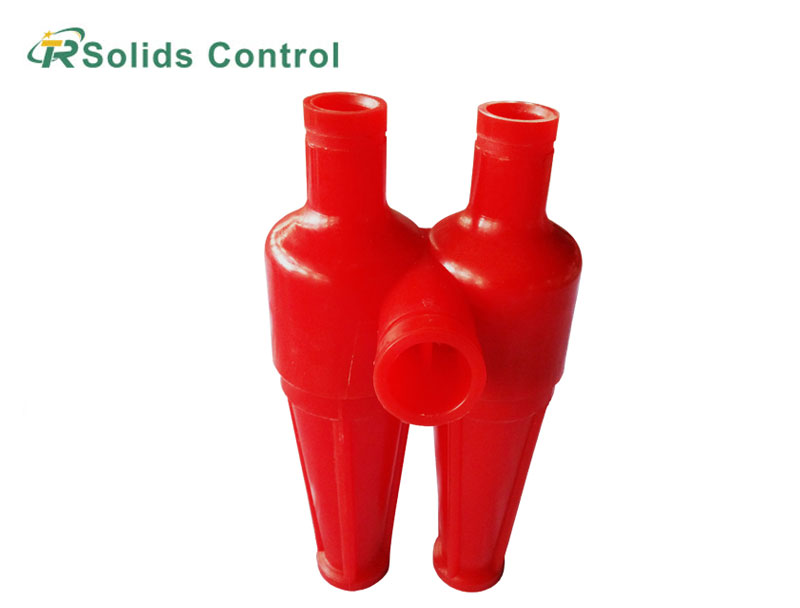
● Desilter: The hydrocyclones used have a smaller diameter, typically 4-5 inches. A smaller diameter generates stronger centrifugal force, improving separation accuracy.
Position in the Solids Control Process
In oilfield drilling control systems, the different installation locations of the two components determine their respective functions, conforming to the "gradual purification and step-by-step progression" process standard of the fluid control system:
● Desander: Located after the shale shaker and degasser, and before the desilter, it is the second stage of purification equipment in the solids control system, performing preliminary separation of fine particles.
● Desilter: Located after the desander and before the centrifuge, it is the third stage of purification equipment in the solids control system. It is responsible for purifying the drilling fluid overflowing from the desander, removing fine harmful solid particles, and creating favorable conditions for subsequent purification by the centrifuge.
Both desanders and desilters are indispensable equipment in oilfield drilling solids control systems. They do not perform the same function, but rather work together in "coarse purification + fine purification" system. By separating solid particles of different sizes from the drilling fluid in stages, they achieve deep purification of the drilling fluid, reduce drilling costs, and ensure efficient, safe, and economical drilling operations.

Address: No.2 Huochang Road, Yangling District,Xianyang City, Shaanxi Province, China
Tel: +86-18509252400
Wechat: 18509252400
Email: info@mudsolidscontrol.com
Contact: Mr.Li
 +86-18509252400