Contact Person: Mr.Li
Mobile: +86-18509252400
Wechat: 18509252400
Email: info@mudsolidscontrol.com
Address: No.2 Huochang Road, Yangling District,Xianyang City, Shaanxi Province, China
Mud shale shakers are solid control equipment used in mud circulation systems for separating coarse and fine particles. Its operating status directly affects the processing efficiency of subsequent solids control equipment and the performance indicators of drilling mud. In the solids control system, the number of mud shale shakers should be determined based on the actual processing capacity to ensure efficient connection of the mud purification process.
In the actual installation of the drilling solids control system, the mud shale shaker is usually fixed above the mud tank. After the drilling fluid returns from the wellhead, it separates coarse-grained solids at the first time, and then transports the purified mud to subsequent solids control equipment (such as desander, desilter, centrifuge) for in-depth treatment. For scenarios with large processing capacity, two to three shale shakers are often designed in a linkage mode, installed on the same template, and then fixed on the solids control tank. This can greatly improve the installation and disassembly efficiency, better match the mud distributor, and ensure the uniformity of mud transportation. With multi-shaker linkage, when one shaker needs maintenance, mud is distributed to the others to ensure normal operation of the drilling rig and continuous and stable operation of the solids control system.
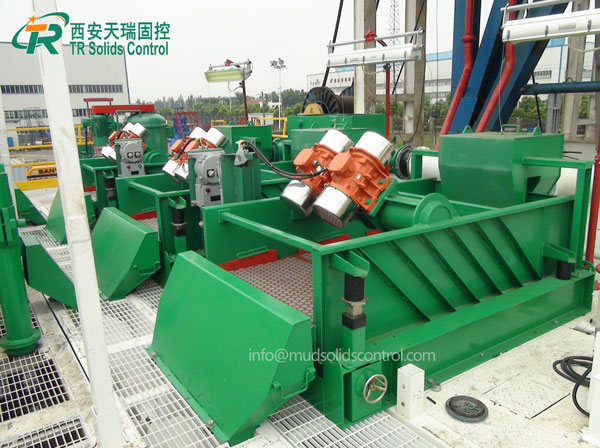
Installed at the front end of the mud circulation system, the mud shale shaker is usually above the drilling mud tank/bin (such as sand settling tank, No.1 mud tank). This position is at the discharge port after the drilling fluid returns from the wellhead, adjacent to the drilling fluid tank, aiming to remove large-grained solids first, avoid hard particles causing wear and blockage to equipment such as centrifuges, extend the service life of subsequent equipment, and reduce equipment maintenance costs.
In terms of installation specifications, three key points shall be emphasized:
The equipment shall be installed stably and horizontally; position deviation will change the stress state of the screen and the mud flow trajectory, leading to reduced separation accuracy and accelerated screen wear.
The connection between the slurry supply pipeline and the shaker feed box shall be firm and sealed to prevent mud leakage, ensure stable mud transportation, and avoid mud flow fluctuation caused by loose pipelines.
The height dimension of the mud storage tank shall be accurately matched, determined according to the height of the mud shale shaker inlet and the height of the drilling rig base, to ensure that the drilling fluid returned from the wellhead can be smoothly injected into the shaker, avoiding liquid accumulation and flow interruption.
The mud transportation and buffering are also closely related to the installation effect. The mud returned from the wellhead is guided to mud shale shaker logging tank through a dedicated pipeline. The logging tank is used to buffer the mud flow, avoid shaker overload caused by fluctuations in wellhead return flow, make mud flow evenly into the screen, and improve separation effect. A regulating valve is installed under the logging tank, which is closed under normal working conditions; when the wellhead return flow exceeds the shaker processing capacity, the valve can be opened appropriately to directly guide part of the mud into the mud tank, thereby reducing the processing pressure of the shaker and ensuring stable equipment operation. After being buffered by the logging tank, the mud is transported to the mud-water separation system through the slurry supply pipeline, enters the lower coarse screen of the shaker, and large-grained solid particles are quickly separated and discharged to complete primary purification.
The mud shale shaker has strong installation adaptability, widely used in onshore and offshore oil and gas drilling, coalbed methane excavation, trenchless directional crossing, piling engineering, waste water and mud treatment and other fields. It can undertake the primary solids control treatment of mud and liquid to be treated according to the needs of different projects, and cooperate with subsequent equipment to complete the secondary and tertiary in-depth purification treatment. Essentially, it is suitable for the primary separation treatment of mud and solid-liquid mixture under various complex environments, and is an indispensable core solids control equipment in various drilling and mud treatment projects.

Address: No.2 Huochang Road, Yangling District,Xianyang City, Shaanxi Province, China
Tel: +86-18509252400
Wechat: 18509252400
Email: info@mudsolidscontrol.com
Contact: Mr.Li
 +86-18509252400