Contact Person: Mr.Li
Mobile: +86-18509252400
Wechat: 18509252400
Email: info@mudsolidscontrol.com
Address: No.2 Huochang Road, Yangling District,Xianyang City, Shaanxi Province, China
In drilling operations, the shale shaker acts as the "first line of defense" for drilling fluid purification. It proactively undertakes the primary solid-liquid separation task, removing drill cuttings and solid impurities from the drilling mud to ensure the fluid maintains its performance. Below is detailed breakdown of how the shale shaker works, presented in active voice to highlight its core role:
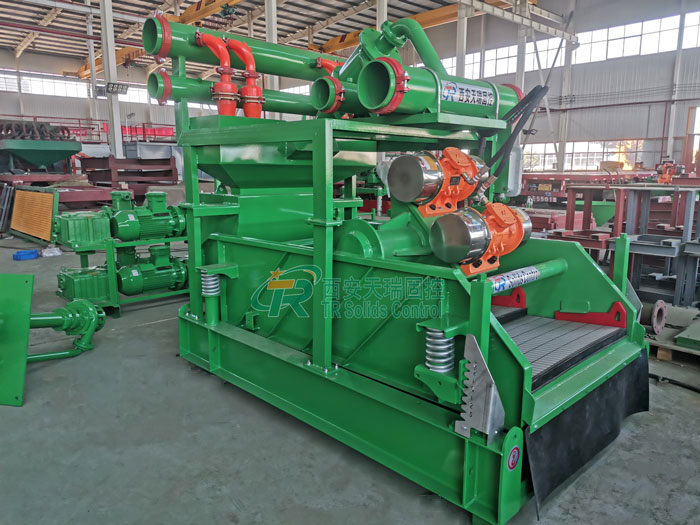
During drilling, the drilling fluid (commonly called "mud") circulates down the drill string, cools the drill bit, lubricates the drill tool, and carries drill cuttings back to the surface. As this contaminated fluid returns from the wellbore, it first flows into the shale shaker’s feed hopper. The shale shaker’s feed system evenly distributes the fluid across the entire surface of its vibrating screen, ensuring no local overload and laying the foundation for efficient separation.
The shale shaker relies on its built-in vibration motor (or eccentric shaft mechanism) to generate high-frequency, low-amplitude vibrations—typically ranging from 2,800 to 3,600 revolutions per minute (RPM). This vibration force directly transfers to the screen bed, making the entire screen surface vibrate vigorously. The vibration not only pushes the drilling fluid forward along the inclined screen but also creates a "stratification effect": it lifts solid particles (drill cuttings) to the upper layer of the fluid, preventing them from clogging the screen pores and ensuring smooth fluid penetration.
The vibrating screen (the core component of the shale shaker) determines the separation effect through its mesh size. As the vibrating fluid moves across the screen:
Clean drilling fluid (the liquid phase) passes through the screen’s pores under the combined action of vibration and gravity, dripping into the shale shaker’s underflow tank. This purified fluid then enters the subsequent purification system (such as desanders or centrifuges) for further treatment before being recycled back to the wellbore.
Drill cuttings (the solid phase), which are larger than the screen’s mesh openings, are retained on the screen surface. The continuous vibration propels these cuttings toward the discharge end of the inclined screen (the shale shaker usually sets the screen at a 5–15 degree angle to facilitate discharge). Finally, the cuttings fall into the waste bin or conveyor belt for centralized disposal.
To ensure stable performance under different formation conditions, the shale shaker allows operators to adjust key parameters actively:
Vibration intensity: By adjusting the motor’s current or the eccentric block’s weight, operators can change the vibration amplitude—enhancing it for viscous mud with high solid content to prevent screen clogging, or reducing it for thin mud to avoid fluid splashing.
Screen mesh size: For fine-grained formations (such as shale), operators replace the screen with a smaller mesh (e.g., 200–400 mesh) to trap tiny cuttings; for coarse-grained formations (such as sandstone), they use a larger mesh (e.g., 20–100 mesh) to improve fluid throughput.
Screen angle: Some advanced shale shakers feature adjustable screen angles—steepening the angle to speed up cuttings discharge or flattening it to extend the fluid’s filtration time.
The shale shaker’s efficient primary separation directly protects downstream purification equipment (e.g., desilters, mud cleaners) and drilling tools. By removing most large and medium-sized cuttings in advance, it reduces the workload of subsequent equipment, prolongs their service life, and avoids costly downtime caused by equipment wear or blockage. Additionally, by maintaining the drilling fluid’s solid content at a reasonable level, the shale shaker ensures the fluid’s lubrication, cooling, and pressure-bearing capabilities—laying a key foundation for safe and efficient drilling.
In summary, the shale shaker works through a "receive-distribute-vibrate-filter-discharge" cycle. It leverages active vibration and precise screen filtration to complete solid-liquid separation, making it an indispensable core device in drilling rigs.

Address: No.2 Huochang Road, Yangling District,Xianyang City, Shaanxi Province, China
Tel: +86-18509252400
Wechat: 18509252400
Email: info@mudsolidscontrol.com
Contact: Mr.Li
 +86-18509252400