Contact Person: Mr.Li
Mobile: +86-18509252400
Wechat: 18509252400
Email: info@mudsolidscontrol.com
Address: No.2 Huochang Road, Yangling District,Xianyang City, Shaanxi Province, China
For any drilling engineer or mud specialist, drilling fluid treatment is what keeps the well from biting you. The process takes returns from the wellbore, removes drilled solids and contaminants, and restores the fluid's properties before recirculation. The single most important part of drilling fluid treatment? Density control.
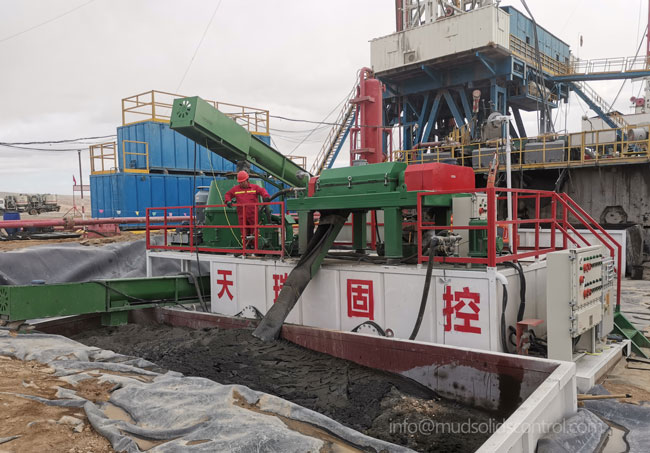
At TR Solids Control, we design and manufacture the full suite of solids control equipment – shakers, desanders, desilters, and decanter centrifuges. Here's how the process works and how you control density at every step.
Returned mud first passes over linear or elliptical‑motion shale shaker. Screens are selected according to API RP 13C with a specified D50 cut point (typically between 100 and 200 microns). Proper screening removes coarse cuttings >150 µm, preventing them from degrading into fines that later drive density upward.
TR Solids Control shakers feature quick‑tension screen panels and adjustable deck angles. A finer mesh than usually chosen – API 140 to 200 – reduces downstream LGS loading. Field data show 15‑20% reduction in density drift per day when shaker screens are correctly matched to ROP and formation.
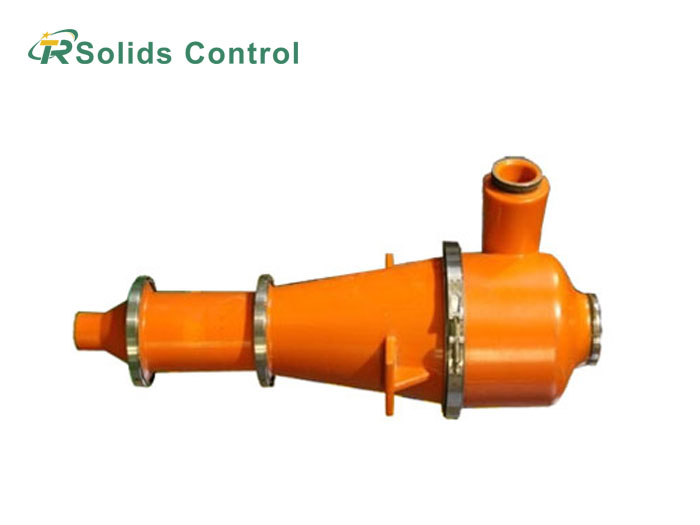
After the shale shaker, mud enters hydrocyclone desanders designed to remove particles in the 40–74 µm range (fine sand and coarse silt). It makes your mud heavier without helping balance pressure. Mud desander removes it, reaches finer separation equipment.
TR Solids Control desander cones are injection‑molded from wear‑resistant polyurethane, achieving a consistent cut point. Depending on the type of base fluid, the specific gravity of the mud can be reduced by 0.05–0.10 sg.
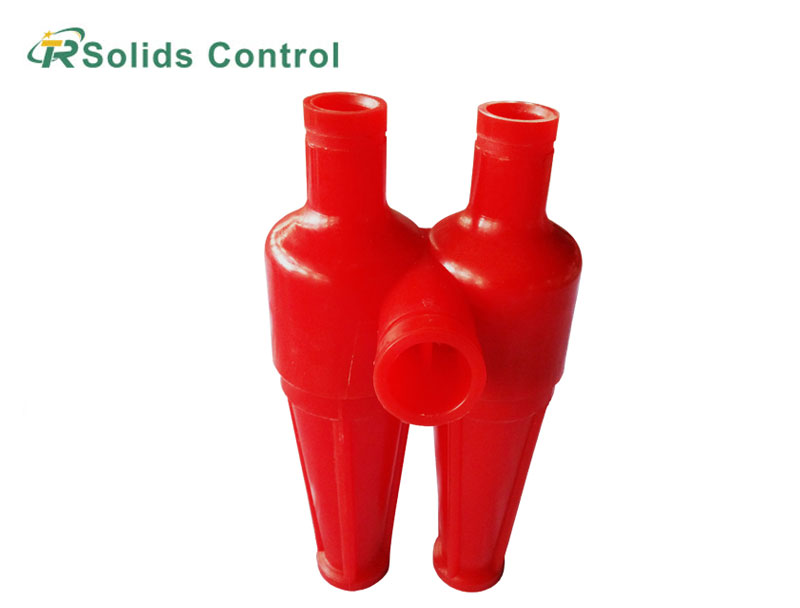
Desilters target particles from 15 to 40 µm. Those fine, low‑gravity solids are the main reason your density drifts up over time.
TR Solids Control desilter packages use 4-inch or 5‑inch polyurethane cones with D50 of approximately 15–20 µm. They remove 60‑70% of the low‑gravity fines that enter this stage.
In many drilling fluid treatment layouts, desilters are the most neglected component. Running them 24/7 is one of the cheapest ways to maintain density stability.
The decanter centrifuge is the only equipment that gives you active density control. By varying bowl speed and differential speed, drilling centrifuge can perform two distinct functions:
Mode 1 – Barite Recovery
Bowl speed: 1800–2200 RPM (low G‑force)
Differential speed: 3–8 RPM
Outcome: Heavy barite particles (SG 4.2) are returned to the system; light LGS (SG 2.0–2.6) are discharged.
Mode 2 – Fine Solids Discard
Bowl speed: 2800–3200 RPM (high G‑force)
Differential speed: 15–25 RPM
Outcome: Essentially all solids below 7 µm are ejected. Density can be lowered by 0.10–0.15 sg in a single circulation loop, useful when the mud is over‑weighted or when LGS has built up excessively.
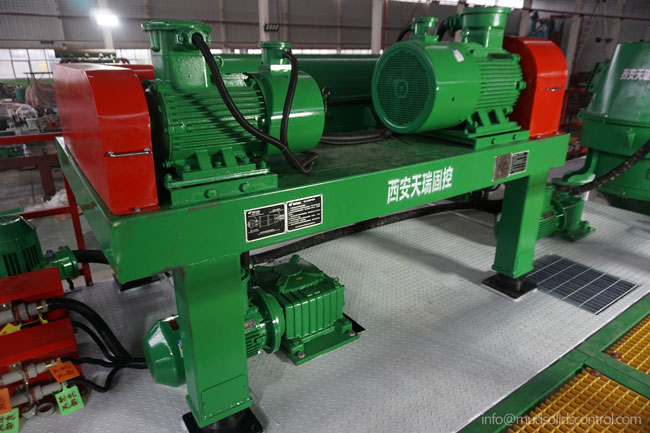
TR Solids Control centrifuges are built with variable‑frequency drive (VFD) as standard. Dial in your bowl speed and differential speed with keypad. The bowl and conveyor are hardfaced with tungsten carbide tiles at the discharge ports, a critical feature for abrasive environments.
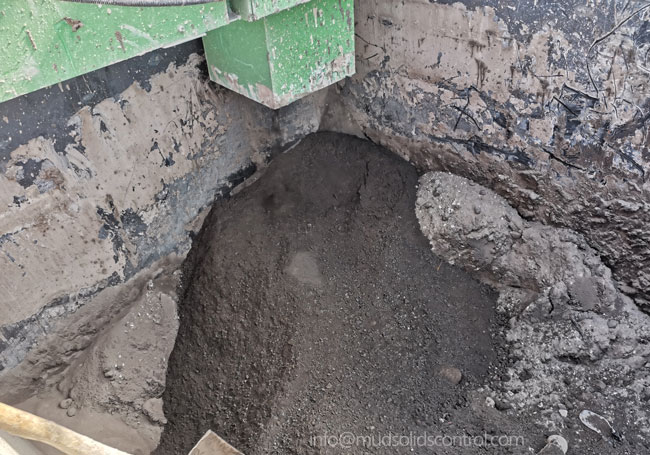
Even with optimal solids control, occasional chemical or density adjustments are required.
To increase density – add barite or alternative weighting agents (hematite, ilmenite) via a jet hopper or auger feeder. Always run the centrifuge in barite recovery mode during weighting to remove the fine LGS that would otherwise spike viscosity.
Flocculants (anionic polymers) can be injected ahead of the centrifuge to aggregate micro‑solids, improving separation efficiency by 15‑25%. Defoamers are essential when gas cutting is present, gas‑cut mud yields false density readings and must be degassed or treated before any density adjustment.
Watch these three metrics during drilling fluid treatment:
Density trend over 4 hours: A steady climb >0.02 sg indicates insufficient centrifuge runtime or worn desilter cone.
MBT (methylene blue test) or retort solids: If low‑gravity solids exceed 6‑8% by volume for water‑based mud (or 4‑6% for oil‑based), the centrifuge is not removing enough fines.
Barite recovery efficiency: Compare barite added vs. barite expected. Efficiency below 70% suggests incorrect centrifuge differential speed or mechanical issue.
Many customers share centrifuge panel photos or vibration readings, and TR Solids Control can recommend exact VFD settings.
TR Solids Control offers fully integrated skid‑mounted systems – shaker, desander, desilter, and centrifuge on a single structure, pre‑piped and pre‑wired. This ensures each stage operates at the correct flow rate and solids loading, delivering predictable density performance.
Our equipment runs on rigs in Texas, the North Sea, the Middle East. We're a manufacturer that actually cares whether your drilling fluid treatment is working and your density is under control.
Drilling fluid treatment is simple: screen out the big stuff, cyclone out the sand and silt, then use centrifuge to control density, by recovering barite or dumping fines.

Address: No.2 Huochang Road, Yangling District,Xianyang City, Shaanxi Province, China
Tel: +86-18509252400
Wechat: 18509252400
Email: info@mudsolidscontrol.com
Contact: Mr.Li
 +86-18509252400